
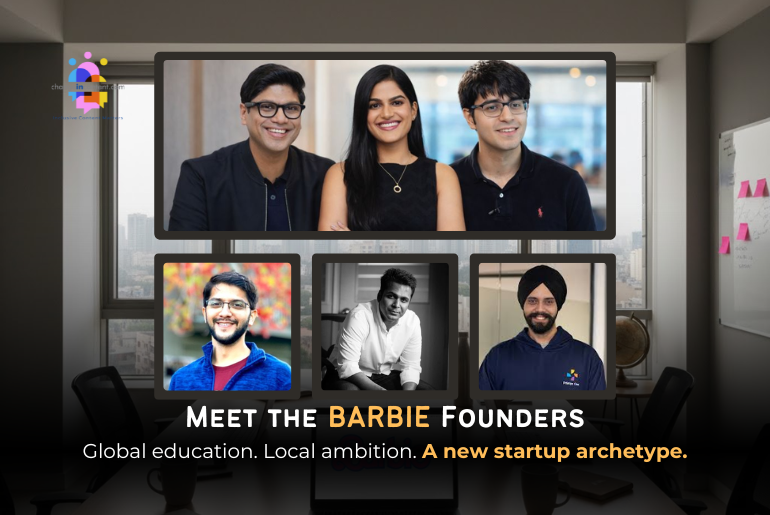
The Indian startup ecosystem is constantly inventing new labels for the kinds of founders it produces. Some come from engineering colleges, some from family businesses, some from consulting or corporate roles. Now, another term is gaining traction: BARBIE Founders.
BARBIE (short for Bachelors Abroad Returned to Build in the Indian Ecosystem) describes a small but influential group of founders who studied overseas and deliberately chose to return to India to build their companies. Coined in “It’s a BARBIE World” by Anmol Maini and Anshul Bhide, the term captures a shift in how global exposure is being channelled back into India’s startup story.
Who are the BARBIE Founders?
BARBIE stands for Bachelors Abroad Returned to Build in the Indian Ecosystem. It describes a group of Indian startup founders who studied for their undergraduate degrees abroad and then returned to India to start and grow companies here. The term was coined by Sajith Pai, Partner at Blume Ventures.
BARBIE founders typically return after studying in countries such as the United States, Canada, or the United Kingdom. Instead of settling overseas, they return with global exposure, new ideas, and a clear goal to build bold, long-term businesses in India’s startup ecosystem.
Why the BARBIE Founders are choosing India over staying abroad
Unlike many Indians who study abroad and decide to settle there for work and lifestyle, the BARBIE founders do not return out of compulsion. Instead, they come with a clear intention to build startups that cater to Indian markets and local needs.
Some well-known BARBIE founders include Peyush Bansal, co-founder and CEO of Lenskart (McGill University), and Aadit Palicha, co-founder of Zepto (Stanford University). So is Romita Mazumdar of Foxtale (UCLA) and Raghav Chandra of Urban Company (University of California, Berkeley).
The rise of the BARBIE Founders in India’s startup ecosystem
India has around 300 BARBIE founders today, and 11 of them lead companies valued at $1B or more. About 3.7% of BARBIE founders have gone on to build unicorns, which is notably higher than founders from the IITs, where the numbers stand at 2.7% for IIT Delhi, 2.0% for IIT Bombay, 2.1% for IIT Kanpur, and 1.6% for IIT Madras. In fact, the BARBIE founders have started 11.5% of all active unicorns in the country.
International lens behind India’s new-age consumer brands
What stands out is that many BARBIE founders lean strongly towards building consumer-focused brands. They also bring fresh ideas and brand concepts shaped by global exposure that may not have emerged as readily without an international perspective.
It not only creates new markets but also helps normalise conversations, improve awareness, and expand what Indian entrepreneurship is willing to take on. Anushka Gupta and Sahil Gupta are strong examples of how the BARBIE founders bring bold, global ideas to the relatively conservative Indian market. Anushka Gupta, a Tufts graduate, and Sahil Gupta, who studied at Columbia University and Harvard Business School, co-founded MyMuse, India’s first bedroom essentials and sexual wellness brand.
More and more BARBIE founders are building brands focused on consumer wellness and fitness. As more Indians become health-conscious and willing to spend on self-care, fitness, and mental well-being, these founders see an opportunity to build brands that go beyond basic needs and focus on lifestyle.
What comes next for the BARBIE Founders in India?
Right now, there are only about 300 BARBIE founders in India. Why isn’t the number higher? How many Indian students can realistically become BARBIE founders, given that this path often requires access to top international universities, strong networks, and financial resources? Are we missing out on a vast pool of talent that lacks these opportunities?
Not all returnees can immediately find the right opportunity or resources to start their business. Some may settle for corporate roles or consultancies, which means their international exposure isn’t fully leveraged for entrepreneurship in India.
The future of the BARBIE founders depends not just on individual ambition but also on systemic support. Scholarships, global exposure programs, mentorship, easier access to funding, and a startup-friendly ecosystem can help more returnees consider India as the place to build their ideas. At the same time, India’s domestic infrastructure, such as policies, regulations, and market readiness, needs to evolve so that ambitious founders can take risks confidently.
The changeincontent perspective
At Changeincontent, we see the BARBIE founders as both a signal and a question. They show what becomes possible when global exposure meets local intent. At the same time, they highlight how uneven access to opportunity remains. Studying abroad, building international networks, and returning with capital or confidence are not paths available to most Indian students. It is especially true in the case of women and those from non-urban backgrounds.
If India wants the BARBIE phenomenon to evolve into something truly inclusive, it cannot remain an elite loop. Global exposure should not be a privilege reserved for a few. Instead, it should be a pipeline widened through scholarships, mentorship, exchange programmes, and institutional support. Otherwise, the ecosystem risks celebrating returnees while ignoring the many capable founders who never had the chance to leave in the first place.
The closing thoughts
The BARBIE founders are showing a new path for Indian entrepreneurship. But the BARBIE wave is just the beginning. Right now, it’s a relatively small, elite group making an impact, but the real potential lies in scaling this model so that more people across India can follow a similar path.
Millions of talented students and young professionals lack the same opportunities to study abroad or to access global networks. If India wants the BARBIE phenomenon to scale and truly transform entrepreneurship, it needs to create pathways for more people to enter it.
Also Read: H1B Visa for Indian Women: A quiet shift that says more than it shows.
Disclaimer: The views expressed in this article are based on the writer’s insights, supported by data and resources available both online and offline, as applicable. Changeincontent.com is committed to promoting inclusivity across all forms of content. We broadly define inclusivity as media, policies, law, and history. It encompasses all elements that influence the lives of women and marginalised individuals. Our goal is to promote understanding and advocate for comprehensive inclusivity.
