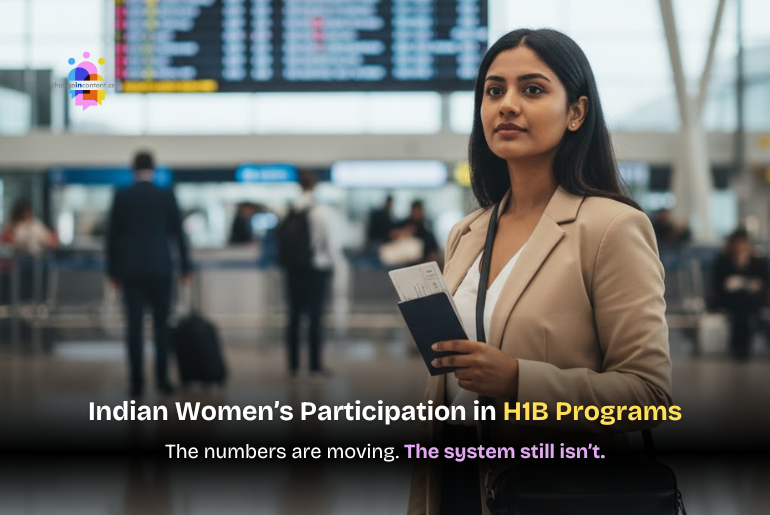
The H1B visa for Indian women has become an unexpected data point to watch. That is not because it proves parity, but because it signals movement inside one of the most selective skilled-migration systems in the world.
Over the last five fiscal years, the share of H-1B approvals for Indian-born women has risen from 21% (FY 2020) to 25% (FY 2024), based on USCIS data analysed by Manifest Law. What looks like a modest climb is actually a persistent trend line, and persistence is the story.
The H1B visa for Indian women in five numbers
The USCIS trend, as cited in the analysis, reads like this:
- FY 2020: 21%
- FY 2021: 23%
- FY 2022: 24%
- FY 2023: 24%
- FY 2024: 25%
It does not mean the pipeline is suddenly fair. Instead, it means more Indian women are reaching the final mile.
H1B visa for Indian women: Why this “small” rise is not small
The H-1B approval stage sits at the end of a long corridor of gates. They involve the types of jobs employers sponsor, the roles women take on, internal mobility, salary thresholds, visa strategy, and the sheer willingness to relocate. When you see a change at the approval level, it suggests something upstream is shifting, even if the data cannot pinpoint exactly where.
That is why the movement matters. Not because 25% is a victory, but because the system rarely budges unless pressure is applied from multiple directions.
The geopolitical context: The H-1B debate is never just about work
Any conversation about the H-1B visa comes with political weather. Even when policy does not change overnight, the temperature does: scrutiny, rhetoric, processing posture, audits, and compliance anxiety for employers and candidates alike. In recent months, the debate has once again sharpened around who should get skilled visas, how selections should work, and what the programme should reward.
For Indian women, this matters in a specific way: volatility tends to penalise the candidates who already feel they need to be “extra prepared” to be taken seriously.
What is powering the rise of the H1B visa for Indian women
Here is what is driving the growing participation of Indian women in the global workforce.
1. A slow but visible change in who gets sponsored
Employers sponsor based on immediate business need and internal confidence. More Indian women showing up in approvals hints at something interesting. More organisations are trusting women with high-impact roles that justify sponsorship, not just support roles that do not.
2. Credentials are often the tax women pay to be seen as “safe hires”
One uncomfortable insight in H-1B patterns globally is that women frequently need stronger signals to cross the same credibility threshold. The analysis notes that women approved in the H-1B system are often concentrated in higher education, which can indicate not an advantage but a higher bar to entry.
3. The India-side story: Ambition exists, but pathways are uneven
The H-1B population is not “India’s workforce.” It is a narrow slice that is already skilled, already networked, already positioned. That is precisely why it becomes a helpful indicator of what is happening at the top of the opportunity ladder and who is being allowed to climb.
What this means for Indian recruiters and employers
If Indian women can push through one of the world’s tightest skilled-migration filters, the question Indian workplaces should ask is blunt: why are we still losing so many of them before they even reach senior leadership here?
A few non-negotiables if you want to retain the same talent India proudly exports:
Employers need pay clarity, not pay conversations that depend on confidence. They need promotion criteria that can survive sunlight. Additionally, they need sponsor-like advocacy inside the organisation, not just mentorship programmes that end at “you are doing great.” And they need to stop treating women’s career breaks as a character flaw instead of a predictable outcome of a caregiving economy.
Let us not think of it as charity, because it is capacity building. If women’s access expands, India’s economic capacity expands with it.
The changeincontent perspective
At changeincontent, we look for stories where the data exposes the culture. The trend on H1B Visa for Indian Women is one of those rare signals. These trends show that Indian women are inching forward even when the system is not built for them. Our job is to turn this into the next question for employers, policymakers, and the broader professional ecosystem: If they can win globally, what exactly is failing them locally?
Because parity is not a poster, it is a pipeline.
H1B Visa for Indian women: Summing up
A rise from 21% to 25% does not sound revolutionary until you remember what it takes for an H-1B approval to happen, and how stubborn gender pipelines are. The shift is narrow, but it is real. And it deserves attention not as a celebration, but as proof of something deeper: Indian women are adding measurable value to the global skilled workforce, even while navigating barriers that were never theirs to carry.
Also Read: Surviving unemployment as a woman in 2026.
Disclaimer: The views expressed in this article are based on the writer’s insights, supported by data and resources available both online and offline, as applicable. Changeincontent.com is committed to promoting inclusivity across all forms of content. We broadly define inclusivity as media, policies, law, and history. It encompasses all elements that influence the lives of women and marginalised individuals. Our goal is to promote understanding and advocate for comprehensive inclusivity.