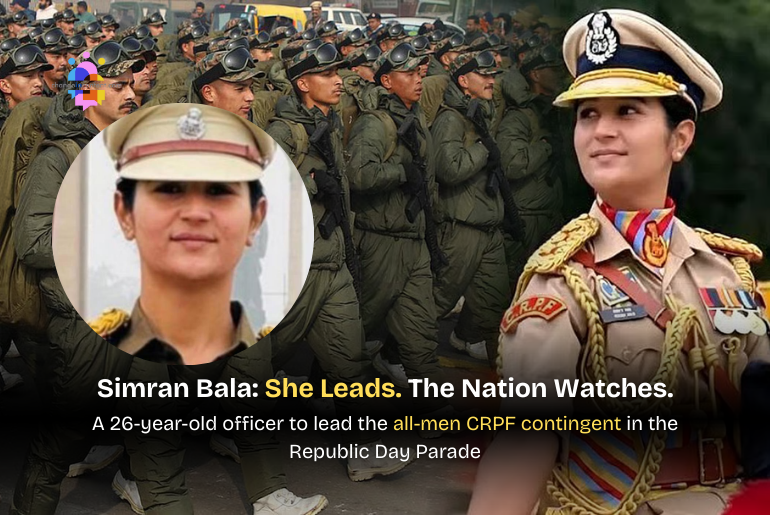
The Republic Day Parade has always been about the spectacle of precision, power, and pride. But in 2026, it carries something more profound. When the parade rolls down Kartavya Path, Simran Bala, a 26-year-old officer from Jammu and Kashmir, will command an all-men Central Reserve Police Force contingent.
This is beyond just symbolic inclusion. It is operational trust, which is public, visible, and irreversible.
Republic Day Parade 2026: Why this moment matters
For decades, women have served in India’s uniformed forces, often invisibly. They trained, deployed, and commanded in fragments, rarely in moments designed for national memory.
The Republic Day Parade is different. It is not a closed-door appointment or an internal promotion. It is the country’s most televised assertion of who leads and who belongs.
That is why Simran Bala’s command matters. She is not leading a women’s contingent. She is leading men. And that distinction exposes how far India has come, and how carefully women have had to earn visibility.
Who is Simran Bala? A journey from Rajouri to Kartavya Path
Simran Bala hails from the Rajouri district in Jammu and Kashmir. She is the first woman from the region to join the CRPF as an officer. A political science graduate from the Government College for Women in Jammu’s Gandhinagar, she cleared the UPSC-conducted CAPF Assistant Commandants examination and was commissioned in April 2025.
Her first posting was with the ‘Bastariya’ battalion in Chhattisgarh. Anti-Naxal operations, not ceremonial optics, define that terrain. At the CRPF academy in Gurugram, she was recognised as the best officer in training and excelled in leadership and public speaking.
By January 2026, she will command over 140 male personnel of the Central Reserve Police Force. It will mark the first time a woman officer has done so at this scale during the Republic Day Parade.
Republic Day Parade and the weight of military trust
Command in uniformed services is not performative. It is earned through discipline, credibility, and the ability to lead under pressure.
The CRPF (India’s largest internal security force with over 3.25 lakh personnel) operates across anti-Naxal theatres, counter-terror operations in Jammu and Kashmir, and insurgency zones in the Northeast.
Placing a young woman officer at the helm of a high-visibility parade contingent is beyond just optics. It reflects an institution slowly learning to align public representation with internal reality.
From Operation Sindoor to Kartavya Path: A pattern is emerging
Simran Bala’s moment does not stand alone. In recent years, women officers have stepped into public command roles that were once unthinkable:
- Sophia Qureshi and Vyomika Singh briefed the nation during Operation Sindoor and earlier led multinational exercises.
- Noreen Shanet John commanded Agniveer training battalions.
- Madhuri Kanitkar became one of the first women to reach the rank of Lieutenant General.
These are not exceptions anymore. They are signals.
Legal milestones, including the Supreme Court’s 2020 ruling on permanent commissions, forced institutions to confront a simple truth. The SC says that capability does not have a gender.
What this means for women watching from the margins
For young women, Simran Bala’s leadership carries layered meaning. It is especially true for those from conflict-affected regions like Jammu and Kashmir.
She is not being celebrated despite her origin. She is leading because she earned it. That distinction matters in a country where women are often invited into narratives only when they soften them.
Here, authority is not diluted. It is amplified.
The Changeincontent Perspective
At Changeincontent, we do not celebrate “firsts” without asking why they took so long.
Simran Bala’s leadership at the Republic Day Parade is a lot more than just a feel-good headline. It is evidence of what happens when institutions are forced by law, visibility, and persistence to confront their own exclusions.
Representation in uniform matters because it resets aspiration. It tells women that leadership is not a favour. It is a responsibility they can claim.
The final thoughts
When Simran Bala marches at Kartavya Path on January 26, 2026, she will not just be leading a contingent. She will be leading a narrative shift. It will be a shift where women are no longer exceptional footnotes in India’s security story.
The Republic Day Parade will still have its drums, its precision, its pride. But this year, it will also have something rarer: truth in leadership.
Disclaimer: The views expressed in this article are based on the writer’s insights, supported by data and resources available both online and offline, as applicable. Changeincontent.com is committed to promoting inclusivity across all forms of content. We broadly define inclusivity as media, policies, law, and history. It encompasses all elements that influence the lives of women and marginalised individuals. Our goal is to promote understanding and advocate for comprehensive inclusivity.