
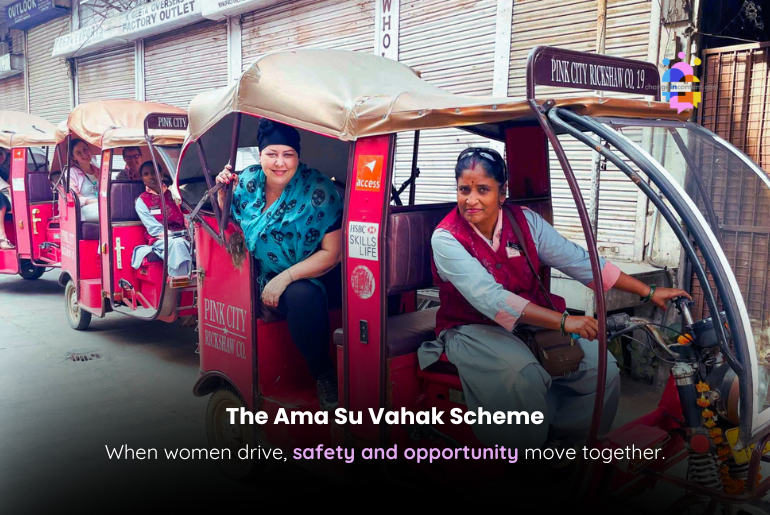
Women are among the largest users of public transport in Indian cities. Nearly 84% of women depend on buses, trains, shared autos, and cabs for daily travel. Yet this dependence comes with a high cost. Studies show that over 56% of women have faced sexual harassment while commuting. More than half have turned down education or job opportunities simply because they did not feel safe travelling to and from those spaces. Against this backdrop, the Ama Su Vahak Scheme is giving hope.
This scheme is not a livelihood programme. It is a response to a long-standing contradiction in India’s cities and towns. Women rely on public transport more than anyone else. Still, they remain almost invisible as owners, drivers, and decision-makers within the mobility sector.
To address this gap, the Odisha government has introduced a women-focused mobility entrepreneurship scheme that supports women as drivers, vehicle owners, and service providers. Known formally as Atmanirbhar Mahila Su Vahak (Ama Su Vahak), the programme aims to do two things at once: create income opportunities for women and make everyday travel safer for other women.
What is the Ama Su Vahak Scheme?
The Atmanirbhar Mahila Su Vahak (Ama Su Vahak) scheme aims to create business opportunities for women in the transport sector. It supports women who want to work as drivers and entrepreneurs in the mobility sector. Under the scheme, women can receive interest-free loans of up to ₹10 lakh to buy four-wheeler taxis and earn a steady income.
Women who choose electric taxis will receive an extra incentive of ₹2 lakh, in line with the Odisha Electric Vehicle Policy. The scheme also offers exemptions from road tax and registration charges.
Ama Su Vahak is a part of the Su Vahak programme launched in December 2023. The earlier scheme focused on improving driver skills and reducing accidents caused by untrained drivers. While Su Vahak includes both women and men, Ama Su Vahak is designed only for women. At least 30 women have already completed training under the first Su Vahak scheme.
Over the next four financial years, the government plans to create 1,100 women mobility entrepreneurs through a phased rollout. This includes 200 women in the first year, 250 in the second, 300 in the third, and 350 in the fourth. The programme will require an estimated ₹46.66 crore. Participants will receive free training in driving skills, road safety practices, personal grooming, customer care, and basic vehicle maintenance.
Eligibility criteria under the Ama Su Vahak Scheme
Odisha Permanent Citizens can be a part of this program. Applicants must be women aged 21–40 years, with a family income of ₹3 lakh per annum, and hold a valid driving licence. They must also complete skill training at an Institute of Driving Training and Research (IDTR).
The scheme will give preference to women currently driving government buses, members of women’s self-help groups, and Subhadra beneficiaries.
Why women-focused mobility schemes matter
Schemes like Ama Su Vahak play a crucial role in opening up the mobility sector for women. The transport sector has long remained male-dominated, even though it offers stable, better-paying work. By supporting women as drivers and vehicle owners, such programmes help break long-standing barriers. They also make daily travel safer and more comfortable for women passengers.
One of the biggest challenges women face in the mobility sector is access to formal finance. Limited funding options often restrict women’s ability to own vehicles or start transport-related businesses. Over 86% of women gig workers report difficulties in financing vehicles, with collateral requirements posing a major obstacle.
The patriarchal family dynamics also play a role. In many households, decisions about buying costly assets like vehicles do not rest solely with women, even when they plan to use them for work. Spouses or parents often step in, and in most cases, male family members or elders make the final call. Schemes that support women directly help by giving them ownership, confidence, training, and independence.
Why the Ama Su Vahak Scheme matters: A deeper context
Vehicles and driving jobs still carry a strong male image, which discourages women from entering the sector or owning vehicles. In India’s transportation sector, women account for just 0.03% of the workforce, and only 0.01% work in higher-paying roles as mobility service providers (MoSPI 2023). Did you know that women drivers can earn about INR 5,000 more per month than those working in tailoring, factories, or domestic work?
As mentioned, the scheme offers women an extra incentive of ₹2 lakh if they choose electric taxis. It encourages more women to join the electric vehicle (EV) sector, which is already growing rapidly as the future of the automobile industry. By supporting women in EV mobility, programmes like this give women a chance to be part of a major, emerging job market.
This is why targeted programmes like Ama Su Vahak deserve stronger support and large-scale adoption. Several Indian states already run such initiatives. We have schemes like the Pink Auto Scheme and the Pink Bus Scheme that encourage women to work as auto-rickshaw and bus drivers. These programmes play a key role in designing inclusive and safe public transport systems by bringing more women into the field of automobile entrepreneurship and mobility services.
The final thoughts
Schemes like Ama Su Vahak help women earn better, become entrepreneurs, and enter a sector that has mostly kept them out. When women drive, own vehicles, and run mobility services, transport also feels safer and more welcoming for other women. India needs more programmes like this and stronger support for the ones already in place. These initiatives also shift how society looks at driving and vehicle ownership.
When more women take up these roles, it slowly challenges the idea that transport work belongs only to men. Young girls see new possibilities, families grow more accepting, and communities welcome the women in visible public roles.
The changeincontent perspective
At Changeincontent, we see the Ama Su Vahak Scheme as more than a transport policy. It is a quiet but radical shift in how mobility, safety, and entrepreneurship intersect.
When women control mobility, cities change. Travel feels safer. Access expands. Work opportunities stop disappearing at the bus stop.
But for this impact to last, such schemes cannot remain pilot projects or state-specific experiments. India needs scale, replication, and sustained funding. More importantly, it needs to stop treating women’s safety as a downstream issue and start designing systems that put women in decision-making roles from the start.
Mobility is power. And power, when shared, reshapes cities.
Also Read: Gig Economy 101: What India’s fast-growing workforce looks like today.
Disclaimer: The views expressed in this article are based on the writer’s insights, supported by data and resources available both online and offline, as applicable. Changeincontent.com is committed to promoting inclusivity across all forms of content. We broadly define inclusivity as media, policies, law, and history. It encompasses all elements that influence the lives of women and marginalised individuals. Our goal is to promote understanding and advocate for comprehensive inclusivity.
