
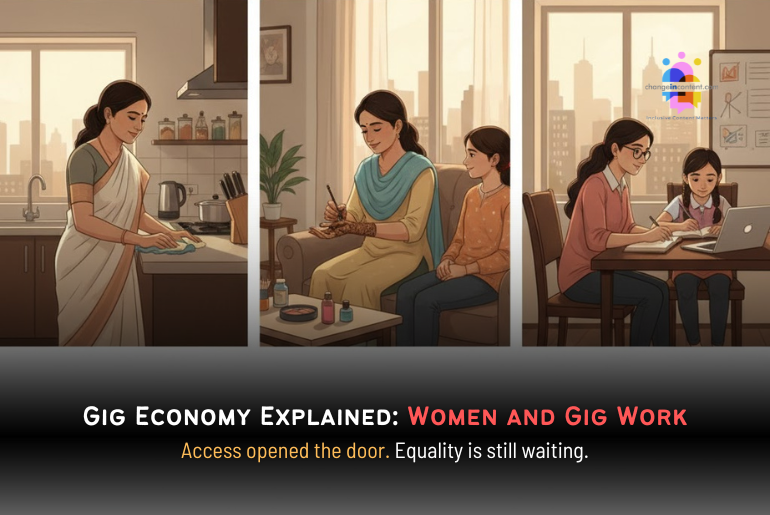
In the second part of Gig Economy 101, we turn our focus to Women and Gig Work. The gig economy offers flexible hours, quicker income opportunities, and greater control over when and how much to work. For many women balancing household responsibilities, caregiving duties, or limited mobility, this flexibility can be a crucial entry point into paid work.
In India, platform-based gig work has opened doors that many traditional sectors still keep shut. Women are increasingly finding work through apps and online platforms in areas such as beauty and hairdressing, household maintenance, residential care, and tutoring. These roles often allow women to earn close to home and structure work around their daily realities.
Despite this growing presence, women still account for only a small share of the overall gig workforce. Sex-disaggregated data show that women make up only 28% of platform economy workers. This gap highlights that while the gig economy creates access, it has not yet delivered equality at scale.
Women and gig work in India: Are jobs still gendered?
In low- and mid-skilled gig work, men and women often end up in very different roles. Men largely dominate food delivery and ride-hailing jobs, which involve moving across cities and working long hours. Women, meanwhile, tend to take up work that society already labels as suitable for them. Beauty services, care work, domestic help, and cleaning continue to attract the majority of women gig workers.
Why women cluster in care and beauty services
Women gig workers in India are mainly concentrated in two areas. One is beauty and grooming, where many use existing skills to meet the growing demand for at-home personal care services. The other is domestic help, which includes everyday household work and assistance. Online tutoring does create some space for women, but most low-skilled and mid-skilled women remain clustered in these two sectors.
Why driving and delivery still feel out of reach
Driving and delivery work have historically remained male-dominated. Long hours outside the home, late-night shifts, and frequent interaction with unknown customers often invite scrutiny or resistance from families and communities. These factors make it harder for women to enter ride-hailing or delivery jobs.
Digital platforms can connect workers to gig jobs quickly, but they cannot undo the ideas that restrict where women can go and what kind of work they are expected to do. As a result, many gender gaps in the gig economy continue to mirror those seen in traditional work.
Pay gaps and algorithmic bias in women and gig work
Even when women step into parts of gig work that men have traditionally dominated, bias shows up most clearly in pay and access to work. Take delivery jobs, for example. A TeamLease survey found an 8–10% wage gap between male and female delivery executives.
How platform targets penalise women
Platform algorithms set strict targets that apply to all workers, regardless of gender. These targets rarely account for the fact that many women work fewer hours due to caregiving duties, safety concerns, or household responsibilities. When women fail to meet these targets, the system responds by offering them fewer orders and fewer earning opportunities.
STEM training
According to UN Women (2022), women remain overrepresented in digital gig work that pays less, while they remain underrepresented in STEM training, the broader tech workforce, and leadership roles within technology companies. In short, women enter the gig economy in large numbers but often end up concentrated in lower-paying, less secure roles.
Some surveys also report that while the gig economy attracts more women each year, women also tend to exit these jobs faster than men. The higher dropout rate raises questions about sustainability. It suggests that access to gig work alone does not guarantee stable income, fair pay, or long-term participation for women. Without changes to how platforms design work and reward labour, many women may continue to enter the gig economy only to leave it just as quickly.
Platform-based domestic work: Opportunity with conditions
Does the fact that many women enter gig work through beauty services, caregiving, or domestic work make this labour less valuable? Definitely not. For many women, especially in peri-urban areas, these roles offer one of the easiest ways to enter or return to the workforce. Limited education, care responsibilities at home, and social restrictions often narrow their job options, and platform-based work helps bridge that gap.
Today, several platforms mediate the hiring of domestic workers, including BookMyBai, Housejoy, and Urban Company. These platforms have made it easier for workers to find jobs and for households to access services.
A worker’s story from Mumbai
We spoke to a gig worker (name withheld upon request), who works with Snabbit as a domestic help in Andheri West, Mumbai. She says that her move from Mira Road and her work on an hourly basis have increased her earning potential from daily Rs. 200/- to approximately Rs. 800/- a day. It also gives her more family time, as she starts her workday at 12 noon.
Domestic work remains one of the largest unorganised sectors dominated by women in India. While there is no guarantee that platforms have fully improved working conditions, it is reasonable to assume that platform models introduce some degree of order through defined rules, tracking systems, identity verification, and payment processes. In some cases, workers may also receive basic training, including the use of newer tools or cleaning technologies.
The limits of gig platforms for women workers
Even with platforms and apps entering domestic and care work, many deep-rooted problems remain. Domestic work in India has long been seen as low-status labour rather than skilled work. Most domestic workers come from Adivasi and Dalit communities, which places them at the intersection of caste, class, and gender inequality. These factors influence how workers are treated, regardless of whether the job comes through an app or through personal networks.
Control without protection
One major limitation of gig platforms is the lack of control without protection. Platforms often set prices, assign jobs, track workers through ratings, and penalise cancellations, but they do not always guarantee minimum wages, steady income, or social security. A worker may follow strict platform rules yet still lack basic protections such as paid leave, health coverage, or compensation for injuries.
Caste, class, and safety inside private homes
Another issue lies in customer behaviour. Even when services are booked online, many workers continue to face disrespect at the workplace. Some customers still expect domestic workers to use separate utensils, avoid certain areas of the home, or work long hours without extra pay. The app may make the booking easier, but it cannot prevent caste- or class-based discrimination inside private homes.
Safety is another concern. Platforms may offer helplines or emergency features, but many women still travel alone to unfamiliar homes, often at odd hours. If harassment or abuse occurs, workers may hesitate to report it for fear of losing future work or receiving poor ratings. Which means we should be addressing how power still rests with customers and platforms, not with workers.
Gig platforms alone cannot solve the problem. What’s needed are specific laws and clear rules that recognise domestic and care work as skilled labour, protect workers’ rights, and address caste and gender bias. Without these changes, gig platforms may help women find work, but they will fall short of offering dignity, safety, and fair treatment to the women who depend on these jobs.
The final thoughts
The gig economy has created new work options for women, especially for those who need flexible hours or live close to home. For many, it offers a way to earn when regular jobs remain out of reach. But this access has not changed the deeper problems women face at work. Old gaps around pay, safety, respect, and job security persist, even as the work moves to apps.
If gig work is to truly work for women, access alone is not enough. We need clear laws, fair platform rules, and social change that treats domestic and care work as real, skilled jobs. Without this, the gig economy may offer work, but it will not provide dignity, safety, or long-term stability for the women who depend on it.
Changeincontent perspective
At Changeincontent, we believe we cannot discuss women and gig work solely through the lens of flexibility and access. Access without protection is not empowerment.
Gig platforms have expanded opportunities, but they have also reproduced old hierarchies in digital form. Without labour protections, gender-aware algorithms, and recognition of domestic and care work as skilled labour, gig work risks becoming another temporary fix rather than a long-term solution.
If the gig economy is here to stay, then dignity, safety, and fair pay must be built into its design, not treated as afterthoughts.
Disclaimer: The views expressed in this article are based on the writer’s insights, supported by data and resources available both online and offline, as applicable. Changeincontent.com is committed to promoting inclusivity across all forms of content. We broadly define inclusivity as media, policies, law, and history. It encompasses all elements that influence the lives of women and marginalised individuals. Our goal is to promote understanding and advocate for comprehensive inclusivity.
