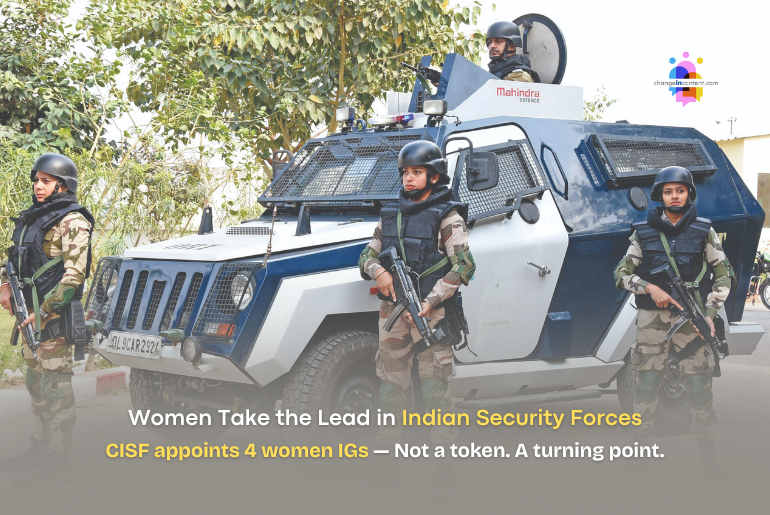
India’s paramilitary landscape has long been male-dominated, with women rarely featured in leadership roles. But this year, the Central Industrial Security Force (CISF) has quietly scripted history. Four women officers—Shanti Jaidev, Jyoti Sinha, Pratibha Aggarwal, and Neelima Rani—have risen to the position of Inspector General (IG). These women CISF officers in leadership roles will now oversee some of the most sensitive and strategic portfolios in national security. These appointments represent a paradigm shift in what leadership can look like within uniformed services.
This breakthrough is not merely symbolic. It signifies a more profound structural change in a system that has, for decades, denied women equal access to power in national defence and policing. It is also a reflection of India’s Nari Shakti (women empowerment) agenda in action, especially in sectors where the presence of women has long been undervalued or overlooked. The implications of this move go beyond the CISF. They send a loud, clear message to every girl aspiring to wear the uniform: leadership is within reach.
Women CISF officers in leadership roles: Who are these women, and what are their roles?
The four newly appointed IGs in the CISF represent a diverse mix of leadership expertise.
- Shanti Jaidev leads the Eastern Sector. It is a region sensitive to insurgency movements.
- Neelima Rani commands the Central Sector. This sector includes some of the most critical industrial zones and conflict-prone areas.
- Jyoti Sinha has been entrusted with the Department of Atomic Energy (DAE) and Department of Space (DOS) establishments. These are two of India’s most high-security zones.
- Pratibha Aggarwal heads the Tech and Provisioning division at the CISF headquarters. She will be overseeing technological operations, innovation, and logistics.
Their roles are not ornamental. They come with absolute authority, complex responsibilities, and enormous strategic impact. In paramilitary hierarchies, IGs oversee entire sectors or verticals. They make frontline decisions that affect not only operational success but also national safety.
With over 200,000 personnel and 359 high-value installations under its protection, CISF’s IGs are decision-makers at the helm. That four of these eight IG posts (50%) are now held by women is a turning point in the force’s legacy.
Why this matters in the context of uniformed services
Across central armed police forces, such as the BSF, CRPF, ITBP, and CISF, leadership has historically been male-centric. Even when women were inducted, their promotions were slower, and their postings were often confined to administrative or internal roles. This development disrupts that pattern.
It also comes at a time when visibility matters more than ever. As retired IPS officer Meeran Chadha Borwankar aptly noted, visible female leadership is crucial. It encourages girls to dream bigger and signals to society that investing in a girl’s education and ambition is worthwhile. More importantly, this is not just a policy win; it is an operational necessity.
Women leaders bring new perspectives, empathy-driven management, and better engagement in diverse field conditions. These are factors that we have long undervalued in the command structures of Indian security forces.
CISF’s evolving relationship with Nari Shakti
The CISF has steadily aligned itself with India’s broader gender inclusion agenda. From appointing Nina Singh as the first woman to lead a paramilitary unit to now placing four women in senior IG roles, the force has moved from symbolic gestures to structural shifts. These appointments are not the end goal. Instead, they are part of a journey toward more diverse and inclusive institutions.
Notably, these appointments are not solely through lateral IPS inclusion, but also through internal promotions within the CISF cadre. It proves that the system is not only accepting women from outside but nurturing talent from within. This long-term cultivation of women officers shows that inclusion can be sustained, not just curated for headlines.
What this signals for DEI conversations in Indian institutions
The rise of women CISF officers to the IG rank pushes the needle in India’s broader DEI (Diversity, Equity, Inclusion) journey. While private companies are working to integrate women into leadership and boardrooms, government institutions have often lagged in enabling women-led decision-making in areas of power.
The significance here is layered. It is not only about representation, but also about trust in women’s ability to lead in high-pressure environments, such as border security, nuclear safety, and crisis management. One should never mistake inclusion in leadership for charity; it is competence that is now being recognised across sectors.
Women CISF officers in leadership roles are a signal
These appointments are a definitive shift away from tokenism. The rise of women in India’s CISF leadership is proof that capability knows no gender. It is also a sign that India’s armed and paramilitary forces are beginning to reflect the same equity-driven ideals they defend.
Yet, the job is not done. For every high-ranking woman officer, there are thousands of women in the security ecosystem waiting for the same recognition. Therefore, this moment is not a celebration alone. Instead, it is a call to widen the pipeline and create more seats at the table, so that inclusion becomes the norm, not the news.
Also Read: Female commandos in SPG: Breaking barriers in Indian security.
Disclaimer: The views expressed in this article are based on the writer’s insights, supported by data and resources available both online and offline, as applicable. At Changeincontent.com, our commitment is to promoting inclusivity across all forms of content. We broadly define inclusivity as media, policies, law, and history, encompassing all elements that influence the lives of women and marginalised individuals. Our goal is to promote understanding and advocate for comprehensive inclusivity.