
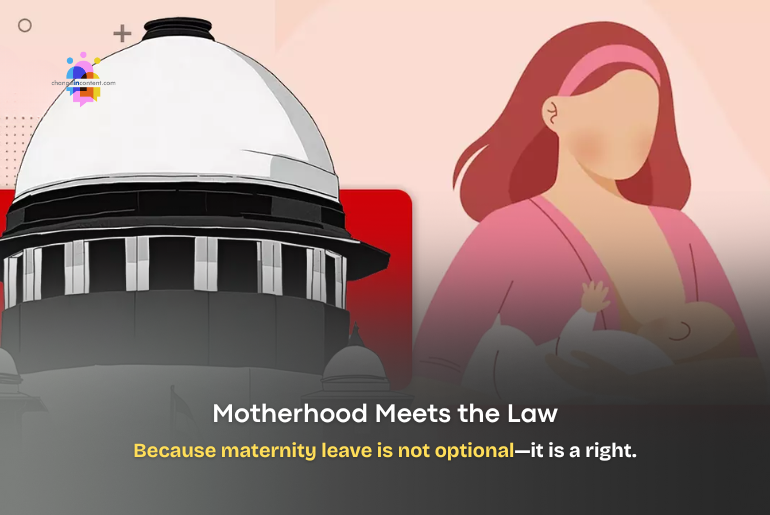
When discussing maternity leave in India, we often refer to the 26-week policy as though it addresses all concerns. But real protection comes not just from policy, but from how that policy is interpreted when it matters most, in courtrooms. This article examines the various aspects of this legal battle for reproductive rights, one verdict at a time.
Maternity leave in India has seen notable legal changes over time. The core law governing it, the Maternity Benefit Act, has been amended to better support working women during pregnancy and childcare. The Maternity Benefit Act of 1961 initially provided 12 weeks of paid leave, allowing women to recover from childbirth and care for their newborns. In 2017, the government amended the Act and extended the leave period to 26 weeks. This change aligned India’s laws more closely with international standards and recognised the increased demands that pregnancy and early motherhood place on working women.
At ChangeinContent, we have followed how courts are slowly changing the way we understand maternity leave in India. The law might be in place, but real clarity has come through individual cases. These are some official judgments related to the Maternity Benefit Act that every working woman in India should be aware of.
Maternity leave counts in bonded medical service, says Madras High Court
The Madras High Court recently delivered a significant verdict that benefits women in medical services. It ruled that maternity leave taken during mandatory government bond service must count as valid service. The court also ordered the return of educational certificates that had been withheld as a result of this dispute.
This decision came in response to a writ appeal filed by Dr. E. Krithikaa, a postgraduate medical student who had completed her MS in General Surgery from Thanjavur Medical College. After finishing her degree, she joined Thittagudi Government Hospital as an Assistant Surgeon and worked there for one year. During this time, she went on maternity leave.
Since her leave meant she didn’t complete the full two-year service bond, the state refused to return her original educational certificates. When her initial petition failed, she appealed the decision and the division bench of Justices G.R. Swaminathan and K. Rajasekar ruled in her favour.
The verdict
Justice Swaminathan, who wrote the verdict, said one cannot push aside maternity rights simply because a woman is working under a bond. He wrote, “Maternity leave is integral to maternity benefit and forms a facet of Article 21. The appellant, though not a regular government employee, is entitled to the same treatment under the law.” The court further stated that rights granted under the Maternity Benefit Act take precedence over any conflicting clauses in service bonds or employment contracts.
Maternity leave is a constitutional right, even for the third child
One of the most important rulings we highlighted earlier was the Supreme Court’s declaration that maternity leave is a constitutional right. Additionally, it is part of a woman’s reproductive rights, even for a third child.
A government school teacher in Tamil Nadu, Umadevi, was denied maternity leave for her third child because a state rule only allows it for the first two children. While the Madras High Court initially ruled in her favour, stating that the state rule conflicted with the central Maternity Benefit Act, a division bench later reversed that decision.
The case then went to the Supreme Court, which ruled in favour of Umadevi. The Court confirmed that maternity leave is part of a woman’s reproductive rights. It is essential to protect it as a fundamental right, especially for women in government service. This decision pushed back against narrow interpretations of the law. It affirmed that all working women, regardless of the number of children they have, are entitled to equal protection under the Act.
For more details, check out our full report on the judgment here.
Maternity leave in India: Sundays count in maternity leave
The case of B. Shah v. Presiding Officer, Labour Court, Coimbatore and Others (1977 INSC 199) provided a key interpretation of the Maternity Benefit Act, 1961, particularly regarding the definition of a “week” for calculating maternity benefits. The matter arose after Subbammal, a female plantation worker, challenged the method used to calculate her maternity benefits.
The main question was whether a “week” under the Act meant seven days, including Sundays (non-working days), or just six working days. While a “week” typically refers to seven consecutive days, the legal definition can vary depending on the specific law in question.
In this case, the Supreme Court clarified that, under the Maternity Benefit Act, a week includes all seven days, including Sundays. Since maternity benefits are based on the average daily wage, the Court held that all days within the leave period must be considered, not just working days.
The ruling made it clear that the purpose of the Act is to provide complete and fair support to women during maternity leave. Excluding Sundays or non-working days from the calculation would go against that goal. Therefore, all seven days in each week must be counted while determining the benefit amount.
No job status barrier for maternity and childcare leave
In the case of Dr. Rachna Chaurasiya v. State of U.P. and Others (Civil Misc. Writ Petition No. 24627 of 2017), the Court directed the Uttar Pradesh government to grant 180 days of paid maternity leave to all women employees. It was regardless of their employment type, whether permanent, temporary, ad hoc, or contractual. The court further ordered the state to provide 730 days of childcare leave to all female employees. The court stated that maternity and child care benefits must be extended equally, without discrimination based on job status.
A similar case was Smt. Archana Pandey v. State of Madhya Pradesh (Writ Petition No. 15523 of 2016). In this case, the Madhya Pradesh High Court ruled that contractual employees are entitled to maternity leave on the same terms as regular staff. The state had denied the benefit, pointing to a clause in the appointment contract that allowed maternity leave only after one year of service. However, the Court clarified that under Section 27 of the Maternity Benefit Act, employers are legally required to provide all necessary maternity benefits, regardless of the nature or duration of employment.
The final thoughts
The Maternity Benefit Act has given working women in India the right to take leave during pregnancy and after childbirth. However, it’s the court rulings over the years that have helped explain how these rights should actually work. These rulings have helped fix gaps in how the law is applied.
At ChangeinContent, we will continue to monitor the evolution of the law surrounding maternity leave to better support working women. Raising awareness about these legal rights is crucial to ensuring fair treatment in the workplace. We also believe that maternity leave is a matter of dignity, equity, and constitutional rights. Each courtroom win is a reminder that women in India are not asking for favours. They are asking for what is legally and rightfully theirs.
Disclaimer:
The views expressed in this article are based on the writer’s insights, supported by data and resources available both online and offline, as applicable. Changeincontent.com is committed to promoting inclusivity across all forms of content. We broadly define inclusivity as media, policies, law, and history. It encompasses all elements that influence the lives of women and marginalised individuals. Our goal is to promote understanding and advocate for comprehensive inclusivity.
