
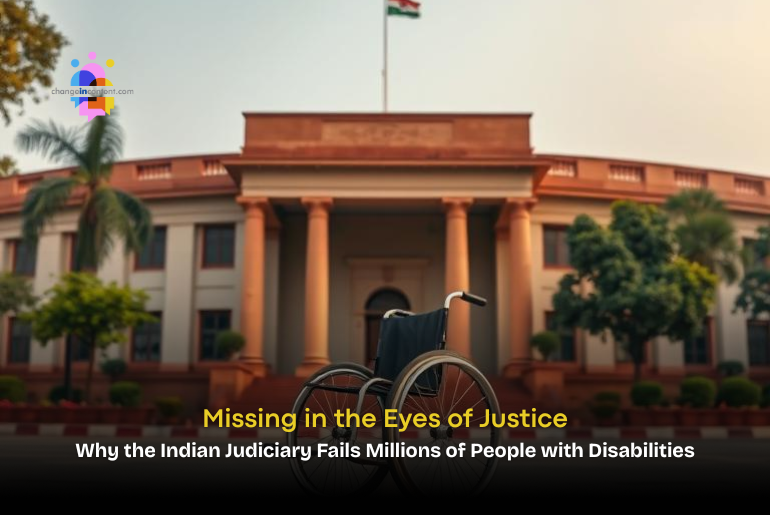
Despite decades of advocacy and multiple legal safeguards, disability inclusion in the Indian judiciary remains more rhetoric than reality. The system’s failure to collect and analyse disability-disaggregated data makes millions of Indians with disabilities invisible in the eyes of the law. This article examines the Pacta report’s scathing findings and raises questions about how a democracy can deliver justice if it cannot even account for who it serves.
A recent report by Pacta, a Bengaluru-based law and policy think tank, has brought much-needed attention to how India’s justice system continues to exclude persons with disabilities. Titled Access to Justice for Persons with Disabilities in India: A Data-Informed Report, the study exposes major gaps in how the police, prisons, judiciary, and legal aid systems serve the disabled community. India’s legal framework includes several progressive provisions aimed at ensuring equal access to justice. However, the report shows that persons with disabilities face widespread exclusion due to poor implementation and a near-total absence of reliable data.
Despite joining the UN Convention on the Rights of Persons with Disabilities (UNCRPD) in 2008 and enacting the Rights of Persons with Disabilities (RPwD) Act in 2016, implementation across Indian states remains poor. Some states have made efforts, but others lag far behind. Without consistent policies or a shared approach, the justice system becomes uneven and unpredictable for disabled individuals.
The silence around disability inclusion in Indian Judiciary
The report discusses the shortcomings in the accessibility of the justice system, both physically and digitally. Many police stations, courtrooms, and prisons continue to disregard basic accessibility requirements, despite legal mandates in place.
Among the 30 courts examined, only two had tactile paths for people with visual disabilities. Only two courts had interpreters for those with hearing impairments. In 2023–24, persons with disabilities made up only 0.29% of all individuals who received legal aid services in India. This data reveals how inaccessible procedures and a lack of awareness shut many people out of services they are legally entitled to.
The same issue affects prisons. According to the NCRB’s 2022 Prison Statistics, India has 69 sanctioned positions for psychologists and psychiatrists in state and union territory prisons. Only 25 of these roles are filled, which is just over one-third of the required strength. The report sees this as a clear sign that prisons lack both the resources and commitment needed to support disabled inmates, especially those with mental health conditions.
Missing from the bench: Where are the disabled lawyers, judges, and police?
The report also raises concerns about representation. Persons with disabilities are mostly absent from roles within the justice sector. The law provides for reservation in employment, but the implementation remains weak. As a result, disabled professionals are rarely seen in police departments, courtrooms, or legal aid offices. Some High Courts have established accessibility committees to address these gaps. However, these efforts have not reached lower courts, where most people interact with the legal system.
A legal system that rarely hires disabled professionals
Although the Rights of Persons with Disabilities (RPwD) Act, 2016 mandates a 4% reservation in government jobs, the report finds that police departments across states and union territories continue to remain outside its scope. In 2021, The Centre had removed 4% job reservation for the differently-abled in all posts of IPS, Railway Protection Force, the police force for Delhi, Andaman and Nicobar Islands, Lakshadweep, Daman, Diu, Dadra and Nagar Haveli and all combatant posts of Central Armed Police Forces (CAPF), including BSF, CRPF, CISF, ITBP, SSB and Assam Rifles.
The report questions this exclusion, stating that there is no valid reason for the police to remain excluded from disability inclusion. It calls for clear identification and advertisement of roles suited to specific disabilities, along with appropriate accommodations to ensure equal participation in the police workforce.
It also highlights a serious lack of sensitisation within police departments. While Section 48 of the RPwD Act requires disability awareness training, most officers still lack the basic knowledge needed to interact with persons with disabilities lawfully and respectfully.
Why the fight for disability inclusion in Indian Judiciary starts with data
One of the report’s most important findings is the complete lack of disability-disaggregated data. Without accurate records of how many disabled individuals interact with police, attend court hearings, or require legal aid, authorities cannot make informed decisions or track progress.
The lack of data is the primary reason why judicial institutions continue to overlook persons with disabilities. When the system fails even to record their presence, it cannot begin to address their needs.
Without data, there is no justice for people with disabilities
In his foreword to the report, former Chief Justice of India D Y Chandrachud explained why data matters. He said that having the right information helps move past personal stories or emotional appeals. It provides a clearer picture of what needs to change, where the system is falling short, and who is being left out.
“Data-driven reports go beyond anecdotal or moral appeal. They enable precise policymaking, track compliance, and create accountability. They also provide civil society, courts, and policymakers with the tools to move from aspiration to action,” wrote former CJI Justice Chandrachud.
Justice Chandrachud also pointed out that inclusive systems do not only help those with disabilities. They improve access for everyone. As an example, he mentioned the “curb cut” effect. Sidewalk ramps, which were initially designed for wheelchair users, also help parents with strollers and travellers with luggage. Similarly, accessible courts and better-trained staff can enhance the overall functioning of the entire justice system.
Reimagining justice: The call for inclusive reform
The report concludes with a powerful message for all stakeholders involved in India’s justice system. It urges civil society groups, philanthropists, lawyers, researchers, and government officials to act together. Change will not come from policy alone. It must come through commitment, training, and structural reform.
Some of the key suggestions include mandatory data collection disaggregated by disability status, regular public accessibility audits, and a transparent system for tracking accommodations. The report also recommends that disability rights be integrated into the core training curriculum for judges, police officers, and legal aid providers.
Pacta’s founder, Nivedita Krishna, summed up the urgency of the issue. “Access to justice is a foundational right and a necessary condition for the realisation of all other rights. Yet, for persons with disabilities in India, the justice system remains difficult to navigate, marked by physical, procedural, attitudinal, and systemic barriers.“
She added that over 26 million people with disabilities in India remain excluded from meaningful participation in the justice system. To change this, institutions must focus on raising awareness, enforcing reservation policies, making infrastructure accessible, and collecting comprehensive data.
Disability inclusion in Indian judiciary: Justice missing in action
The barriers faced by persons with disabilities in India’s justice system are not due to a lack of laws but a lack of will, coordination, and accountability. The Pacta report concludes that unless institutions recognise and respond to the exclusion built into their systems, the promise of justice will remain out of reach for millions.
At Changeincontent, we believe inclusion begins with acknowledgement. The absence of disabled individuals from our justice systems is not a marginal issue, but a symptom of systemic apathy. Change will not come through courtroom slogans or token accessibility ramps. It will come when data becomes the mirror that institutions cannot ignore, and reform becomes a responsibility, not a choice. Disability inclusion in Indian judiciary is no longer optional; it is overdue.
Also Read: Chasing ‘Khaki’ dreams: Why women lag in India’s top bureaucracy.
Disclaimer: The views expressed in this article are based on the writer’s insights, supported by data and resources available both online and offline, as applicable. Changeincontent.com is committed to promoting inclusivity across all forms of content. We broadly define inclusivity as media, policies, law, and history. It encompasses all elements that influence the lives of women and marginalised individuals. Our goal is to promote understanding and advocate for comprehensive inclusivity.
