
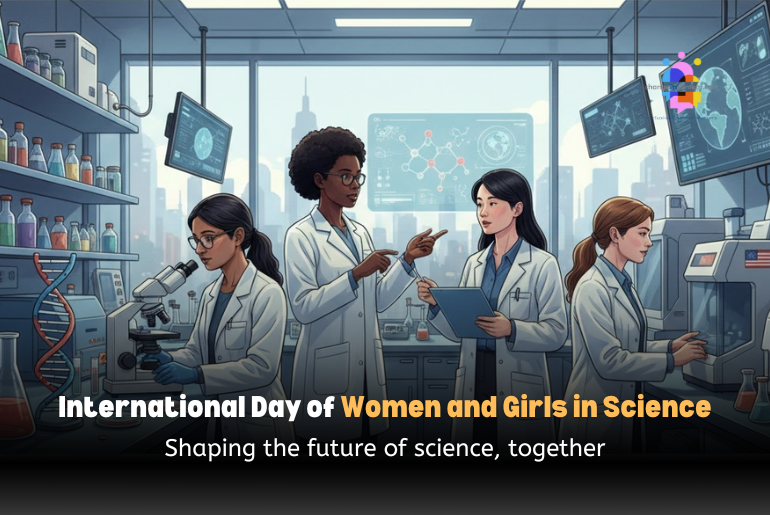
The International Day of Women and Girls in Science is observed annually on 11 February, but its relevance extends beyond a single date on the calendar. It exists because progress in science, technology, engineering, and mathematics remains uneven. Moreover, it exists because talent continues to be filtered through gendered barriers rather than ability.
As the world marks this day in 2026, the conversation has shifted from representation alone to retention, recognition, leadership, and structural change. This day is not about inspiration alone. It concerns evidence, accountability, and the costs of exclusion in a world increasingly shaped by science and technology.
The origins of the International Day of Women and Girls in Science
The International Day of Women and Girls in Science was established by the United Nations General Assembly in 2015, following years of advocacy by scientists, educators, and gender equality organisations. The resolution recognised a simple but uncomfortable truth: women and girls systematically face underrepresentation across scientific disciplines, despite equal capability and growing participation in education.
The purpose of establishing this day was to highlight the need for full and equal access to science for women and girls and to address the structural barriers that prevent their participation. From the outset, the observance was positioned not as a symbolic gesture. Instead, it is a policy-driven call to action rooted in education systems, labour markets, research institutions, and funding structures.
Women in science: What the data tells us in 2026
Despite decades of progress, global data continues to show persistent gaps. According to UNESCO estimates, women make up approximately one-third of the world’s researchers. The numbers narrow further in fields such as engineering, artificial intelligence, physics, and advanced computing.
In higher education, women often outnumber men at the undergraduate level in several countries, including in the life sciences and medicine. However, this pipeline narrows sharply at doctoral, postdoctoral, and leadership stages. Senior research positions, patent ownership, editorial boards, and funding decision bodies remain overwhelmingly male-dominated.
The challenge is not entry. It is continuity. Women leave STEM careers at higher rates, often due to workplace cultures, caregiving expectations, lack of mentorship, and unequal recognition of work.
The gender gap in STEM is structural, not personal
The persistence of inequality in science is often misattributed to personal choice. In reality, the barriers are systemic. Research environments frequently reward uninterrupted career trajectories, long working hours, and informal networks that exclude women, particularly those balancing care responsibilities.
Bias also operates subtly. Studies have shown that identical research proposals receive different evaluations based on the perceived gender of the applicant. Women are cited less frequently, invited as keynote speakers less often, and promoted more slowly, even with comparable output.
The International Day of Women and Girls in Science exists precisely because these patterns are not accidental. They are embedded in systems that were never designed with gender equity in mind.
International Day of Women and Girls in Science 2026: What is happening this year
In 2026, the International Day of Women and Girls in Science focuses on accelerating structural change rather than celebrating individual success stories alone. The emphasis is on creating environments in which women need not be exceptional to belong.
UNESCO is hosting a global event on 11 February 2026 to bring together policymakers, scientists, educators, and young researchers. It aims to examine how science systems can advance gender equality alongside innovation. The event highlights policy reform, funding equity, and the importance of early intervention in education.
The 2026 observance also places a strong focus on emerging fields such as artificial intelligence, climate science, biotechnology, and data systems. These are areas where early gender imbalance risks becoming permanent if left unaddressed.
How the European Union is driving change
The European Union has emerged as a key driver of gender equality in research and innovation. Through its Horizon Europe framework and gender equality plans, the EU has made gender inclusion a condition for public research funding.
The EU efforts for women and girls in science include mandatory gender action plans for research institutions. Moreover, it includes integrating gender analysis into the research design and accountability mechanisms tied to funding outcomes. The EU’s approach recognises that voluntary commitments are not enough, and that policy levers matter.
By embedding gender equality into research governance, the EU is shifting the conversation from encouragement to enforcement. It is a move that experts increasingly see as necessary globally.
Why representation alone is not enough
While visibility matters, representation without power changes little. Women remain underrepresented in decision-making roles that shape research agendas, allocate funding, and define scientific priorities.
This underrepresentation of women in STEM has real consequences. Research questions, product design, and technological systems often reflect the perspectives of those who build them. When the system excludes women, science risks reinforcing existing inequalities rather than solving them.
The International Day of Women and Girls in Science, therefore, asks a deeper question: not only who is present in science, but who decides what science is for.
Changeincontent Perspective
At changeincontent, we see the International Day of Women and Girls in Science as a reminder that inclusion in science is a knowledge imperative. Therefore, it would be incorrect to consider it a diversity initiative. Scientific progress depends on who gets to ask questions, test hypotheses, and shape solutions.
We believe the conversation must move beyond motivation and mentorship to policy, pay equity, caregiving infrastructure, and institutional accountability. Women do not leave science because they lack ambition. They leave because systems are slow to adapt to lived realities.
Our work focuses on connecting data with lived experience and on advancing conversations that treat gender equity in science as essential to innovation, not separate from it.
The closing thoughts on the International Day of Women and Girls in Science
As the world marks the International Day of Women and Girls in Science in 2026, the challenge is no longer awareness. It is action. The evidence is clear that the talent exists. What remains is the political and institutional will to redesign systems that still operate on outdated assumptions.
Science shapes the future. And ensuring that women and girls shape science is foundational, not optional.
Disclaimer: The views expressed in this article are based on the writer’s insights, supported by data and resources available both online and offline, as applicable. Changeincontent.com is committed to promoting inclusivity across all forms of content. We broadly define inclusivity as media, policies, law, and history. It encompasses all elements that influence the lives of women and marginalised individuals. Our goal is to promote understanding and advocate for comprehensive inclusivity.
