
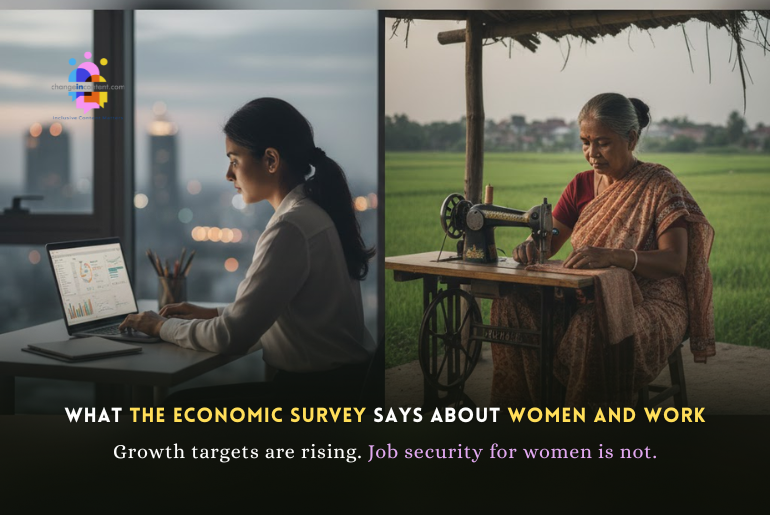
The Economic Survey, released annually by the Department of Economic Affairs under the Ministry of Finance, offers a detailed snapshot of India’s economic health. The Economic Survey 2025–26 makes it clear that India cannot sustain long-term GDP growth unless women’s participation in the workforce rises sharply, to nearly 55% by 2050.
As of December 2025, the Female Labour Force Participation Rate for individuals aged 15 and above stands at 35.3%. While this marks a steady improvement over previous years, the Survey also acknowledges that structural barriers continue to keep women on the margins of the labour market. These barriers include unpaid care work, unsafe, low-wage jobs, weak childcare systems, and limited access to formal employment.
Women and the changing nature of work in India
Many women, especially in rural areas, work in self-employment or family-run businesses. In the second quarter of FY26, only 10.8% of rural women held regular wage jobs. In contrast, 37.5% worked as own-account workers or employers. 34.2% worked as helpers in household enterprises. This data shows that most women do not enter formal salaried jobs and instead rely on flexible or home-based work.
Women often choose self-employment or family businesses because these options fit better with their daily responsibilities. Many women manage unpaid care work, such as cooking, cleaning, childcare, and elder care, alongside paid work. Flexible jobs allow them to balance both. Limited access to education, skills training, transportation, and safe workplaces also pushes women toward informal, unpaid, family business-based work. In rural areas, social norms further restrict mobility, which makes regular office or factory jobs harder to access.
The upside and the downside
Self-employment gives women greater control over their time and income. Many women run small businesses, farms, tailoring units, food ventures, or online stores. That builds financial independence and encourages entrepreneurship at the grassroots level. Digital platforms and self-help groups also help women reach customers, access credit, and learn new skills. For many, this path offers a practical way to stay in the workforce without leaving home.
At the same time, most self-employed women work in the informal sector. They earn less, face unstable incomes, and lack job security, paid leave, or social protection. Helpers in household enterprises often work without formal wages and remain economically invisible. These jobs rarely offer career growth or long-term financial stability. Flexibility comes at the cost of safety, income, and recognition.
Women remain stuck in the unorganised workforce
As of January 2026, the e-Shram portal has registered over 31 crore unorganised workers, with women accounting for more than 54% of this workforce. Moreover, only about 6% of working women are in the formal sector with social benefits.
Women cluster in low-paying sectors such as agriculture, care work, textiles, food processing, and domestic services. Even within these sectors, women rarely advance to supervisory or decision-making roles. Men control ownership, capital, and leadership, whereas women perform repetitive, low-value tasks.
Degrees without jobs
We discussed this earlier in our article on why educated women in India remain out of the workforce. The Her Path, Her Power report by TeamLease Degree Apprenticeship shows that barely one-third of graduating women meet employability standards.
Many colleges fail to provide practical and industry-aligned skills. At the same time, employers hesitate to hire women due to expectations around career breaks, safety concerns, and ‘boys club’ workplace structures. As a result, many qualified women either leave the labour market or take up informal, low-skilled work well below their capabilities.
India produces lakhs of educated women every year, but the economy does not create enough stable and secure jobs for them.
Conclusion: What the Economic Survey reveals about women’s work
India needs policies that support women beyond survival-level work. The government must invest in skill training, affordable childcare, safe transport, and access to formal credit. Better working conditions and stronger labour protections can help women transition from informal work to stable, well-paid jobs. If India wants more women in the workforce, it must ensure that employment is not only flexible but also secure and worthwhile.
The changeincontent perspective on the Economic Survey
What the Economic Survey reveals, without stating outright, is that India’s growth model still depends heavily on women absorbing economic shocks quietly. They are doing so through unpaid care work, informal labour, and low-wage flexibility.
Asking women to participate more without addressing childcare systems, workplace safety, wage parity, and access to formal employment shifts responsibility to individuals rather than institutions. Inclusion cannot stop at labour force entry. It must extend to job quality, income security, and dignity at work.
If policy continues to celebrate participation numbers without addressing why women exit, stagnate, or remain informal, India risks building growth on invisible labour. Women do not need encouragement alone; they need systems that actually make work worth staying in.
Disclaimer: The views expressed in this article are based on the writer’s insights, supported by data and resources available both online and offline, as applicable. Changeincontent.com is committed to promoting inclusivity across all forms of content. We broadly define inclusivity as media, policies, law, and history. It encompasses all elements that influence the lives of women and marginalised individuals. Our goal is to promote understanding and advocate for comprehensive inclusivity.
