
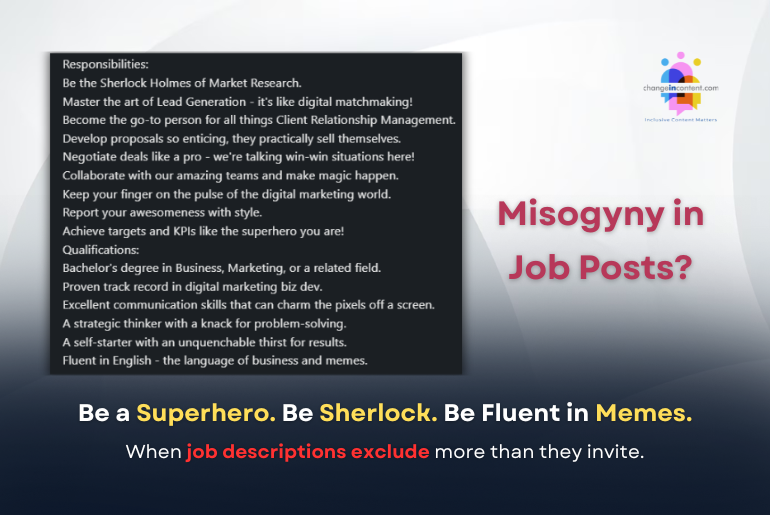
Misogyny in job posts often hides behind metaphors and clever copywriting. What appears quirky and brand-friendly can sometimes alienate and exclude, especially when language defaults to the male perspective. This is not just about a single job post—it is about how organisations write, think, and define leadership through their words.
Tonic Worldwide, a reasonably well-known name in the advertising industry, recently posted a job opening for the AVP of Business Development position on LinkedIn. Now, I stumbled upon the post purely by chance. I wasn’t actively job hunting, just casually scrolling. But the description made me pause. Not because it was exceptionally creative or innovative but because something felt…OFF.
In the first quick “Oh, let me just skim through this” reading, it looks like your average job poster. However, for someone seriously exploring roles like this, it’s hard to miss how the wording leans in a certain direction—one that feels less gender-neutral and more selective in tone.
Let’s examine the subtle bias in this JD. It’s a quick read, and if you’re writing one soon, here’s something to keep in mind. What irks me is that all brands talk about inclusive communication, but when it comes to internalising it, many miss the mark.
Misogyny in job posts: Job descriptions don’t need gendered labels
One line in the job description reads, “Achieve targets and KPIs like the superhero you are!” Sounds fun at first, until you stop and think about who typically comes to mind. Most people picture Batman, Superman, or Iron Man. The word “superhero” still pictures a man in pop culture. For women, it has long been “superheroine.”
Instead of using terms like “superhero” or “superheroine,” companies can keep it simple: “Achieve targets and KPIs like the hero you are.” “Hero” works just fine. It doesn’t suggest a gender. If you called a team the “heroes of the project,” no one would assume they’re all men. The word has evolved. While “hero” once mainly referred to men, today, it applies to everyone. Or you may even say “superhuman.”
Of course, this may seem like nitpicking to some. But language influences how people feel. The goal of a job post is to invite diverse people in. If a single word can make a role feel more open and less stereotyped, why not use it?
When words exclude
The first line under the responsibilities section reads, “Be the Sherlock Holmes of Market Research.” It is meant to sound clever until you realise it is another example of a gendered label tucked inside what should be a neutral job post.
Let’s talk about what market research actually involves. It examines consumer behaviour, studies economic trends, and gathers data to help businesses shape their strategies. It’s thoughtful, analytical work. It relies on tools, not instincts. It calls for attention to detail, not mystery-solving. More importantly, you don’t have to rely on a male pop culture figure.
Framing it like a detective’s job may seem fun, but it can also feel less inclusive, especially to those who don’t identify with that metaphor.
So why not just say what you mean? Ask for someone who is analytical, detail-oriented, and curious about market trends. Job descriptions don’t need to entertain. They need to inform and invite.
Avoid language bias to avoid misogyny in job posts
The final line of the job description reads, “Fluent in English – the language of business and memes.” A better phrase would have been “proficient in English.”
Yes, English dominates global business and communication spaces. But it’s not a one-size-fits-all language. Vocabulary shifts. Accents differ. So, when a job post assumes English is the universal language for business and memes, it ignores how language actually works across cultures.
In India alone, people use both Hindi and English across business settings. Add to that regional languages like Malayalam, Tamil, or Bengali, and you’ll see that communication (yes, even meme culture) looks very different across states.
Moreover, one person’s “fluent” may not sound fluent to someone else. For example, someone who speaks English comfortably in daily conversations may consider themselves fluent, while a hiring manager might expect polished grammar, formal vocabulary, and business writing skills. The expectations don’t always match. So, instead of using vague or subjective terms like “fluent,” it’s better to be specific.
If the job needs someone who can write emails clearly, join meetings confidently, or create presentations in English, the description should say “able to communicate effectively in professional settings.”
Who is writing your job descriptions?
The kind of gender bias in these job posts raises an important question. Does the company have enough women in decision-making roles? Or are women only visible when it’s time for a Women’s Day social media post? When a job description quietly discourages women through subtle bias, it’s fair to ask who approved this.
The digital services and media industry, which must attract Gen Z, is making a mistake by writing such descriptions. They hold the power to shape opinions and set trends. Therefore, it is important to have more women and allies in leadership roles.
Say, if a woman is part of the team creating job descriptions, but gender bias still slips in, it could point to deeper issues like internalised misogyny or imposter syndrome. Both of these often go unnoticed in workplace culture. When women feel like they have to “fit in” rather than influence, bias goes unchecked even when they’re in the room. That is why companies need to do more than hire women. They need to listen, include, and build cultures where every voice feels confident enough to challenge bias.
No one says every word must undergo a gender audit. But it’s worth asking, “Who does this language speak to?” If your company values diversity, it should reflect that throughout.
The final thoughts
Here, the role might still attract some brilliant candidates. But imagine how many more would apply if the job description focused on leadership, strategy, and results without sounding like it quietly excluded certain people.
Of course, this doesn’t mean job descriptions shouldn’t include specific requirements or expectations. They definitely should. It’s important to set clear standards and expectations for the role. However, there’s a clear difference between defining eligibility and gatekeeping leadership through outdated metaphors that don’t reflect today’s diverse talent.
Changeincontent perspective
This incident is not just a one-off mistake—it reflects the deeper issue of misogyny in job posts across the corporate spectrum. If inclusion is genuinely a priority, it must show up in language, leadership, and intent—not just marketing campaigns.
At Changeincontent, we believe in calling out such blind spots because gender equality cannot exist if the entry points to power still whisper exclusion. That is why we say #NoWomensDay should be every day.
Disclaimer: The views expressed in this article are based on the writer’s insights, supported by data and resources available both online and offline, as applicable. Changeincontent.com is committed to promoting inclusivity across all forms of content. We broadly define inclusivity as media, policies, law, and history—encompassing all elements that influence the lives of women and marginalised individuals. Our goal is to promote understanding and advocate for comprehensive inclusivity.
