The Quick Read
- Reservation for women in government jobs in Uttarakhand provides 30% horizontal reservation in direct recruitment for eligible women domiciled in the state.
- The provision is governed by the Uttarakhand Public Services (Horizontal Reservation for Women) Act, 2022, enacted in January 2023.
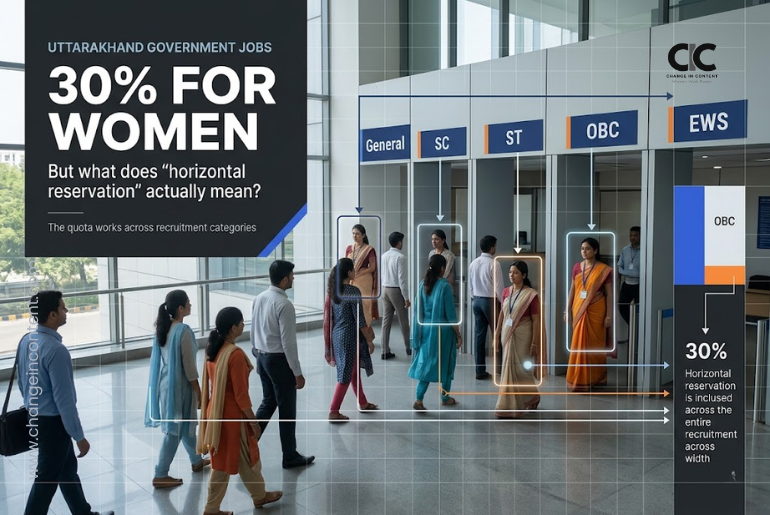
- “Horizontal” means the women’s reservation cuts across existing categories such as Scheduled Castes, Scheduled Tribes, Other Backward Classes, EWS and open competition. It is not a separate additional 30% block sitting outside them.
- The law applies to direct recruitment, not a general 30% reservation in promotions.
- If enough suitable women are not available for the earmarked posts, the vacancies are not carried forward under this law; qualified male candidates of the corresponding category may fill them.
- The wider policy question is what happens after recruitment: representation becomes more meaningful when women also find fair postings, career progression, workplace safety and leadership opportunities.
Horizontal reservation for women in government jobs, Uttarakhand
30% sounds straightforward. The mechanism behind it is not.
Government of Uttarakhand has again highlighted its provision for 30% horizontal reservation for women in government jobs, presenting it as part of its effort to increase women’s participation in state services. The Chief Minister’s official website lists the measure among the government’s women-empowerment and governance initiatives.
The policy has existed in different forms for considerably longer than the latest discussion suggests.
Under the current statute, women domiciled in Uttarakhand receive 30% horizontal reservation in vacancies filled through direct recruitment in covered public services and posts.
The number is important. The word horizontal is even more important.
What does horizontal reservation mean?
India’s reservation system contains both vertical and horizontal reservations.
Vertical reservations generally refer to categories such as Scheduled Castes, Scheduled Tribes and Other Backward Classes. Horizontal reservation operates across those vertical categories.
The Supreme Court describes horizontal reservations as “interlocking” reservations that are calculated alongside vertical categories rather than as entirely separate pools. The easiest way to understand this is through an illustration.
Imagine a recruitment process with 100 posts. A 30% horizontal reservation for women does not ordinarily mean creating: 70 regular posts plus another 30 posts exclusively for women.
Instead, the recruitment process has to ensure that women receive the prescribed representation across the different applicable categories.
So women may be selected within:
- The open category,
- Scheduled Castes,
- Scheduled Tribes,
- Other Backward Classes,
- EWS,
- or other applicable categories.
The Uttarakhand law specifically provides that the women’s reservation operates for candidates belonging to these different categories, according to the government rules in force at the time of recruitment.
That is the “horizontal” part. It cuts across the recruitment structure.
Does that mean women cannot compete for open seats?
No. This is another common misunderstanding.
An open or unreserved post is open to everyone who qualifies on merit. The Supreme Court has reiterated that the open category is not a quota reserved for people who do not receive reservation benefits; candidates from reserved categories can also secure open positions on merit.
The horizontal mechanism is then applied through the prescribed adjustment process to ensure the required representation.
So the policy should not be read as placing women only inside 30% of the recruitment. Women remain eligible to compete for posts through the ordinary recruitment process as well.
Who qualifies under the Uttarakhand law?
The domicile condition is significant.
The Act defines an eligible woman candidate as one with Uttarakhand domicile. It covers women whose domicile of origin is in Uttarakhand, subject to the statutory conditions, as well as women originally from elsewhere who have obtained permanent domicile in Uttarakhand under the applicable government rules.
The Act’s definition of public services is also broader than secretariat departments alone.
It covers services and posts connected with the affairs of the state. It can extend to covered local authorities, state-controlled bodies, corporations and certain educational institutions under state ownership, control or grant-in-aid, subject to the provisions of the law.
Most importantly, Section 3 speaks specifically about direct recruitment. That means the headline should not be interpreted as a blanket rule reserving 30% of every stage of a woman’s government career.
What happens if there aren’t enough eligible women?
The Act addresses that too.
If suitable women candidates are unavailable for posts earmarked under the horizontal reservation, those vacancies are not carried forward under this provision. Instead, they may be filled by qualified male candidates in the relevant category according to merit.
That detail helps explain why horizontal reservation is better understood as a recruitment mechanism rather than a permanently sealed set of posts. It is also consistent with the Supreme Court’s explanation that horizontal reservations function differently from vertical reserved pools.
Why does Uttarakhand see this as an employment measure?
The state’s stated objective is straightforward: increase women’s participation in government services. There is a wider employment context behind that ambition.
Change in Content has previously examined how underrepresented women remain in parts of India’s public administration. In the Central Board of Direct Taxes, for example, women represented just 17.5% of the workforce in the gender profile we analysed in 2025. Our report on women in the Central Government also looked at why representation in public institutions matters beyond employee numbers.
The wider labour market remains uneven as well.
Our analysis of PLFS data for Q1 2026 found female labour-force participation well below male participation, with particularly difficult conditions for young and urban women.
Government employment cannot close that gap alone. But public recruitment is one place where policy can directly influence who gets access to stable, formal employment.
Getting women through the door is one part of the outcome
A 30% recruitment provision can improve representation. Its longer-term success deserves to be measured through more than the number of women appointed.
- What happens to them afterwards?
- Do women remain in service?
- Do they receive meaningful assignments?
- Can they work across departments and geographies?
- Do family and care responsibilities influence postings or progression differently?
- How many advance into senior administrative positions?
- Are workplaces safe and professionally supportive?
- And eventually, do women reach a stage where representation no longer needs to be corrected so deliberately?
These questions do not weaken the rationale for reservation. They tell us whether the policy is producing the larger result it was designed to encourage.
The Change in Content Perspective: Access is the Beginning of Representation
There is something useful about the 30% reservation for women in government jobs in Uttarakhand. It acts as the entry gate.
If women have historically been less represented in parts of public employment, changing who gets a realistic opportunity to enter can change the composition of institutions over time.
But a percentage should be the start of the measurement. 30% recruited. Then what?
- How many remain?
- How many advance?
- How many lead departments?
- How many occupy positions from which policy is made?
- How many find that a government career gives them the same professional possibilities it gives their male colleagues?
Those answers will tell us more about the eventual success of the policy than the reservation figure alone. There is also a future worth hoping for. One in which women do not require extraordinary measures simply to appear in ordinary numbers.
Until opportunity reaches that stage naturally, policies such as horizontal reservation offer one way of addressing an imbalance deliberately.
The useful test is what women can do with the opportunity once the door opens.
Editorial Note and Disclaimer
This Policy Pulse article explains the Uttarakhand Public Services (Horizontal Reservation for Women) Act using the official text available through India Code, Government of Uttarakhand material and Supreme Court jurisprudence on horizontal reservation. Individual recruitment notifications may contain additional eligibility requirements, category calculations and service-specific rules. Candidates should refer to the relevant official recruitment notification for applicable conditions. This article is intended for editorial and informational purposes and does not constitute legal or recruitment advice.
Sources
- India Code: Uttarakhand Public Services (Horizontal Reservation for Women) Act, 2022
- Chief Minister, Government of Uttarakhand: Three Years of Service, Good Governance and Development
- Supreme Court of India: 2026 judgment discussing horizontal and vertical reservation principles