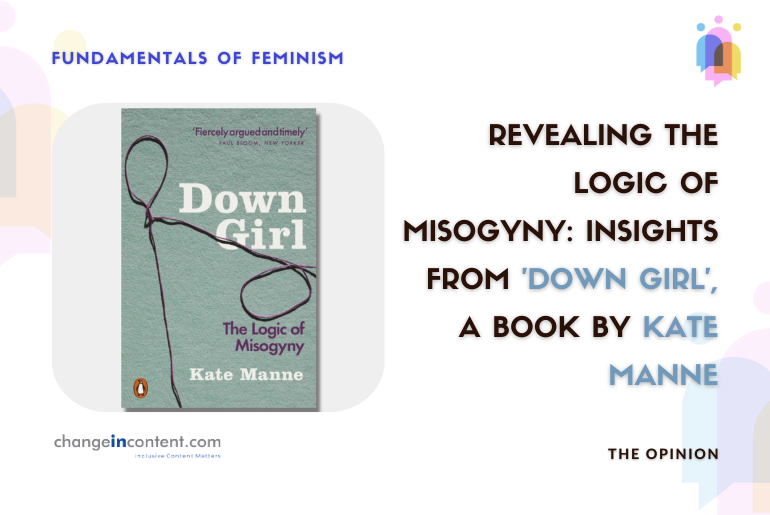
Kate Manne, the author of the book ‘Down Girl: The Logic of Misogyny’, was born in 1983 in Australia. She is an Australian philosopher and associate professor of philosophy at Cornell University. She specialises in feminist philosophy, moral philosophy, and social philosophy. Manne studied philosophy, logic, and computer science at the University of Melbourne, earning a BA (Honours) in philosophy. She received her PhD in philosophy from the Massachusetts Institute of Technology, where her dissertation argued that practical reason should not be the central concept in ethics.
Manne was a junior fellow at the Harvard Society of Fellows from 2011 to 2013. Additionally, she has been with Cornell University’s Sage School of Philosophy since 2013. In 2019, Prospect Magazine named her one of the world’s top 50 thinkers. In 2024, she was awarded the Lebowitz Prize by Phi Beta Kappa and the American Philosophical Association for a presentation on dehumanisation.
Down Girl: The logic of misogyny (2017)
In her first book, Down Girl: The Logic of Misogyny, Kate Manne distinguishes between sexism and misogyny. She argues that sexism is an ideology that supports patriarchal social relations. That makes gender roles seem natural or given. In contrast, misogyny is an effort to control and punish women who challenge male dominance.
According to Manne, misogyny functions as the “law enforcement branch of the patriarchy.” It imposes social costs on women who break from traditional roles and warn others not to do the same. She also introduces the term “himpathy,” describing the disproportionate sympathy powerful men often receive in cases of sexual assault, intimate partner violence, and other misogynistic behaviours. The book explains how misogyny serves to keep women in a patriarchal order by punishing those who defy it.
Understanding the logic of misogyny in Down Girl
The book explores the logic and persistence of misogyny. It highlights the hostilities women face in a world historically dominated by men. The book defines misogyny as a system that enforces and polices gendered norms and expectations within patriarchal societies. Despite claims that countries like the United States, Australia, and the United Kingdom are post-patriarchal, the book argues that misogyny persists in these cultures in specific forms, especially after the advent of legal equality for women.
Manifestations of misogyny
Misogyny adapts to new contexts by obligating women to be moral “givers” and validating male entitlement. The book examines various manifestations of rape culture, such as:
- The ubiquitous entreaty for women to “Smile, sweetheart!“
- Donald Trump’s boasts about grabbing women during his 2016 presidential campaign.
- The Isla Vista killings in California.
- A police officer in Oklahoma sexually assaulted African American women with criminal records.
- The conservative anti-abortion movement.
- Online mobbing of women in public life deters their participation.
Mechanisms of control in Down Girl: The logic of misogyny
The book discusses how misogyny takes the form of taking from women what they are (falsely) held to owe men. Moreover, it discusses what prevents them from competing for positions of power and authority. It delves into the practices of silencing women, such as “testimonial smothering,” where women’s voices are suppressed or disregarded.
Gaslighting and silencing in misogyny
The concept of “gaslighting” is introduced to explain how male dominance often involves blocking or rewriting women’s experiences to engineer their agreement. This manipulation creates a false reality where women doubt their own perceptions and experiences.
Analysing misogyny in Down Girl: The logic of Misogyny
The book provides a functional and political analysis of misogyny, presenting it as a system that serves to enforce gendered norms and expectations. It emphasises the intersection of patriarchal forces with other systemic forms of domination, oppression, and vulnerability. The book shows misogyny as a property of social environments where women face hostility due to the enforcement of patriarchal norms.
Misogyny vs. sexism
The distinction between “sexism” and “misogyny” is highlighted:
- Sexism is the ideology that justifies and rationalises a patriarchal social order. It is scientific and rational.
- Misogyny is the enforcement mechanism that polices and upholds patriarchal norms. It is moralistic and punitive.
Real-world examples of the logic of misogyny
The book references real-world examples to illustrate its points, such as:
- Julia Gillard’s misogyny speech as the prime minister of Australia helped redefine the term’s dictionary definition.
- Rush Limbaugh’s attacks on Sandra Fluke are an example of misogyny targeting women who challenge gender norms.
Scope of the book
The book also explores the flipside of misogyny’s punishment of women, which is the dismissal of privileged men who engage in misogyny. This phenomenon, called “himpathy,” involves the flow of sympathy up the social hierarchy away from female victims toward male perpetrators. It is connected to epistemic injustice and oppression, theorised by Miranda Fricker and Kristie Dotson.
The book contrasts well-publicised cases like the Isla Vista killings with less publicised instances like the serial rapist police officer in Oklahoma City, who preyed on black women with criminal records, highlighting the concept of “misogynoir”—a term by Moya Bailey describing the unique form of misogyny black women face due to the intersection of racism and sexism.
Humanism vs. misogyny
The book contests a rival approach to misogyny called “humanism,” which attributes misogyny to a failure to recognise women’s full humanity. Instead, it argues that misogyny recognises women as human, resenting and punishing them for violating social norms. The book sees dehumanising attitudes as a way to manage the threat certain women pose to male dominance.
Patriarchal norms and expectations
Misogyny continues to enforce patriarchal norms by obligating women to provide moral goods such as attention, care, and sympathy, while privileged men feel entitled to these from women. It manifests in behaviours like catcalling, mansplaining, manspreading, and rape culture, as well as family dynamics where men feel ownership over their female family members.
Ideology of victim culture
The book critiques the ideology of “victim culture,” which casts women who claim to be wronged as melodramatic and manipulative, further enforcing the idea that women should be moral “givers” rather than victims. This ideology prevents women from receiving moral attention and support for their own needs, which people often dismiss as narcissistic or selfish.
Case study: 2016 presidential election
The analysis of misogyny is applied to the 2016 presidential election, where Hillary Clinton faced significant misogyny from both right and left-wing sources. The book argues that biases against women in leadership positions contributed to her defeat, with research showing that competent women are often deemed less likeable than their male counterparts.
The final thoughts
The book concludes by discussing the future of the struggle against misogyny. It advocates for a realistic, self-protective approach to combating it. It emphasises the importance of continuing to assert women’s entitlement to moral, material, and social benefits despite the challenges posed by entrenched misogynistic attitudes.
Disclaimer: The views expressed in this article are based on the writer’s insights, supported by data and resources available both online and offline, as applicable. Changeincontent.com is committed to promoting inclusivity across all forms of content, which we define broadly to include media, policies, law, and history—encompassing all elements that influence the lives of women and gender-queer individuals. Our goal is to promote understanding and advocate for comprehensive inclusivity.