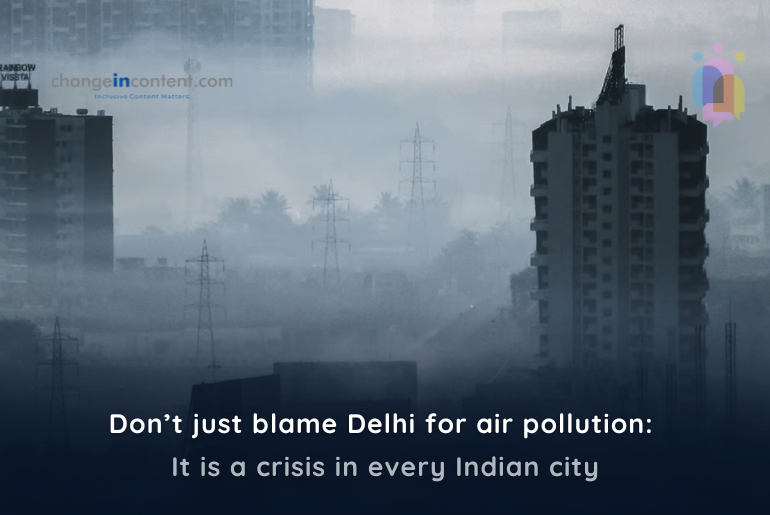
When discussing air pollution in India, people often associate the issue primarily with Delhi. This assumption is widespread because Delhi’s air quality issues frequently dominate news headlines and public discourse. The severe pollution levels in the city are indeed a significant concern that demands immediate action. However, the growing air pollution crisis is not specific to Delhi or NCR. It is a pan-India problem, as many other cities in India face nearly the same harmful pollution levels.
Mumbai, for instance, has been experiencing poor air quality. However, because people often use Delhi as the reference point for severe pollution levels, Mumbai’s pollution issue has been overlooked until its Air Quality Index (AQI) surpasses or matches Delhi’s. Why wait for pollution levels to worsen significantly before taking action?
It is not just a Mumbai or Delhi problem. A recent WHO report highlights that 10 out of the 20 most polluted cities in the world are in India. Shockingly, all 1.4 billion people in the country are exposed to harmful levels of ambient PM2.5. It is a highly toxic pollutant originating from various sources. The problem is that the government, organisations, and even citizens only act when the situation is out of control.
Air pollution isn’t just an environmental issue—it’s a human issue, a societal issue. When we talk about sustainability and ESG goals, we must address the air pollution crisis with the same urgency. It’s not only about cleaner air; it’s about ensuring a healthier, more equitable future for everyone. ~ Saransh Jain, Founder, Changeincontent.com
India’s air pollution crisis: From Delhi to Begusarai
The 2023 World Air Quality Report, based on real-time air quality data from IQAir, reveals that the world’s top three most polluted countries are Bangladesh, Pakistan, and India, in that order. New Delhi is the most polluted capital city globally, with an average PM2.5 concentration of 102.1 µg/m3. It is 20 times higher than the WHO limit and more than two and a half times over India’s national limit of 40 µg/m3.
The report also highlights that India continues to struggle with severe air pollution, with PM2.5 concentrations exceeding the WHO annual guideline by over 10 times. Nine of the ten most polluted cities worldwide are in India. Furthermore, Begusarai in Bihar was identified as the most polluted metropolitan area globally in 2023, followed by Guwahati and New Delhi. India is home to four of the world’s most polluted cities (Begusarai, Guwahati, Delhi, and Siwan), and 14 out of 15 of the most polluted metros in Central and South Asia are in India.
As of 2025, little has changed. Mainstream media continues to overlook cities like Begusarai, with coverage likely limited to one article a year following some air quality reports. But what happens after that coverage fades? Will the issue be addressed or forgotten again?
Another question is, what is the air pollution situation in Southern India?
Air pollution crisis in the South: Is it any different from the North?
New research by Greenpeace India shows that air quality in Bengaluru, Mangaluru, and Mysuru has dropped significantly, while air pollution has increased in these cities. The Greenpeace report “Spare the Air-2” highlights serious health risks as levels of particulate matter (PM2.5 and PM10) in 10 major cities in southern India rise, far exceeding the air quality guidelines set by the World Health Organization.
In cities like Hyderabad, Chennai, and Visakhapatnam, PM2.5 levels are up to 10 times higher than the recommended limits. The annual average PM10 levels in Mangaluru, Hyderabad, Kochi, Amravati, Chennai, and Vijayawada are about 1.5 times higher than the National Ambient Air Quality Standards (NAAQS).
Air pollution crisis in South: What deserves attention
What is particularly concerning is the apparent disregard for the rising pollution levels in southern cities, which are often considered cleaner and less crowded. The truth is cities across the entire country are now grappling with deteriorating air quality; it is not simply a north problem or south problem.
#FightToBreathe Campaign: Raising awareness for nationwide action
Air pollution is a nationwide issue that requires attention and solutions for all cities, no matter where they are located. Sure, the Indian government is not entirely unaware of the problem. They have developed plans and are monitoring the situation. For comparison, Bangladesh only monitors air quality in two locations, while Pakistan has 10 monitoring sites. India, on the other hand, monitors 256 cities. However, despite these efforts, the Indian government’s approach to addressing the country’s pollution problem is still lacking.
What will truly make a difference is raising awareness so that more people realise air pollution isn’t just a Delhi problem. Because when citizens don’t fully grasp the urgency of the situation, there is little accountability for those who have the power to address it. The #FightToBreathe campaign is one such effort, working to make people aware and push for meaningful change. It is a collaboration between readers, experts, and Newslaundry to identify the root causes of pollution, evaluate government actions, and develop actionable solutions.
The lesson from the #FightToBreathe Campaign to fight air pollution crisis
A critical lesson from the #FightToBreathe campaign is the effective use of the Right to Information (RTI), a fundamental right of every Indian citizen. By using RTI, any citizen can request data, documents, or updates on government actions, making it easier to assess what progress is being made in areas that impact public health, like air pollution. #FightToBreathe campaign is also a reminder that citizens must not be passive participants.
It is not just about air pollution, though. The principle of asking questions and seeking information can apply to a wide range of issues that affect public interest. This shift can bring about a more informed and engaged society.
The growing air pollution crisis: The final thoughts
The reality is that air pollution has become a problem for everyone, not just for those living in the most polluted cities. To effectively combat this issue, citizens must raise their voices and demand action from their leaders. That is why awareness is key so that more citizens understand the urgency of the situation. As we saw with the #FightToBreathe campaign, asking questions and pushing for accountability can lead to meaningful change.
At ChangeInContent, we believe the fight against the air pollution crisis is deeply intertwined with the principles of sustainability and equity. Just as ESG frameworks demand accountability from organisations, citizens, too, must demand accountability from policymakers. This is not just about combating pollution but about building a future where health, safety, and equality are non-negotiable. Together, we can push for the systemic changes needed to address this crisis meaningfully.
References
- Interactive global map of 2023 PM2.5 concentrations by city
- World Bank Group: How is India Trying to Address Air Pollution?
- GreenPeace: Are cities in Southern India Breathing Safe Air?
- Greenpeace report: Spare the Air-2
- Newslaundry #FightToBreathe Campaign
Disclaimer: The views expressed in this article are based on the writer’s insights, supported by data and resources available both online and offline, as applicable. Changeincontent.com is committed to promoting inclusivity across all forms of content. We broadly define inclusivity as media, policies, law, and history—encompassing all elements that influence the lives of women and gender-queer individuals. Our goal is to promote understanding and advocate for comprehensive inclusivity.