
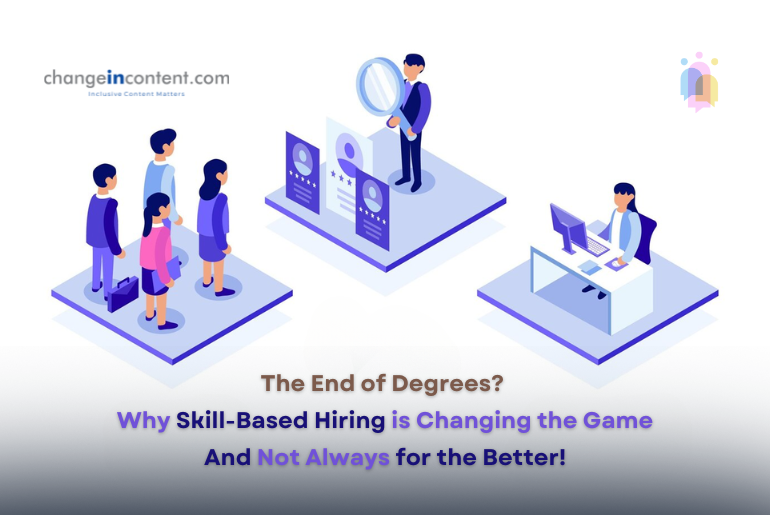
Traditional hiring has long been dominated by degree-based qualifications, prestigious university backgrounds, and years of experience—all of which often overshadow actual skills. However, as industries evolve rapidly, particularly in technology, skill-based hiring is gaining momentum as a game-changing approach to recruitment. Rather than evaluating candidates solely on formal credentials, companies are shifting towards assessing practical competencies and demonstrated abilities.
Growing skills gaps, automation, and the need for a more adaptable workforce are driving this trend. A Harvard Business Review study found that nearly 45% of employers have already moved toward skills-based hiring. It is reducing dependency on degree-based requirements. The potential advantages are significant—more expansive talent pools, faster hiring cycles, and greater workplace diversity. But there is also a darker side to this shift. Some companies may misuse skill-based hiring as a loophole to sidestep inclusivity efforts. They may use it to create new biases instead of eliminating old ones.
The question remains: Can skill-based hiring truly make workplaces more diverse, inclusive, and efficient, or will it merely shift the barriers without breaking them down?
What is skill-based hiring? A paradigm shift in recruitment
Skill-based hiring focuses on what candidates can do rather than where they have been. Instead of filtering applicants based on academic degrees or specific job titles, employers assess practical skills, problem-solving abilities, and real-world experience.
This shift is particularly relevant in sectors like technology, finance, healthcare, and engineering, where job requirements are evolving faster than universities can update their curricula. For example, a self-taught cybersecurity expert with extensive hands-on experience may now stand a chance against a computer science graduate from a top-tier university.
Companies embracing skill-based hiring use:
- Standardised skill assessments instead of resumes.
- Coding tests, portfolio reviews, and real-world task simulations to evaluate candidates.
- AI-powered hiring tools to analyse skills rather than credentials.
Major corporations like IBM, Tesla, and Google have already eliminated degree requirements for many technical roles. The shift is reshaping how companies identify talent. But does it benefit everyone equally?
The Data: Who benefits from skill-based hiring?
A report by McKinsey Global Institute states that 87% of companies worldwide face skill gaps or anticipate them in the near future. As industries struggle to find qualified talent, skill-based hiring has emerged as an efficient alternative.
Key statistics on skill-based hiring:
- 50% of Fortune 500 companies have adopted skill-based hiring practices.
- 76% of hiring managers believe this approach helps build more agile teams.
- More than 1 million job listings have removed degree requirements in the past two years.
- Employees hired through skill-based assessments perform 30% better than those selected based on resumes alone.
This hiring model can open new doors for workers, particularly those without traditional degrees or career breaks. However, it is not a magic bullet—it requires careful implementation to avoid replacing one form of bias with another.
The challenges of skill-based hiring: Bias in a new form?
While skill-based hiring appears to be a progressive shift, it comes with unintended challenges:
New biases emerge
Even though degrees may not be mandatory, biases can still influence how hiring managers perceive “non-traditional” candidates. Unconscious preferences for familiar backgrounds, communication styles, or specific training platforms can skew hiring decisions.
Subjectivity in skill assessments
AI-powered hiring tools and skill-based assessments are not foolproof. A recent study found that AI hiring tools frequently favoured candidates who “looked like” past successful hires, reinforcing historical biases.
The illusion of meritocracy
Skill-based hiring claims to create a level playing field. However, socioeconomic factors often limit access to high-quality online courses, boot camps, and certifications. Thus, those who already have access to resources benefit the most, not necessarily those with the most potential.
Women and marginalised groups face a double hurdle
For women and underrepresented communities, skill-based hiring should be an opportunity. However, instead, it is often an excuse for companies to avoid addressing systemic barriers. “We do not see enough qualified women” is becoming a common excuse. That masks underlying structural issues in hiring and promotion practices.
Skill-based hiring alone cannot replace structural inclusivity efforts—it must be part of a broader equity-driven hiring strategy.
How some companies use skill-based hiring to avoid inclusion
While skill-based hiring should promote diversity, some organisations have used it as an excuse to sidestep DEI (Diversity, Equity, and Inclusion) initiatives.
The “We Only Hire on Merit” fallacy:
Some hiring managers argue that removing gender or racial considerations makes hiring “fairer.” However, some reports revealed that companies adopting “merit-only” hiring actually reduced female and minority hiring by 18%. That is because they failed to address systemic disadvantages in access to skills and training.
The rise of AI hiring bias:
A study found that AI recruitment tools were more likely to reject resumes from women applying for tech roles because they lacked “preferred” keywords despite having the required skills.
Lack of mentorship and leadership pipelines:
Even if women and marginalised groups get hired based on skills, fewer career advancement opportunities mean they often remain stuck in junior roles.
For skill-based hiring to truly work, companies must recognise that skill acquisition is not equally accessible to everyone—and take action to bridge those gaps.
The Changeincontent perspective: A call for thoughtful hiring
Skill-based hiring is not inherently good or bad—it depends on how companies implement it. Done right, it reduces barriers, widens talent pools, and creates better workplaces. Done carelessly, it becomes a tool for exclusion under the guise of objectivity.
Hiring should prioritise skills but also do so without abandoning the responsibility to create inclusive workplaces. If companies genuinely want diverse teams, they must actively invest in training, mentorship, and equitable access to opportunities. They should not just assume the “best candidate” will naturally rise to the top.
Actual progress happens when organisations:
- Recognise that skill gaps are not just individual problems—they are systemic ones.
- Invest in mentorship, training programs, and leadership pipelines for diverse talent.
- Use AI hiring tools ethically, ensuring they do not reinforce biases.
Skill-based hiring should not replace DEI—it should strengthen it.
The final thoughts
Skill-based hiring represents a fundamental shift in how companies identify talent. By prioritising real-world abilities over traditional credentials, businesses can broaden their talent pools, speed up hiring, and adapt to market demands.
However, the success of skill-based hiring depends on execution. If companies genuinely want innovation, diversity, and efficiency, they must approach hiring thoughtfully, ethically, and inclusively. The future of work should not just be about who has the best skills but about creating environments where everyone—regardless of background—has a fair shot at success.
Disclaimer: The views expressed in this article are based on the writer’s insights, supported by data and resources available both online and offline, as applicable. Changeincontent.com is committed to promoting inclusivity across all forms of content. We broadly define inclusivity as media, policies, law, and history—encompassing all elements that influence the lives of women and marginalised individuals. Our goal is to promote understanding and advocate for comprehensive inclusivity.
