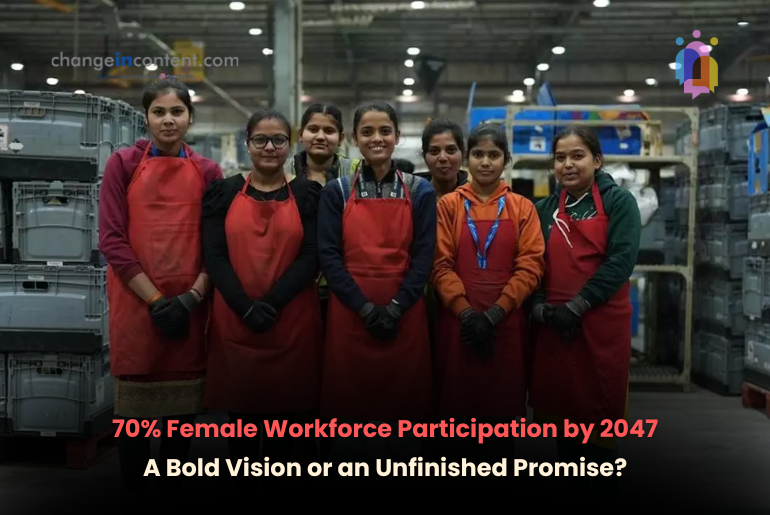
India has set an ambitious target to achieve 70% female workforce participation by 2047. It is a significant milestone in the country’s journey toward gender parity in employment. Addressing the G20 Employment Working Group Meeting 2025 in Port Elizabeth, Union Labour Secretary Sumita Dawra highlighted the country’s ongoing initiatives to improve women’s participation in the workforce. Key government reforms, including extended maternity leave, enhanced creche facilities, and equal pay provisions, were underscored as essential drivers in this mission.
Despite significant progress, women’s workforce participation in India has remained lower than global standards. The Government’s commitment to increasing its presence in high-growth sectors like IT, research and development, and engineering will boost economic growth. However, achieving this goal demands not just policy interventions but a fundamental shift in workplace culture, corporate policies, and social attitudes.
The Government’s vision for 70% female workforce participation by 2047
The Indian Government has undertaken significant labour market reforms to create a more inclusive workforce. Sumita Dawra reaffirmed that India is on a mission to increase female workforce participation to 70% by 2047. This commitment aligns with broader economic strategies, focusing on formal employment generation, social security expansion, and skill development programs.
She highlighted key initiatives such as:
- e-Shram portal, which has registered over 300 million unorganised workers to bring them under formal employment.
- Modernisation of ESIC and EPFO schemes, ensuring better healthcare and pension benefits for women workers.
- Employment Linked Incentive (ELI) scheme, designed to create more formal sector jobs for women.
The reforms aim to bridge the gender gap in employment by offering better protection and support for women, especially in sectors where they traditionally face underrepresentation.
Women in high-growth sectors: A path to economic empowerment
India is witnessing a rise in female representation in IT, R&D, and engineering, sectors traditionally dominated by men. Dawra emphasised how women’s increasing participation in these high-growth industries is a crucial factor in driving India’s economic growth.
Key highlights:
- STEM Inclusion: More women are joining the IT and R&D workforce, contributing to global tech advancements.
- Engineering and infrastructure: The push for female engineers is growing, but representation remains significantly low.
- Corporate inclusion: Policies promoting leadership diversity are gradually shifting workplace cultures.
However, representation does not equate to equal opportunities. Many women still face barriers in career progression, pay disparity and unconscious biases. While the numbers are increasing, the challenge is ensuring that these jobs provide long-term career stability and leadership opportunities for women.
Social security and labour market reforms: Expanding coverage for women
One of India’s most significant achievements has been the expansion of social security coverage. Dawra cited the ILO’s World Social Protection Report 2024-26, noting that social security coverage has doubled from 24.4% in 2021 to 48.8% in 2024.
Key social security developments include:
- Formalisation of gig and platform workers, ensuring women in the informal sector receive benefits.
- Maternity leave extensions and creche facilities supporting working mothers.
- Labour Codes, designed to enhance women’s legal rights in the workplace.
Despite progress, gaps remain. Many female workers in low-paying sectors, rural industries, and gig work remain excluded from formal benefits. Strengthening implementation mechanisms will be key to ensuring that these protections reach every working woman.
Employment trends: India’s declining unemployment rate and women’s participation
Dawra also addressed India’s improving employment landscape. The unemployment rate dropped from 6% in 2017-18 to 3.2% in 2023-24. Additionally, India’s Labour Force Participation Rate (LFPR) and Worker Population Ratio (WPR) have seen steady rises.
This progress can be due to:
- Growth in global supply chains, creating export-driven employment.
- Investments in agriculture, MSMEs, and medical education are sectors that offer significant employment for women.
- Digital transformation and remote work policies are making jobs more accessible to women.
However, labour market flexibility must not come at the cost of job security. Women in India still struggle with wage gaps, job retention, and career growth stagnation. While employment numbers are improving, ensuring quality, stable jobs for women remains a challenge.
The global context: India’s collaboration with ILO & G20 countries
India’s employment policies are gaining international recognition, with partnerships involving the ILO, OECD, and major G20 economies. Agreements on skills mapping and skilled labour mobility with countries like the Netherlands, Norway, and UAE are being explored.
India’s push for global workforce integration includes:
- Bilateral agreements are making it easier for skilled Indian women to work abroad.
- Global best practices, integrating successful gender-inclusive employment models.
- Cross-country research, helping India learn from economies with high female workforce participation.
International collaborations will be crucial in shaping India’s labour policies to create a more gender-inclusive economy.
Changeincontent perspective: Beyond policies, what needs to change?
India’s goal of 70% female workforce participation by 2047 is ambitious, necessary, and achievable. However, it can only be achieved if businesses and society actively support it. The Government has introduced strong policies, but corporations and institutions must step up to create a real, lasting impact.
Saransh Jain, Founder of Changeincontent.com, shares his perspective:
“Legislation alone cannot solve the gender workforce gap. Organisations must change hiring practices, build inclusive leadership, and offer real support for women’s career growth. A 70% female workforce target is about reshaping the way workplaces function at every level. Do not think of it just as numbers. Come forward, and support women’s participation in the workforce.”
If companies genuinely prioritise gender inclusion, it will reflect in:
- Equal pay structures and transparent promotions.
- More women in senior leadership roles.
- Corporate mentorship programs to bridge gender gaps in male-dominated fields.
The change must start now—not in 2047.
70% Female Workforce Participation: The final thoughts
India’s commitment to 70% female workforce participation by 2047 is a game-changer, but the success of this vision depends on policy execution, corporate responsibility, and cultural shifts. While efforts in social security, labour market flexibility, and employment generation are paving the way, true inclusion requires transformational change at every level of work and society.
This is not just about hitting a target—it is about ensuring that women in the workforce are valued, supported, and given equal opportunities to thrive.
Disclaimer: The views expressed in this article are based on the writer’s insights, supported by data and resources available both online and offline, as applicable. Changeincontent.com is committed to promoting inclusivity across all forms of content. We broadly define inclusivity as media, policies, law, and history—encompassing all elements that influence the lives of women and marginalised individuals. Our goal is to promote understanding and advocate for comprehensive inclusivity.