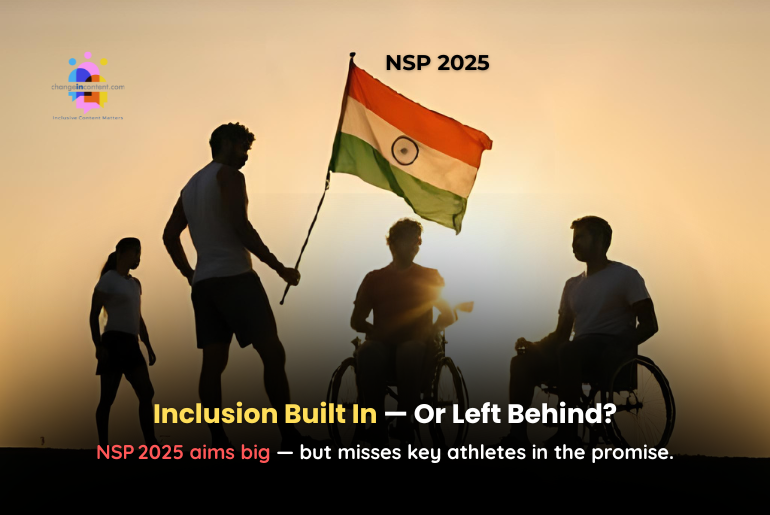
On 1 July 2025, the Union Cabinet approved the updated National Sports Policy 2025 (NSP 2025), ambitiously branded “Khelo Bharat Niti.” The policy has five strategic pillars: excellence, economic and social development, mass participation, and edu-sports integration.
The policy pledges inclusion for women, persons with disabilities, tribal communities, and economically disadvantaged groups. However, as commentators note, a lack of legal mandates, measurable targets, or enforceable quotas leaves its inclusive vision fragile.
The policy is right in spirit: grassroots infrastructure, athlete welfare, and technological investment are sorely needed. However, without structural accountability, the commitment to equity remains aspirational. In this analysis, we unpack what NSP 2025 does, where it truly succeeds, and where it disappoints vital stakeholders like women, transgender persons, and athletes with disabilities.
What does the National Sports Policy 2025 get right
Here is what the NSP 2025 gets right:
- Strategy & Scope: The five pillars, from elite performance to education integration, show holistic thinking. Coordination across ministries, the use of AI and data analytics, and a monitoring framework are promising approaches.
- Inclusion Rhetoric: The policy calls for increased participation among women, disabled athletes, tribal communities, and economically weaker sections, and promotes parasports.
- Economic Potential: It connects sports with economic growth through PPPs, CSR initiatives, and sports manufacturing, opening the door to entrepreneurship and career paths within sports.
- Education Linkage: Aligning with NEP 2020, the NSP encourages physical literacy, sports educator training, and dual-career models for student-athletes.
Accountability gaps on gender equity
Let us look at the shortcomings of the policy.
- No Quotas, No Consequences: Though mentioning women repeatedly, the policy doesn’t mandate board quotas, funding conditionalities, or selection targets. These are benchmarks in sporting nations such as Australia and the UK.
- Federation Leadership Imbalance: Women continue to be underrepresented in sports federations. Without tied performance metrics or consequences, this status quo is unlikely to change.
- Global Comparisons: By contrast, Sport England requires diversity action plans for funding; Australia mandates gender parity on governing boards — India has neither
Disability inclusion — Parallel, not integrated
The NSP 2025 also ignores PwDs, which raises questions about its inclusivity.
- Separate Track for Parasports: While para-athletics gets mention, disabled athletes are not integrated into mainstream programmes. There is no universal design mandate in new infrastructure.
- Compliance with UN CRPD Required: NSP 2025 falls short of India’s obligations under the UN Convention on the Rights of Persons with Disabilities. Equality demands integrated access, from grassroots to elite levels.
- Impact on Athletes: Athletes with disabilities like Avani Lekhara face access barriers despite high performance, as key talent remains dependent on occasional initiatives rather than systemic inclusion.
Trans & non-binary athletes — Silent omissions
The policy also silently omits trans and non-binary athletes.
- No Acknowledgement: NSP 2025 references “underrepresented groups” but fails to acknowledge transgender or non-binary athletes, ignoring self-ID protocols and anti-discrimination clauses.
- Vulnerability to Policy Lacunae: This silence exposes athletes to biased exclusion, invasive sex-verification protocols, or denial of competitive spaces.
- Global Good Practices: Countries such as Canada and New Zealand, as well as IOC-supported frameworks, now incorporate inclusive systems. India’s omission leaves trans athletes vulnerable.
Institutional oversight & enforceability
There is more that the policy ignores. Here are more of its shortcomings:
- Monitoring Without Mandates: Even with KPIs and monitoring frameworks outlined, without funds tied to outcomes or performance metrics, inclusion remains optional
- No Independent Watchdog: Unlike some countries that establish oversight bodies to monitor equity performance, India’s NSP offers no mechanism to track compliance, investigate discrimination, or sanction non-compliance.
- Counting vs Changing Culture: Without measurable targets, progress remains at the level of people counting, not systems changing.
India’s New National Sports Policy: Vision with gaps
India’s New National Sports Policy 2025 (NSP 2025) presents a strong narrative blueprint for the country’s sporting future. However, without enforceable quotas, equal access mandates, and protections for gender-diverse athletes, the policy risks being perceived as a well-intentioned statement rather than a catalyst for structural change. To ensure its impact extends beyond a mere narrative, inclusion must become a cultural transformation within Indian sports.
To become truly pioneering, NSP must evolve:
- Tie funding to diversity targets across governance, coaching, and athlete selection.
- Enforce universal design in infrastructure.
- Ensure legal protections and acknowledgement for transgender and non-binary athletes with self-ID guidelines.
- Establish an independent oversight body to enforce equity across federations.
Only this can make inclusion more than optics, but instead, a cultural transformation within Indian sport.
Also read: “It’s a Revenue Issue”: The excuse that holds back women in sports.
Disclaimer: The views expressed in this article are based on the writer’s insights, supported by data and resources available both online and offline, as applicable. Changeincontent.com is committed to promoting inclusivity across all forms of content. We broadly define inclusivity as media, policies, law, and history. It encompasses all elements that influence the lives of women and marginalised individuals. Our goal is to promote understanding and advocate for comprehensive inclusivity.