
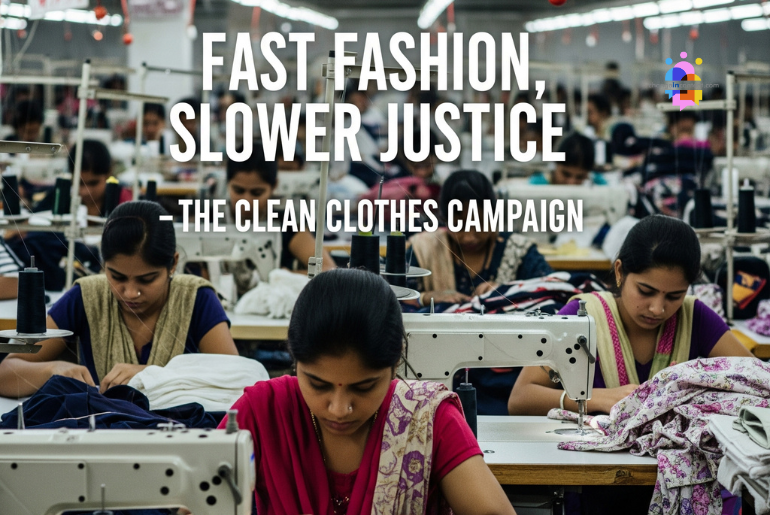
As the Clean Clothes Campaign gains momentum online, it has begun forcing a tough question: Are the clothes we wear worth the cost others pay? At the heart of this movement is a call to reimagine fashion not just as a style statement but as a human rights issue. From unsafe factories to unpaid overtime, the Clean Clothes Campaign is exposing an industry built on systemic neglect.
Clean Clothes Campaign: Stitching truth into fashion
There is a viral post circulating on the internet claiming that France has banned SHEIN hauls. The kind of videos where influencers open up bags full of fast fashion clothes, toss them across their beds, try them on for five seconds, and then quietly return half of them. However, the ban is not entirely accurate; a soon-to-be-passed piece of legislation in France will directly target ultra-fast fashion giants like Shein and Temu through environmental and advertising regulations.
France is set to launch an eco-score system that will rate clothing brands based on factors such as carbon emissions, resource use, and the ease of product recycling. This score will determine a new tax.
Starting in 2025, the tax could go up to €5 per item. By 2030, it could double to €10 or up to 50% of the item’s retail price. The money collected would support France’s sustainable fashion industry. France also plans to ban ads for ultra-fast fashion brands altogether. That includes Instagram try-ons and TikTok hauls, not just billboards and TV spots. Influencers who continue to promote these brands could face penalties.
Now that France’s move against ultra-fast fashion has made the news, it’s also a good time to discuss the reality of fast fashion and its impact on women.
Fast fashion’s exploitation is deeply gendered
Clean Clothes Campaign is a global network of labour rights organisations, trade unions, and activists working to improve working conditions for garment workers. The campaign reports that approximately 80% of garment workers worldwide are women, primarily based in countries such as China, India, and Bangladesh. These regions became the centre of global garment production when Western companies shifted manufacturing overseas to cut costs, knowing that local labour laws are weaker and exploitation is easier.
Most of the people making the world’s cheapest clothes are women of colour. Asia employs the largest number of garment workers in the world, with approximately 75% of the total workforce based there. Out of these, an estimated 42 million are women.
Many of them face harsh, unsafe working conditions. The truth is, these kinds of conditions would never be accepted in wealthier countries, especially for white workers. Sexual harassment, workplace violence, pregnancy discrimination, and denied maternity leave are common. In Cambodia, one in three women garment workers report experiencing some form of sexual abuse or violence at work. In Bangladesh, that number is 80%.
Although most garment workers are women, very few of them hold leadership positions or earn higher salaries. They’re the ones sewing, packing, and working on the factory floor, but men are more likely to be the supervisors or managers.
Not one fast fashion giant can guarantee a living wage
Research carried out by the Clean Clothes Campaign found that no major clothing brand can prove its workers receive a living wage in Asia, Africa, Central America or Eastern Europe. Globally, only 2% of garment workers earn a living wage to meet their basic needs.
A living wage is not the same as a minimum wage. A minimum wage is often too low to cover essential expenses such as food, housing, and healthcare. A living wage is the bare minimum a worker should earn to live with dignity, and it’s still treated like a luxury in many parts of the fast fashion supply chain.
Take Bangladesh, the world’s second-largest exporter of clothing. Ten years ago, the monthly minimum wage for garment workers was 5,300 taka (about €62). Workers needed at least 8,900 taka to cover their basic needs. Even with long hours, sometimes 60 to 140 hours of overtime a week, they were often denied overtime pay.
The new minimum wage is 12,500 taka ($106) a month. It appears that some progress has been made, until you realise that trade unions had asked for 23,000 taka ($195), which is still the lowest wage that could lift workers above the poverty line.
So, what happened when workers asked for fair pay? They had to face violence.
Repression instead of reform
In late 2023, thousands of Bangladeshi garment workers took to the streets demanding fair pay during the national wage revision process. Their protests were largely peaceful, but they were met with harsh repression. Police violence left four workers dead, 131 arrested, and around 30,000 workers are still facing criminal charges simply for standing up for their rights.
Many brands whose suppliers were involved in this crackdown have chosen to stay silent. Their refusal to hold suppliers accountable has allowed the repression to continue. Workers have been fired, charged with crimes they didn’t commit, or accused anonymously in what appears to be a strategy to suppress labour organising.
Holding fast fashion brands accountable
The Clean Clothes Campaign has a brand tracker listing companies that remain complicit in the repression of workers. It calls on them to take responsibility, to demand that suppliers drop charges, rehire workers, and pay withheld wages. Brands like Zara and H&M are under pressure to act, and consumers are joining the campaign. Thousands have already emailed these companies. 2,845 (and counting) have sent an email. The goal is to reach 5,000.
The Fashion Checker, a project by the Clean Clothes Campaign and the European Union, collects data from brand audits and worker interviews across different countries. The platform tracks details such as maternity leave (or the lack thereof), working hours, wages, and housing conditions, supported by real documentation, including payslips. The platform will expand as more countries and brands are added to the study. Its goal is to promote greater transparency, enabling consumers to make more informed decisions and demand accountability from brands.
Conclusion: The Clean Clothes Campaign is a wake-up call
No major fast fashion brand today can prove it pays the garment workers a living wage. Not one. The fast fashion industry is built on low wages, long, unsafe working hours, and a workforce that’s mostly women of colour. Organisations like the Clean Clothes Campaign (CCC) are tracking the underpaid, overworked, and unheard garment workers, exposing abuse, and pushing for change.
These are the kinds of stories we continue to bring forward at ChangeinContent because they rarely receive the attention they deserve. A sustainable future in fashion begins with fair pay, worker safety, and amplifying voices that we often overlook. Awareness is the first step toward meaningful change.
Changeincontent perspective
At ChangeinContent, we believe this is not just a conversation about fashion. It is a conversation about gender, race, and power. The Clean Clothes Campaign reminds us that consumerism cannot come at the cost of basic human dignity. The real fashion statement is fairness. And we are here to keep asking: Who pays the price when we do not?
Also Read: Sustainability by Indian Women: How the average Indian woman made sustainability a daily habit.
Disclaimer: The views expressed in this article are based on the writer’s insights, supported by data and resources available both online and offline, as applicable. Changeincontent.com is committed to promoting inclusivity across all forms of content. We broadly define inclusivity as media, policies, law, and history. It encompasses all elements that influence the lives of women and marginalised individuals. Our goal is to promote understanding and advocate for comprehensive inclusivity.
