
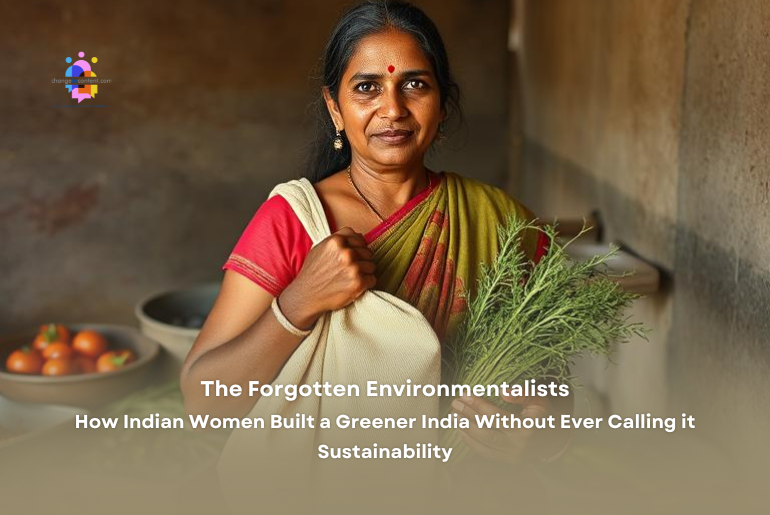
When we talk about climate action, the conversation often centres around innovations, corporations, and government policies. But what about the quiet, everyday revolutions? Sustainability by Indian women has never been a trend. Instead, it has been a lifestyle, often invisible, but always impactful.
The story of sustainability by Indian women: A relatable one for all
I grew up in a middle-class nuclear family in India. Wait, no, this isn’t one of those usual stories about the struggles of growing up in such a household. It is about something else entirely. How that upbringing quietly taught me the principles of sustainability and eco-friendly living.
But I didn’t figure it out on my own. It was always the women in the family—my mother, grandmother, and aunt—who passed it down to me. They never used the word “sustainability,” but they lived it every day.
Today, many think of sustainability as some Western, elite concept, something distant from everyday life. However, in truth, sustainability has always existed in Indian homes, led by women who scraped, saved, and reused long before it became a trending topic. Despite this, women rarely get recognition or a seat at the table when policies and decisions around sustainability are made.
Plastic bags and purpose: Sustainability by Indian women starts here
I may forget school lessons, but I’ll never forget the giant plastic bag my mother kept in a cupboard. Inside it were smaller plastic bags, whether mini, medium, or whatever odd size or shape you wanted. Whenever my father left to buy groceries, my mother would hand him one from this stash.
Those plastic bags had many lives. They carried fruit to our home, then went on to wrap lunchboxes tightly to prevent spills. They held wet umbrellas, worked as makeshift gloves when I helped dye my grandmother’s hair, and even made repeat appearances at the grocery store.
There was no need to throw them away. We used it again and again. They were reused until they gave out.
The storage hack every Desi kid knows
Social media might pressure us to colour-coordinate kitchenware or buy fancy storage sets. But back home, food delivery containers still store leftovers, dry fruits, and spice mixes. Those old cookie tins? Yes, the ones that never have cookies, held needles, buttons, threads, and everything in between. As a child, I found it annoying. Why couldn’t we just throw it away? Why pretend a cookie box was something else?
Now, as an adult, I get it.
Takeaway food containers may not make my kitchen counter look like something out of Nara Smith’s Instagram reel. These reused jars and tins may not win awards for aesthetics, but they serve a purpose. They reduce waste. They make use of what’s already there. My kitchen’s happy, and so is the planet.
No curated storage set from a luxury brand can match the practicality of something already available and still usable.
The backyard that fed us: A forgotten eco-model
At home, we had a small patch of backyard garden where we planted a variety of vegetables. It helped us cut down on expenses while keeping our meals fresh and nutritious. Back then, no one called it “organic” or spoke about “clean eating.” It was simply how they did things.
The same Bhindi and papaya I disliked as a child, especially because I saw my mother picking them from the backyard and knew they would end up on my lunch plate, now come wrapped in shiny plastic with labels like 100% organic and no pesticides. Ironically, the same kids who once refused to eat them now buy them from fancy stores, believing they’ve discovered something new.
The art of zero food waste, Amma style
In our home, wasting food was never an option. Even during my teenage dieting phase, when skipping a meal felt like self-control, my mother made sure I ate what was cooked for me. Looking back, I’m genuinely thankful. My body got the nourishment it needed, even if my teenage mood didn’t agree at the time.
When leftovers did happen, they didn’t end up in the bin. They went into the compost pit, right along with tea leaves, fruit peels, vegetable scraps, and eggshells. What seemed like garbage to most people became manure for the backyard garden.
Why my pillowcase was once a Sari
Hand-me-downs were a way of life in every middle-class household. As the eldest, I didn’t experience it much, but my younger sister did. And honestly, it worked. Why throw away a perfectly good outfit when someone else at home could still use it?
Now, of course, we’re all chasing the latest fashion drops and the new saree Alia Bhatt wore last week. I’m guilty of it too. After watching Deepika Padukone in that Levi’s ad, I was convinced I needed the same pair of jeans even though I had a perfect pair sitting in my cupboard. Life is strange like that. Spoiler alert: I didn’t buy the jeans. I’ll wait until I actually outgrow the ones I already have.
Middle-class minimalism: The original green movement
Back then, when we couldn’t wear those clothes, they were still not discarded. They just changed their purpose. Some became floor wipes. My father used a few old shirts to clean his bike. My mother turned old sarees and worn-out clothes into pillowcases, kitchen towels, and more. Nothing ever went to waste. Everything was stretched, stitched, and reused.
My Amma didn’t call it sustainability, but that’s precisely what it was.
Sustainability by Indian Women: A movement hidden in plain sight
The path to a greener future might already be within our homes, led by the quiet hands of women who have been doing this all along. Every single thing had a second, third, and fourth life, and that was the average Indian grihani’s way of sustainability. Call it zero-waste or call it jugadu. Or call it minimalism or creative repurposing. The middle-class lifestyle meant you were taught to live within your means and needs.
Who made that possible? The woman who is running the house. The women who knew how to stretch every rupee and every resource. To suggest that women have no role in sustainability is both inaccurate and unjust, given their longstanding contributions to resourceful living.
At Changeincontent, we believe sustainability is not just about new solutions—it is about recognising the ones we have long ignored. Indian women, especially from middle- and lower-income households, have been the original eco-warriors. It is time we value and include their methods in our mainstream environmental dialogues.
Also Read: Inclusive Education Policy: Bridging the gap for a truly inclusive society.
Disclaimer: The views expressed in this article are based on the writer’s insights, supported by data and resources available both online and offline, as applicable. Changeincontent.com is committed to promoting inclusivity across all forms of content. We broadly define inclusivity as media, policies, law, and history, encompassing all elements that influence the lives of women and marginalised individuals. Our goal is to promote understanding and advocate for comprehensive inclusivity.
