
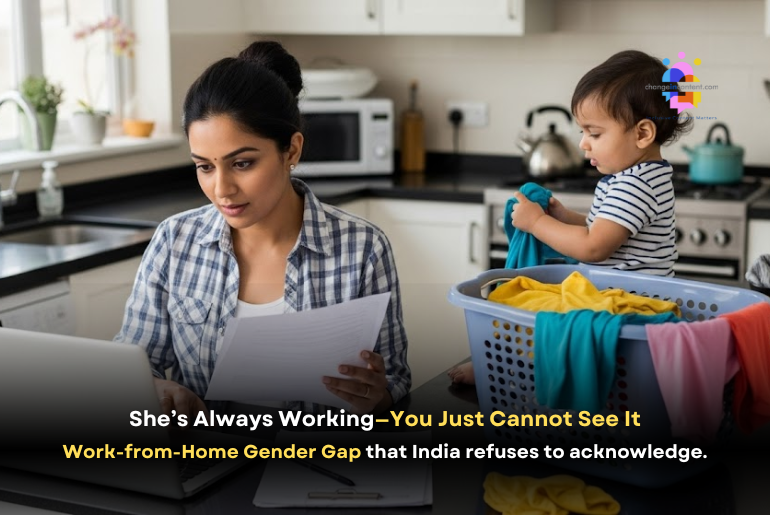
When remote work became the new normal, it was hailed as a liberating shift, especially for women. Freed from long commutes and rigid office hours, it seemed like a long-overdue win for working mothers and caregivers. But behind the glow of virtual meetings and flexible schedules lies a truth rarely discussed: the work-from-home gender gap is quietly widening.
In India, where social norms tightly bind women to unpaid domestic work, work-from-home (WFH) arrangements have only deepened the load. The flexibility women were promised has, in many cases, turned into a double shift, with no end in sight. While Western data shows that women opt for remote work more than men, especially mothers, the Indian context reveals a more layered, complex, and exhausting reality.
The global snapshot: A gender divide in remote preferences
In the United States, 36% of women reported working from home in 2024, compared to 29% of men, according to the U.S. Bureau of Labour Statistics. This preference is strongest among mothers of young children, who report the highest rates of fully remote work. The trend reflects an apparent reality: many women are choosing flexibility to juggle careers with caregiving demands that fall disproportionately on them.
However, this choice is often rooted in necessity rather than empowerment. As employers increasingly incentivise in-office work with bonuses, promotions, and visibility, women working from home face a new barrier: the motherhood penalty, where their absence from office corridors equals missed leadership opportunities.
India’s reality: Flexibility or feminised labour trap?
In India, the narrative takes on a more invisible (but more taxing) form. Women here are already spending an average of 7.2 hours per day on unpaid work, according to OECD data. When they also work from home, the overlap between office work and housework creates a suffocating blur. There are no boundaries, no breaks, and no bargaining power.
What is often presented as a benefit (remote flexibility) becomes a silent trade-off. Women may be more likely to “choose” WFH in India. Still, that choice often stems from lack of support systems, inaccessible childcare, or patriarchal expectations that place home duties squarely on their shoulders.
The new age burnout: Working women, exhausted at both ends
One Delhi-based project manager shared anonymously: “From 8 AM to 11 PM, I am either on a work call or prepping meals, doing laundry, tutoring my child, or cleaning. The office never really ends, and neither does the home.”
It is not a one-off case. Countless Indian women in remote roles echo the same sentiment. Without formal help or equal distribution of labour at home, they now live at work and work at home.
This continuous, invisible burden is not only exhausting but also career-altering. Women report dropping out of upskilling opportunities, skipping internal trainings, and missing project visibility simply because they are overwhelmed.
Remote work, unequal recognition
A 2024 KPMG survey found that 86% of global CEOs admit they reward in-office employees more. The rewards come through better projects, bonuses, and raises. In the Indian corporate sector, although formal figures are scarce, the pattern remains consistent. Many women in remote roles say they are being edged out of decision-making and being seen as “less ambitious” simply because they are not visible in office spaces.
This invisibility, ironically, is what remote work was supposed to solve. Instead, it has further hidden women from the growth charts of organisations.
What we are not talking about: Structural solutions
Despite the clear imbalance, few organisations are addressing the Work-from-Home Gender Gap as a structural issue. Here is what is missing:
Lack of gender-sensitive WFH policies:
Few companies in India have formal guidelines to address gendered expectations or domestic loads when assigning remote projects.
No recognition of unpaid work burdens
Corporate productivity metrics still assume a “neutral worker”, often male, unburdened by household duties.
Tech access gaps
In some semi-urban and rural Indian contexts, women still have less access to laptops, stable internet, or digital literacy compared to men in the same household.
Unless these gaps are acknowledged and addressed, remote work will continue to benefit only those who already have privilege.
What needs to change?
In my opinion, a lot needs to change. From policies to mindsets, we are making significant mistakes in assessing the situation and the burnout it can lead to.
-
- Redesign WFH roles to include flexibility for unpaid duties, including staggered work hours, project-based assignments, and regular check-ins.
- Create visibility channels for remote women, whether through virtual leadership programs, mentorship, or peer reviews not dependent on office presence.
- Train managers to evaluate output, not hours logged or location.
- Incentivise men to work remotely too, so the domestic load is not assumed to be a gendered responsibility.
- Push for government policy that makes unpaid care work visible and valuable, starting with data collection and taxation benefits.
Conclusion: The Work from home gender gap is real and unfair
Remote work was supposed to be the future of inclusive workspaces. But in both the U.S. and India, it is exposing the deep-rooted gender imbalance in how work, care, and ambition are valued.
Indian women working from home are doing it all, but are often not rewarded for their efforts. Unless companies and policymakers step in to rethink flexibility as more than just a location-based convenience, we will continue to lose a generation of women to burnout, invisibility, and lost potential.
The work-from-home gender gap is not a trend, but a warning. One that tells us inclusion must extend beyond convenience and reach the core architecture of how we work, live, and share responsibility.
Also read: “Invisible on their own day: The stark truth behind Domestic Workers Day”
Disclaimer: The views expressed in this article are based on the writer’s insights, supported by data and resources available both online and offline, as applicable. Changeincontent.com is committed to promoting inclusivity across all forms of content. We broadly define inclusivity as media, policies, law, and history. It encompasses all elements that influence the lives of women and marginalised individuals. Our goal is to promote understanding and advocate for comprehensive inclusivity.
