
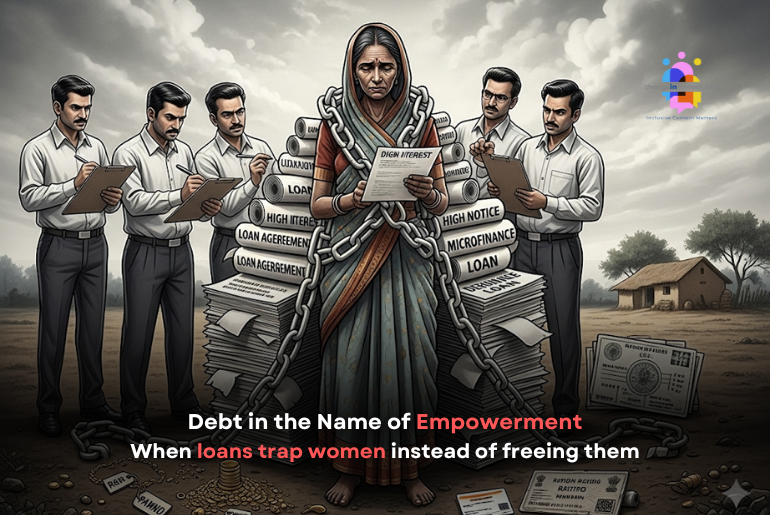
The exploitation of women through microfinance debt traps is no longer a hidden issue. Instead, it is a crisis unfolding across India. The AIDWA survey reveals how debt, often taken in the hope of survival or to support small business growth, has become a vicious cycle of harassment, collateral loss, and financial insecurity. Far from bringing empowerment, these loans are systematically trapping women, particularly from rural and marginalised communities, into deeper poverty.
The scale of exploitation: Women in debt traps
Over the past year, the All India Democratic Women’s Association (AIDWA) carried out an extensive survey to understand the growing debt burden faced by women borrowers. The survey engaged over 9,000 women from 21 states, and its initial findings, drawn from 6,685 respondents across 15 states, were presented at the National Public Hearing on Women’s Rising Indebtedness and Microfinance Exploitation held in New Delhi on August 23–24, 2025.
The testimonies and data show how microfinance institutions (MFIs), including non-banking financial companies, small finance banks, and private banks, have trapped women in cycles of debt. Far from empowerment, these loans have left crores of women vulnerable to harassment, financial insecurity, and exploitation.
Rising debt and multiple loans
The AIDWA reports the widespread practice of taking multiple loans. Nearly 60% of women have borrowed from more than two institutions, while almost one-third owe money to over three. In many cases, women take fresh loans only to repay existing ones, sometimes their own, sometimes their husbands’.
The size of this debt is also alarming. Approximately 40% of the surveyed women hold loans exceeding ₹50,000, while another 40% owe between ₹1 lakh and ₹2.5 lakhs. Do note that 70% of women surveyed live in households earning less than ₹10,000 per month, and 90% earn below ₹30,000. For women earning less than ₹10,000 per month, repayment becomes impossible. Many are forced to pledge jewellery, house documents, Aadhaar cards, or ration cards as collateral.
The situation is no better for entrepreneurship. Over 30% of women borrowed to support small businesses, but only 5% were enrolled under the government’s MUDRA scheme. Even housing support under the PM Awas Yojana has not reached most families, with 25% of respondents reporting that they have borrowed for building or repairing their homes.
Borrowing for basic needs
Women borrow not to start or expand businesses but to survive. Despite holding ration cards, around 20% of respondents took loans just to secure food for their families. With limited support from public schemes, many also turned to debt for healthcare and education.
Barely 20% of women receive financial help for medical needs, while only 30% reported receiving aid for their children’s education. As a result, one-third of the surveyed women had borrowed for these two basic services.
AIDWA’s earlier 2021 study in Tamil Nadu also reported how women relied on loans during the COVID-19 pandemic to cover food, rent, medical costs, and tuition fees. Single women, including widows and divorcees, were the worst affected as they often supported entire families on their own. Many had to pledge Aadhaar cards, ration cards, or even pension books as collateral to secure loans. Others sold gold jewellery to clear debts. Weddings were postponed, and households were pushed into further financial distress.
Deregulation and the rise of MFIs
One of the report’s key findings is the role of government policies in fueling indebtedness. Deregulation by the Government of India and the Reserve Bank of India (RBI) has allowed MFIs and NBFCs to expand aggressively in rural areas. Public sector banks, instead of lending directly to women, have preferred to provide funds to MFIs. These institutions then lend to women at interest rates ranging from 22% to 26% or higher.
Exploitation of women through Microfinance debt traps: Policy gaps
Women in rural areas, particularly from marginalised backgrounds, have no choice but to rely on high-interest loans. According to the survey, 60% of the women come from rural communities. More than 40% are Adivasis and Dalits, 21% belong to minority groups, and 15% are single or widowed.
Perhaps the most disturbing revelation from the survey is the harassment women face when they cannot repay on time. More than 30% reported verbal abuse and repeated harassment through phone calls. One in ten had household goods seized by agents. Five out of every hundred women even reported physical or sexual assault. Such practices are criminal, but the lack of regulation has allowed these practices to continue unchecked.
A call to end MFI loot and debt traps
At the National Public Hearing, 19 women shared their personal testimonies, each reflecting not an isolated incident but part of a widespread pattern of intimidation and exploitation. The jury, comprising Justice Madan B. Lokur (Retd.), economist Prabhat Patnaik, journalist Pamela Philipose, advocate Kirti Singh, and trade union leader Thomas Franco, listened to these stories and drew attention to the MFI Loot. They noted that microcredit, once promoted as a tool of empowerment, has turned into a mechanism of exploitation. MFIs borrow at less than 10% from banks but lend to poor women at rates of 26% or higher.
The call for affordable credit as a right
The jury offered a series of reforms aimed at protecting women from further exploitation. They called for a legal right to affordable credit, urging banks to provide loans to women-headed households at an interest rate of 4%. They recommended priority loans of up to ₹5 lakhs without collateral, as well as access to loans up to ₹1 lakh for all Jan Dhan account holders.
They also stressed the need for interest rate regulation, including a legal ceiling of 4% for microcredit, and demanded that loans to MFIs should no longer qualify as “priority sector lending.”
The jury urged public sector banks to expand their rural presence, set direct lending targets for SHGs and MSMEs, and waive CIBIL checks for smaller loans. On borrower protection, they recommended making harassment by MFIs a punishable offence, providing free legal aid, and expanding financial literacy through women’s organisations.
Exploitation of women through Microfinance debt traps: Closing thoughts
The findings of AIDWA’s survey expose a system that profits from exploiting women under the banner of empowerment. Without urgent reform, women will continue to pay with their labour, their jewellery, and even their safety for loans that were meant to “empower” them. If empowerment is to hold any meaning, it must free women from debt traps created in the name of progress.
As former general secretary of the All India Bank Officers’ Confederation (AIBOC) Thomas Franco pointed out, “When banks can write off ₹16.5 lakh crore of loans to the rich, when a few borrowers get loans at less than 5% interest, and when banks run on people’s deposits – Right to Credit for the poor, especially women, is a justifiable demand. Providing only 5 kg of rice or wheat cannot ensure dignity. Access to affordable credit is essential for justice.“
Changeincontent perspective
At Changeincontent, we believe that true empowerment cannot come from systems designed to exploit. Credit should be a right, not a punishment disguised as opportunity. If women are paying with their dignity for loans marketed as “progress,” then India needs not just reforms but accountability.
Disclaimer: The views expressed in this article are based on the writer’s insights, supported by data and resources available both online and offline, as applicable. Changeincontent.com is committed to promoting inclusivity across all forms of content. We broadly define inclusivity as media, policies, law, and history. It encompasses all elements that influence the lives of women and marginalised individuals. Our goal is to promote understanding and advocate for comprehensive inclusivity.
