India is home to one of the world’s largest LGBTQ+ populations, yet access to healthcare, education, and basic dignity remains deeply unequal. Stigma and lack of awareness continue to push many out of classrooms and hospitals. Amid this reality, LGBTQ+ sensitisation has emerged as a crucial tool to break barriers and build empathy.
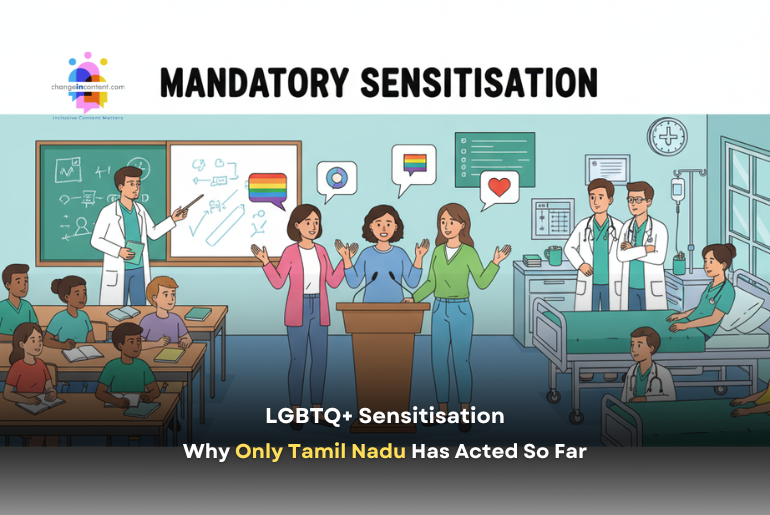
Tamil Nadu recently became the first and only state to make sensitisation mandatory in healthcare and education. The move raises an important question: if one state can act, why are others still silent?
Some official numbers
The only official data on India’s LGBTQ population comes from a 2012 government estimate, which put the number at 2.5 million. However, campaigns and surveys using tools like the Kinsey scale suggest the real figure could be over 135 million, nearly 10% of the country’s population. India is also home to one of the largest LGBTQIA+ communities in the world.
The IPSOS LGBT+ Pride 2021 Global Survey found that 17% of respondents in India did not identify as heterosexual. Despite their growing presence in society, they still struggle to access services that others take for granted, including basic healthcare and quality education.
LGBTQ+ experiences in Indian healthcare
India’s healthcare system often excludes LGBTQ+ people, whether knowingly or unknowingly. Men who have sex with men (MSM) show an HIV prevalence of 4.3%, compared to 0.3% in the general population. Yet stigma, high testing costs, and other barriers keep many from getting tested.
Nearly two-thirds of transgender people do not have access to treatment for sexually transmitted diseases (STDs). While 7.2% live with HIV, only 59% have been referred for testing, and just 33% have received counselling on treatment options. Even during the COVID-19 vaccination drive, many LGBTQ+ people could not register because they lacked valid photo identification.
Healthcare inequalities are a crisis of access.
Dalit transgender and intersex persons face more discrimination than their upper-caste counterparts. In a survey of Dalit respondents from southern states, 24% said they were denied treatment, 16% reported that doctors lacked knowledge about their condition, and 4% said they had suffered physical or sexual assault from healthcare providers.
In one survey, 22% of LGBTQIA+ respondents reported discrimination from healthcare providers, leaving many hesitant to seek care even when they need it. Moreover, access to insurance schemes like Ayushman Bharat also remains restricted due to limited awareness, complicated procedures, and discrimination.
Dropouts, discrimination, and lost opportunities
Education remains another area of challenge, much like healthcare. The 2011 Census recorded a troubling literacy rate of 56.1% among the transgender community, well below the national average of 74.04%. In Kerala, 58% of transgender people are school dropouts.
Within schools, LGBTQIA+ students often face bullying, harassment, and discrimination. These experiences affect not only their academic performance but also their confidence and mental well-being. Surveys show that more than 60% of LGBTQIA+ students have faced such treatment because of their gender or sexual identity.
One study found that among 74 LGBTQIA+ students who reported harassment in school, 20% dropped out temporarily, creating gaps in their education. The same survey also revealed that out of 15 students who dropped out, only one managed to complete post-graduation.
A 2017 study by the Kerala Development Society, covering Delhi and Uttar Pradesh, found that 29.11% of transgender people in Delhi and 33.11% in Uttar Pradesh had never attended school. The same study showed that only 5.33% in Delhi and 4% in Uttar Pradesh had completed a graduate degree.
LGBTQ+ sensitisation in healthcare and education
When asked what could help improve access to healthcare and education, most respondents pointed to inclusion and LGBTQ+ sensitisation. In the Survey on Uniting Diversity: Shaping the Future of Legal Equality for LGBTQ+ in India (2024), 66% said they felt comfortable discussing their healthcare needs with trained providers. However, the shortage of professionals trained to understand LGBTQIA+ needs remains a serious gap. About 28% highlighted the absence of inclusive healthcare policies, and 31% noted that healthcare providers lacked awareness and sensitisation around LGBTQIA+ issues.
Why LGBTQ+ sensitisation matters
The need for sensitisation is equally necessary in education. Many students who dropped out reported that inclusive schools and trained teachers could have provided them with safe spaces and better opportunities to continue their studies. These experiences show why gender sensitisation must become a core part of healthcare and education systems.
Tamil Nadu leads the way in LGBTQ+ sensitisation.
Some progress is visible. A notable step came from Tamil Nadu, where the Tamil Nadu Medical Council (TNMC) recently directed all doctors, educators, and students to undergo sensitisation programmes on transgender health, LGBTQIA+ issues, and the rights and dignity of sexual minorities.
This move followed the release of the State Policy for Transgender Persons by Chief Minister M.K. Stalin, aimed at improving the community’s socio-economic conditions over the next five years. According to the TNMC circular, all Continuing Medical Education (CME) programmes in the state must now include mandatory sessions on transgender health and concerns related to the LGBTQIA+ community.
The circular allowed colleges and training centres to conduct sensitisation sessions either as standalone CMEs or as part of existing schedules. Institutions must also submit completion reports within 30 days, while TNMC will monitor progress by reviewing records and verifying compliance.
The training modules go beyond technical knowledge. They include best practices in medical education and clinical care, while ensuring that transgender and LGBTQIA+ community members share their lived experiences. By doing so, the initiative aims to foster empathy and dismantle the stereotypes that have long prevented healthcare from being accessible to many.
The final thoughts
Training professionals in healthcare and education to understand and effectively respond to the needs of LGBTQIA+ individuals is essential. Sensitisation helps them recognise bias, respond to specific needs, and provide support with respect and dignity. Programs like those introduced by the Tamil Nadu Medical Council serve as an ideal model for meaningful action. These programs combine technical guidance with lived experiences to foster empathy and break down long-standing stereotypes.
Schools and institutions must provide safe spaces where students can learn without fear, where teachers are prepared to support diversity, and where policies actively prevent discrimination. Gender sensitisation today will open doors and opportunities for LGBTQIA+ individuals tomorrow.
Changeincontent perspective
Tamil Nadu’s move proves that meaningful inclusion is not just possible, but also practical. By making sensitisation mandatory, it is setting a benchmark for healthcare and education systems across India. But policies cannot remain isolated. Until other states recognise the urgency of LGBTQ+ sensitisation, millions will remain excluded from essential services. Change requires not just circulars and guidelines, but a nationwide commitment to dignity and equality.
Also Read: These Indian cities ranked ‘Partially Open’ to the LGBTQ+ community.
Disclaimer: The views expressed in this article are based on the writer’s insights, supported by data and resources available both online and offline, as applicable. Changeincontent.com is committed to promoting inclusivity across all forms of content. We broadly define inclusivity as media, policies, law, and history. It encompasses all elements that influence the lives of women and marginalised individuals. Our goal is to promote understanding and advocate for comprehensive inclusivity.