
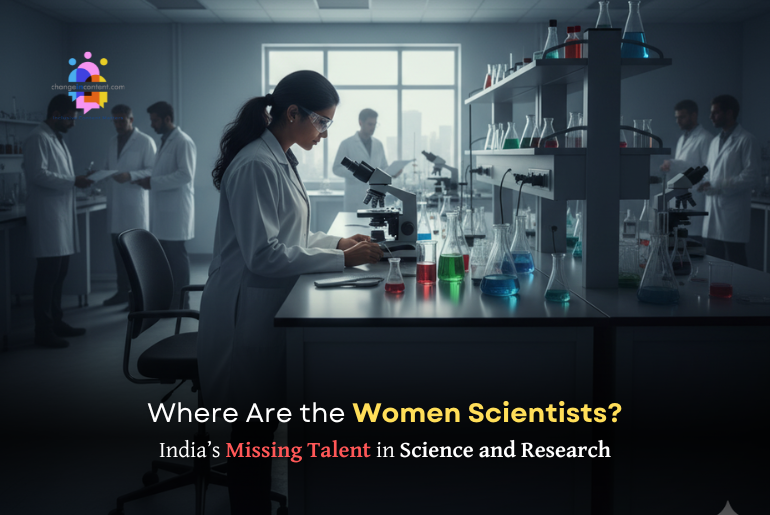
Researchers once conducted a long-term study in which they asked schoolchildren to draw a scientist. Over the course of fifty years, they collected 20,860 drawings from students between the ages of 5 and 18. In the earliest set, taken between 1966 and 1977, there were about 5,000 drawings. Out of all of them, only 28 showed women as scientists, and every single one of those was drawn by girls. In other words, less than 1% of students pictured a woman in a lab coat. The question demands to be asked: Where are the women scientists in India, and why do they remain invisible?
Over time, the drawings started to change. By 1985, 33% of girls were sketching women as scientists. By 2016, that number had increased to 58%. Boys, however, still mostly draw male scientists. Even today, about nine out of ten boys still sketch male scientists.
So what does a scientist look like in the eyes of children today? Increasingly, girls are drawing women. However, outside of these drawings and children’s imaginations, most scientists are still predominantly men. Women scientists remain underrepresented, face more struggles in getting funding on time, and are less likely to be seen at STEM conferences.
The missing numbers of women scientists in India’s research domain
A survey by BiasWatchIndia, which tracks gender bias in science, found that women form only 16.6% of scientists and faculty in higher education and research. The survey looked at 98 universities and institutes across the country. This representation of Indian women scientists is much lower than in most other nations.
UNESCO’s 2015 data showed that only 13.9% of researchers in India were women. In 2020, Swarup and Dey studied the top 20 STEM institutes in India, ranked by NIRF, and found women faculty made up just 11.24%. When we compare these older numbers with the recent median of 16.6%, it becomes evident that women’s representation has shown slight improvement over the last decade.
According to the Department of Science and Technology’s latest Research & Development Statistics report, out of 3.42 lakh R&D personnel in India, only 56,747 are women. Within the Ministry of Science and Technology itself, the Department of Science and Technology (DST) employs only 162 women. A 2024 state-wise list of DST institutions shows states like Haryana, Manipur, and Odisha reported no women researchers at all. Karnataka had the highest, but even there, the number was only 33, followed by Kerala at 31.
Who gets to be a ‘Top Scientist’ in India? Mostly Men
The Shanti Swarup Bhatnagar Prize is India’s highest honour in Science and Technology. First given in 1958 by the Council of Scientific and Industrial Research (CSIR), it is seen as a career-changing recognition. Every year, about 12 scientists under the age of 45 are chosen for this prize. It covers seven fields of science: physical, chemical, biological, medical, engineering, mathematics, and atmospheric sciences.
Out of 571 scientists who have received the prize since its beginning, 552 are men. Only 19 are women scientists. That means in more than six decades, women scientists have hardly made it to the list.
Why is the number so low? The process of selection plays a significant role in this. To be considered, a scientist must be nominated by individuals in influential academic positions, such as vice-chancellors, directors, deans, academy heads, members of the CSIR governing body, or past winners of the award. The problem is that most of these nominators are men. And when men dominate the nomination stage, they often overlook or fail to nominate their female colleagues.
Fewer women get nominated, and as a result, fewer women win. Even though women scientists are making valuable contributions in labs and research centres, their names rarely reach the final list.
One-third of Indian STEM conferences have NO women
A study by BiasWatchIndia, ‘Women’s Representation in Indian Academia and Conferences’, analysed 417 conferences and meetings across two phases, examining the number of women who appeared as speakers based on poster announcements.
In the first phase, from June 2020 to August 2021, the study reviewed 293 conferences. In Mathematics, 80% of conferences had no women speakers at all. Overall, 39% of all conferences during this period had no women on the stage. The study also found that 90% of Mathematics conferences and 60% of all conferences underrepresented women, meaning there were fewer women than expected, given the number of women in the field.
The second phase, spanning from August 2021 to March 2023, examined 124 conferences. There was some improvement. In Mathematics, the number of conferences with zero women speakers dropped from 80% to 25%. In Computer Science, it fell from 50% to 13%.
90% of Math conferences in Phase I had underrepresented women, but that number dropped to 50% in Phase II. The underrepresentation of women scientists in Computer Science conferences went from 69% to 38%.
Women left out of conferences
Overall, the data suggests that when people pointed out conferences that had few or no women speakers, it encouraged organisers to include more women. The proportion of conferences with zero women dropped from 46% in Phase I to 25% in Phase II. Still, women scientists remain underrepresented across almost all fields, showing that there is much more work to be done to achieve real gender balance.
Why women scientists in India struggle to get ahead
For a long time, STEM has been perceived as a male-dominated field. Even when women enter STEM fields, they are often quietly steered toward specific branches. Biology, botany, food science, and other so-called “soft” subjects are usually perceived as feminine, while physics, chemistry, mathematics, and engineering are viewed as the more traditional domains of men.
These stereotypes around what is “feminine” influence the choices girls make, and over time, they shape women’s motivation. Many grow up believing they don’t belong in math or hard science, which limits the paths they take later in life. Even today, people still believe women are not naturally good at math, and if a woman excels, people see it as an exception.
But cultural bias is not the only roadblock. One of the biggest hurdles for women in science is the time lost to caregiving and unpaid work. The years when women are expected to be most productive in their careers are also the years when family planning and childcare demand the most attention. Employers are aware of this, and it also contributes to discriminatory hiring practices.
The human side of exclusion
In India, many research grants and fellowships have strict age limits. Since women often carry more caregiving responsibilities in their late twenties and early thirties, they frequently miss the application deadlines. It may also explain why so few women win the Shanti Swarup Bhatnagar Prize, India’s top science award, which has an age cut-off of 45. For men, the path is easier. They don’t lose years to motherhood or long breaks in caregiving. By the time women return to full-time work, they have already lost a significant portion of the years that count for prizes and promotions.
Rohini Godbole of IISc Bengaluru has suggested an alternative solution: instead of measuring a scientist’s eligibility by biological age, consider their “academic age,” which refers to the years spent actively engaged in research. That way, women who take time away for caregiving are not automatically left behind. But is this change happening in India? Not yet.
The final thoughts
While more children today can imagine a woman in a lab coat, in India’s laboratories, conference halls, and award ceremonies, women are still missing. Representation has inched forward, but systemic barriers remain firmly in place.
The truth is simple: women are not absent from science because of a lack of talent. They are absent due to structural biases, cultural stereotypes, and systems designed around male-dominated careers.
If India truly wants to lead in science and innovation, it cannot afford to ignore half its talent pool. It must measure merit fairly, dismantle outdated barriers, and reimagine the recognition process. Only then will girls drawing women scientists today grow up to see those images reflected in real life.
Related Article: Why are women in STEM still disappearing?
Disclaimer: The views expressed in this article are based on the writer’s insights, supported by data and resources available both online and offline, as applicable. Changeincontent.com is committed to promoting inclusivity across all forms of content. We broadly define inclusivity as media, policies, law, and history. It encompasses all elements that influence the lives of women and marginalised individuals. Our goal is to promote understanding and advocate for comprehensive inclusivity.
