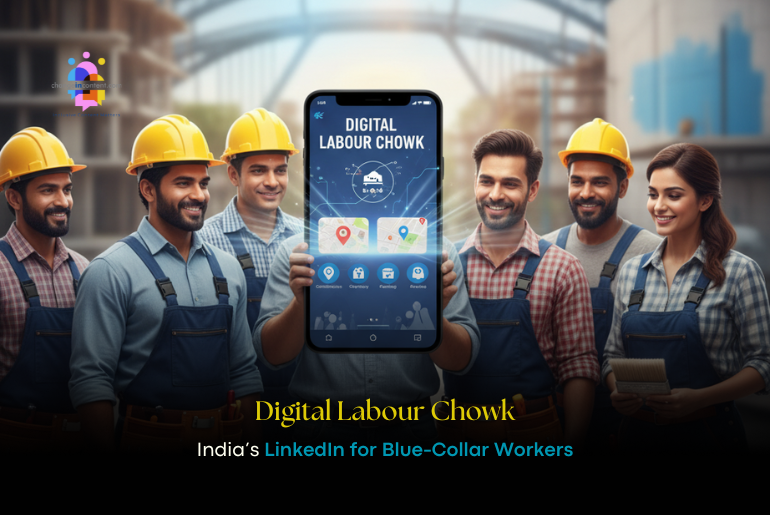
LinkedIn is a very popular social networking site among the business community. You may even call it a professional’s social media platform. Fresh graduates use it to find their first job, people returning from a career break turn to it to restart their journey, and experienced leaders use it to build networks, track industry trends, and explore opportunities. However, LinkedIn’s user base has historically been predominantly white-collar, which did influence how the platform grew and positioned itself.
India’s workforce is significantly larger than the white-collar corporate world, with estimates suggesting that over 300 million Indians are employed in blue-collar jobs. Despite their scale, these workers often struggle to find digital platforms that cater to their needs. This huge number is the gap that this app called Digital Labour Chowk fills.
Often described as India’s first online job portal for daily wage and blue-collar workers, it functions like a LinkedIn for the working class. It connects workers directly with opportunities, helping them find jobs with dignity and employers find reliable talent. Digital Labour Chowk brings the networking and visibility, long associated with white-collar professionals, into the hands of daily wage earners who form the backbone of India’s economy.
The story of Digital Labour Chowk
In 2020, while working at an NBFC in Noida, Chandrashekhar Mandal noticed something that unsettled him every day. Across the road from his office stood a labour chowk, where daily-wage workers gathered in the hope of finding work. Some waited under the harsh sun, others struggled through pouring rain, often without food or shelter.
One morning during heavy rain, Chandrashekhar watched hundreds of workers scramble for cover under trees and food stalls. The sight left him asking why these workers, who form the backbone of India’s workforce, had no reliable system to depend on.
The scene brought back memories of Chandrashekhar’s childhood in Bihar. He had seen his own relatives face the same uncertainty, leaving home every morning, unsure if they would find work. Even when they managed to get hired, they had no guarantee of fair wages, no way to verify employers, and very little safety, especially for women.
When COVID-19 struck, daily wage jobs disappeared, leaving workers with no fallback. That was when Chandrashekhar began to imagine an online space where these workers could find opportunities with more dignity and security.
From idea to launch
By September 2020, Chandrashekhar quit his finance job and started working on the idea full-time. His vision was to create a digital platform where daily-wage workers could connect directly with employers, instead of waiting endlessly at a physical chowk.
Chandrashekhar attempted to raise money through government schemes, such as Mudra loans and the Pradhan Mantri Rozgar Yojana, but to no avail. Soon, a Pune-based incubator believed in his vision and invested Rs. 10 lakh. That breakthrough gave him momentum. He later pitched his idea at the National Innovation Challenge, run by Hitachi India and the Kerala Startup Mission. His startup got selected, and he received Rs. 30 lakh in seed funding. This gave him the resources and confidence to launch his platform.
In March 2023, Chandrashekhar introduced Digital Labour Chowk to the market. The app functions like a LinkedIn for blue-collar workers, helping them find verified job opportunities and providing employers with access to reliable talent.
Inclusion meets innovation: A Digital Chowk for the modern age
Since its launch, Digital Labour Chowk (DLC) has helped over 1.5 lakh workers secure jobs. By September 2024, the platform crossed 1 lakh users and listed more than 3,000 job postings. According to founder Chandrashekhar Mandal, over 1,000 daily-wage workers now find employment each day through the app in states such as Bihar, Noida, and Delhi.
Through DLC, construction and daily-wage workers can create verified accounts using a mobile app that supports 15 regional languages. The platform is designed for construction companies and their workers, including masons, painters, carpenters, and others. Once registered, workers can:
- Search verified job listings
- Access health insurance plans
- Build digital resumes
- Enrol in government-approved upskilling programs
- Receive wages through formal banking channels
Digital Labour Chowk: How the platform works
DLC works much like popular portals such as LinkedIn or Naukri.com, but with a design suited to daily-wage workers. Employers or contractors register their companies, list job requirements, specify wages, and post opportunities on the app. Workers in the relevant location then receive instant notifications and can apply directly.
The platform operates through two separate apps: one for employers and one for workers. Contractors post a job alert and review applications. For workers, the app has been designed with extra care to make it easy and intuitive to use. Because many users are not highly tech-savvy, DLC relies on symbols and signs to guide them.
Workers download the app from the Play Store, verify with an OTP, choose their skill, set their preferred wage, and get immediate access to jobs tailored to their needs. The home screen filters opportunities based on skills and pay preferences, ensuring that every worker sees the most relevant options.
To make the process smoother, DLC introduced a recommendation engine that helps employers discover skilled workers, even those without smartphones. It ensures that workers without access to advanced devices are not left behind. The platform also introduced DLC Coins, a rewards feature that encourages positive engagement.
Turning informal work into a recognised opportunity
Across India, millions of workers earn their living as daily-wage labourers. Without formal records or verified employment records, these workers struggle to prove their skills or track their earnings. Employers, too, face challenges in finding reliable, skilled labour quickly.
The lack of structure creates multiple problems. Workers have no guarantee of fair wages or timely payment. Many people are unable to access benefits such as health insurance, Social Security, or government schemes. Women workers face additional vulnerabilities due to unsafe working conditions and limited verification options. The informal nature of the sector leaves millions caught in a cycle of insecurity, day-to-day survival, and lack of recognition.
That is why initiatives like Digital Labour Chowk were needed. Platforms that provide a verified digital identity for workers can bring structure and fairness to the sector.
Initiatives like this transform the unorganised labour sector into a system where workers are recognised, protected, and empowered. They make daily wage work more predictable, allow workers to plan ahead, and provide opportunities for growth. Most importantly, they give dignity to a workforce that has long remained invisible, proving that technology can serve not just corporate professionals, but the millions of workers who keep the country moving.
The final thoughts
Bringing jobs, recognition, and safety to daily-wage workers, Digital Labour Chowk shows what inclusion in the digital age truly means. Every worker deserves to be seen, valued, and empowered. Digital Labour Chowk makes this possible, and ChangeinContent applauds this transformative initiative, which is shaping India’s workforce for the better. It is a reminder to invest in people who keep our economy moving, the daily-wage workers, tradespeople, and skilled labourers whose efforts often go unseen but form the backbone of our society.
Changeincontent perspective
Digital Labour Chowk is more than a startup story. It is a statement about inclusion. For decades, India’s blue-collar workers have been largely invisible in the digital economy, despite being the backbone of the country’s growth. By providing them with verified identities, structured opportunities, and recognition, DLC demonstrates how technology can break down barriers of class and access. The real test now is whether policymakers, employers, and investors will amplify such efforts to make dignity at work a reality for all.
Related Read: The State of Women in the Blue-Grey Collar Workforce 2025: 52% of women intend to leave within a year.
Disclaimer: The views expressed in this article are based on the writer’s insights, supported by data and resources available both online and offline, as applicable. Changeincontent.com is committed to promoting inclusivity across all forms of content. We broadly define inclusivity as media, policies, law, and history. It encompasses all elements that influence the lives of women and marginalised individuals. Our goal is to promote understanding and advocate for comprehensive inclusivity.