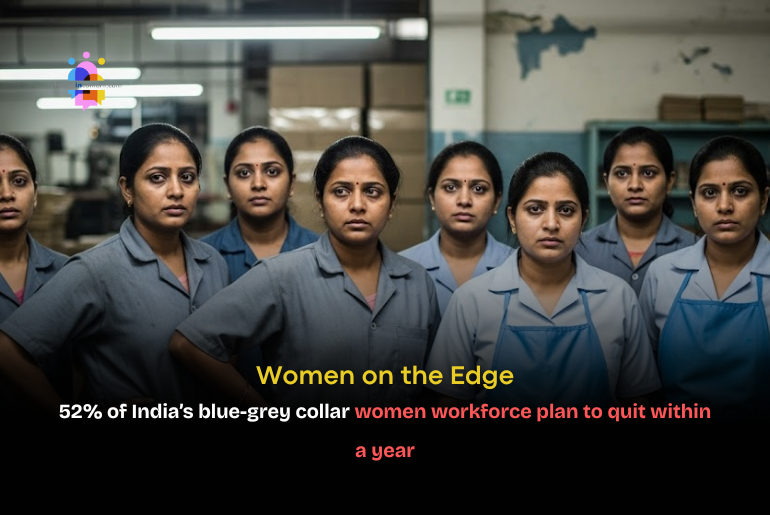
The discussion around gender and labour often overlooks a critical segment: women in the blue-grey collar workforce. From warehouses to shop floors, banks to backend offices, women are holding up the invisible backbone of India’s economy. Yet their struggles are often ignored. The state of women in the blue-grey collar workforce holds a mirror to the inequality, burnout, and systemic gaps they navigate every day.
India’s workforce has seen a steady rise in the number of women taking up blue and grey collar jobs. Nearly 3.9 million women are now part of this segment, contributing across sectors like retail, manufacturing, services, and BFSI. However, while the numbers are growing, the challenges remain the same. Low wages, poor work conditions, long travel hours, and a lack of safety continue to push women out of jobs they want to keep.
The report
A new report, The State of Women in the Blue-Grey Collar Workforce 2025, by the Udaiti Foundation and Quess Corp Ltd, says 52% of women in the blue and grey workforce intend to stay in their jobs for less than a year.
The State of Women in the Blue-Grey Collar Workforce 2025 surveyed 10,620 current women employees (referred to as associates), 1,575 former women employees, and included in-depth interviews with 19 current associates at Quess, India’s largest flexi-staffing company. All current women respondents work under formal contracts, earn at least the minimum wage, and receive social security benefits such as Provident Fund and ESIC medical insurance.
Why women in the blue-grey collar workforce are quitting so soon
One of the most worrying insights of the report is how early women quit. Among those who have been in their jobs for less than a year, 52% said they plan to leave within the next 12 months. In contrast, only 3% of women who have stayed longer than two years say the same. This shows that once women settle in and feel stable, they’re far more likely to continue. The real challenge lies in keeping them through that difficult first year.
Without proper support, many women do not stay long enough to build stability or gain experience. But when they do get through the initial period, they tend to continue. The problem is not women’s willingness to work. It is about whether the system is built to help them stay.
Many women who quit don’t return to work
Of the 1,575 women who left Quess Corp in the last six months, only one in three found another job. The rest are now out of the workforce.
The main factor is the absence of suitable job opportunities. The cost of stepping out of the house for work is high. If the job doesn’t meet basic expectations, such as decent pay, safety, growth opportunities, and manageable commutes, many women choose to stay home.
Pooja Goyal, founding CEO of the Udaiti Foundation, said, “Women aren’t leaving because they lack capability; they’re leaving because we haven’t yet built the infrastructure and designed workplaces for their success.”
Wages are too low to build stability
Women in blue and grey collar roles earn only about 70% of what their male counterparts make. Even more concerning, 80% of currently working women said they save nothing or less than ₹2,000 a month. This shows that many women are working just to get by, with little room for financial security or future planning.
The report also found that women earning more than ₹20,000 were 21% less likely to quit early than those earning below that amount. For women who left their jobs, better pay remains the top reason that could bring them back. Around 42% said they would consider returning to work if they received better pay.
Commute challenges and safety concerns
Transport is another major issue. 61% of women depend on public transport, and 57% say they face serious problems because of it. These include long travel times, unsafe routes, and a lack of transport after dark. For many, this becomes a dealbreaker. Some turn down promotions, while others quit altogether just to avoid the stress of commuting.
Safe and affordable housing is hard to find for single, migrant women, especially outside South India. Only 15% of women surveyed live in hostels, and in other parts of the country, the number drops to just 8%. Even those staying in company hostels report problems. One in five said they still face mobility issues due to poor connectivity and unreliable transport options.
Basic infrastructure, like CCTV cameras, proper lighting, and clean restrooms, plays a key role in how safe women feel at work. Yet 1 in 3 women reported feeling unsafe due to the absence of these facilities. The problem is worse in field and manufacturing roles, where break areas and restrooms often don’t meet basic standards. Among women with over a year’s experience, those who feel unsafe are 52% more likely to quit within the next year.
Rigid work culture and lack of flexibility
An unsupportive work environment is another major reason for exits. About 29% of respondents said they found their workplace culture lacking, and many pointed to inflexible rules as the main problem. Women want flexible hours, part-time opportunities, or work structures that allow for family responsibilities. These needs will only grow as the workforce ages and caregiving duties increase.
Skilling and growth opportunities
Women want to grow in their careers, but few have the right tools to do so. Around 21% of women said they feel stuck in their current roles and want better opportunities. Many of them are graduates or postgraduates, yet only 11% are currently pursuing any skill-based training. There’s a big gap between what women want and what they can actually access.
The report also shows that upskilling leads to better opportunities. Among women who left Quess and went through functional training, 65% were able to land new jobs with salary hikes of over ₹4,000.
What will bring women back to blue and grey collar work?
The State of Women in the Blue-Grey Collar Workforce 2025 report asked 1,575 former women employees what could motivate them to return. Their responses offer a clear view of what the blue and grey collar workforce must prioritise.
About 42% said they would return for better salaries. 20% wanted jobs located closer to home, while 18% said access to training or skill-building opportunities would influence their decision. Flexibility at work mattered to 17% of the respondents, and 3% said they would consider rejoining if reliable childcare support were available.
The future of India’s blue and grey collar workforce depends on how well employers and policymakers respond to these needs.
Conclusion: Supporting women in the blue-grey collar workforce
Women’s participation in blue and grey collar jobs has seen a small rise, moving from 16% in 2020–21 to 19% in 2023–24. While this shows some progress, women still make up only one out of every five workers in these roles. This gap highlights how much more needs to be done. Increasing their participation is important, but that alone is not enough. Women also need the right support systems, such as safe workplaces, fair pay, transport access, and growth opportunities, to stay and succeed.
The Udaiti Foundation has stressed that India cannot reach its full economic potential without women. As the country works towards becoming a $30 trillion economy, including more women in the workforce is not just about equity. It is a practical and urgent need for sustainable growth.
The Changeincontent perspective
At Changeincontent, we believe that inclusion must extend beyond glass offices and boardroom diversity drives. Women in the Blue-Grey Collar Workforce deserve the same attention, infrastructure, and policy support as their white-collar counterparts. They are not just workers; they are contributors to India’s economy, safety net providers for their families, and proof of what women can achieve when systems work with them, not against them. To build a $30 trillion economy, we must start by securing the first mile of the workforce.
Also Read: The 80% gender gap in blue-collar jobs: The underrepresentation of women continues.
Disclaimer: The views expressed in this article are based on the writer’s insights, supported by data and resources available both online and offline, as applicable. Changeincontent.com is committed to promoting inclusivity across all forms of content. We broadly define inclusivity as media, policies, law, and history. It encompasses all elements that influence the lives of women and marginalised individuals. Our goal is to promote understanding and advocate for comprehensive inclusivity.