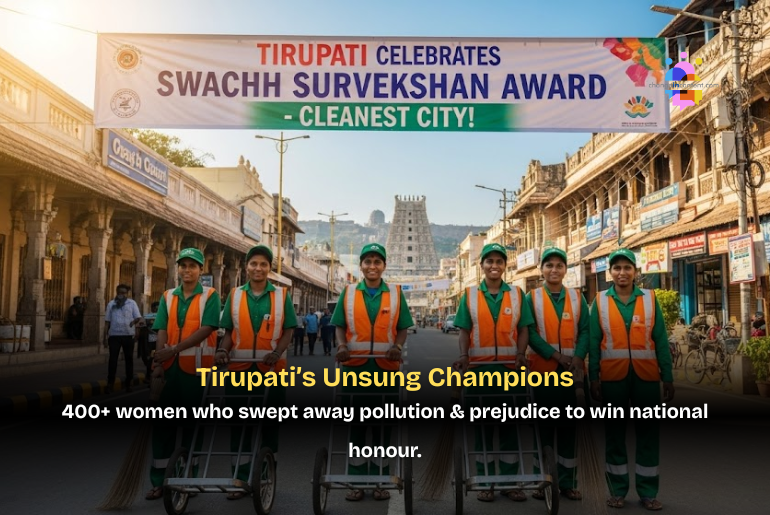
In a powerful convergence of civic determination and women’s empowerment, the temple city of Tirupati has been awarded the Presidential Award in the Swachh Survekshan Super League 2024–25 (population category: 3–5 lakh). But far from being just a top-down victory, the credit truly belongs to the over 400 women sanitary workers whose tireless, sunrise-to-sunset dedication transformed municipal sanitation into a model of consistency and community pride. The nation is now calling it Swaccha Honour for Tirupati women sanitation workers.
Their stories (of grit, resilience, and quiet leadership) are a testament to what inclusive workforce policies can achieve. Yet their recognition also prompts deeper questions: beyond triumphant headlines, does our society truly value these women? Are their efforts sustainable? Or will they remain invisible once the awards fade?
Swaccha Honour for Tirupati women sanitation workers: Early mornings, heavy brooms, greater impact
At 5 a.m., before the city awakens, Tirupati’s women sanitary workers are already sweeping streets, clearing debris, and collecting waste door-to-door across the city’s 31.5 km radius. Most of these women learned from class V and below. With a daily waste generation of 252 tonnes and a municipal population of 5.5 lakh, the task is immense.
Women like P. Subbamma, who has served for 23 years after losing her husband, say little about hardship; instead, they speak of pride and discipline. M. Gangamma, fifth-grade educated, credits the support of the civic leadership. They especially credit the Municipal Corporation Commissioner, who regularly visits workers in the field, listens to them, and keeps morale high. Such solidarity has helped these women grow confident in managing almost all sanitation tasks, except vehicle operation, while also supporting their families.
Leadership that walks the wards
Tirupati Municipal Corporation Commissioner N. Mourya adopted a hands-on leadership style during the Swachh Survekshan drive. He was visiting wards daily between 5:30 and 8 a.m., engaging directly with the workers, guiding processes, and helping to boost team spirit. This daily engagement was integral in achieving 100% door-to-door garbage collection. That was a crucial parameter in the national survey.
The result of this effort was that Tirupati clinched the Presidential Award. The award was presented by President Droupadi Murmu in New Delhi, with municipal and state leaders receiving the accolade on behalf of the city. It was Tirupati’s third consecutive year winning such recognition, a rare feat, cementing the city’s cleanliness leadership.
More than clean streets: Women empowered
This achievement is not merely about sanitation; it’s about Dignity Through Work. For these women (most from economically marginal backgrounds), this government-recognised role offers consistent income, formal identity, and a space in the public realm. Significantly, women now constitute over 60% of the municipal sanitation workforce. That highlights both representation and opportunity in a traditionally male domain.
Every worker, from Subbamma to T. Bagavathi, who sends her children to school despite limited education, speaks of taking pride in work that sustains a pilgrimage city. Moreover, they talk about how the work supports their families’ futures. Through their routines, they embody Changemakers among the unsung.
Yet, beyond awards: Are we listening enough?
Even as Tirupati shines nationally, the broader picture of sanitary workers in India raises critical concerns. While Swachh Bharat Mission-Urban has sought to formalise employment, provide training, and extend social protection, the voices of these frontline workers remain rarely heard outside of recognition ceremonies.
When cleaners earn praise, do we pause to hear their challenges? Do we think enough about health risks, lack of long-term benefits, and work-related injuries? Do we ensure their welfare remains central once awards expire? Tirupati’s success is a model, but will it translate into lasting upliftment across India’s sanitation workforce?
Conclusion: Swaccha Honour for Tirupati women sanitation workers is a turning point or a moment?
The Swaccha Honour for Tirupati women is more than a victory lap. It is a powerful example of DEI in action with formal recognition and elevation of women in public-facing roles that matter. For Changeincontent readers, the message is clear: empowerment begins when visibility meets tangible support.
But this recognition must extend beyond applause. If the women who clean our cities remain invisible in policy, health, and welfare schemes, then even the brightest awards can dim. Let Tirupati’s story inspire more than admiration, and let it demand systemic change that honours these women daily, not just during award season.
Also read: Sustainability by Indian Women: How the average Indian woman made sustainability a daily habit.
Disclaimer: The views expressed in this article are based on the writer’s insights, supported by data and resources available both online and offline, as applicable. Changeincontent.com is committed to promoting inclusivity across all forms of content. We broadly define inclusivity as media, policies, law, and history. It encompasses all elements that influence the lives of women and marginalised individuals. Our goal is to promote understanding and advocate for comprehensive inclusivity.