
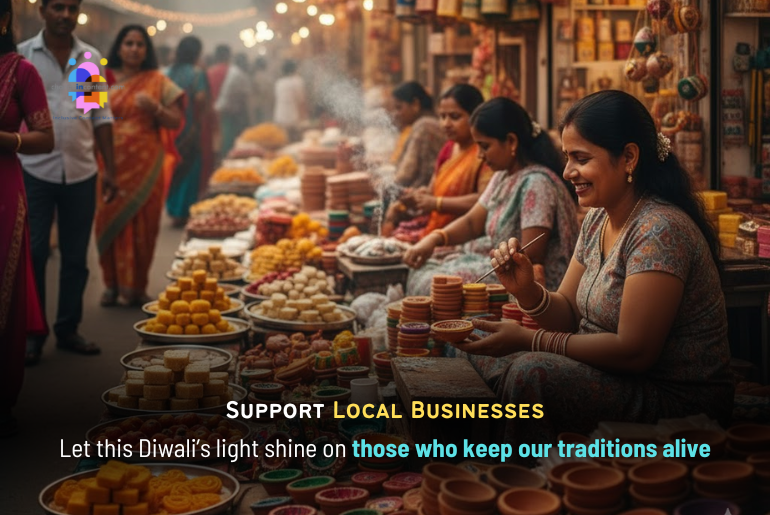
Every festive season in India, we celebrate abundance: lights, colours, gifts, sweets, and shopping. Yet beneath the sparkle lies an unseen economy that truly keeps our festivals alive. From the local diya maker in Varanasi to the small sweet shop in Jaipur, millions of small businesses and artisans rely on festive sales to sustain themselves throughout the year. Together, they drive a parallel economy that fuels jobs, craftsmanship, and community well-being.
This year, as Diwali spending is expected to touch ₹2.19 lakh crore (an 18% rise from last year), it is time to ask: where does this money really go? Do we want our festivals to power small Indian businesses, or do we want them to feed billion-dollar global platforms through flash sales and “festive discounts”?
Why support local businesses? Understand the numbers
If there is one thing that defines India, it is our rich and diverse festivals. In the past few months, Onam, Ramzan, Ganesh Chaturthi, Navratri, and Karva Chauth have all played a significant role in boosting the economy. This year’s Karva Chauth alone generated approximately ₹28,000 crore (US$3.16 billion) nationwide, with Delhi contributing nearly ₹8,000 crore (US$901.81 million).
Ganesh Chaturthi added another ₹20,000 crore to the economy, with Hyderabad alone contributing ₹5,000 crore and supporting more than 20,000 families. Durga Puja generated around ₹40,000 crore, primarily from West Bengal, while the food and beverages sector during the celebrations contributed an additional ₹50–60 crore. Even smaller festivals, such as Raksha Bandhan, generated approximately ₹400 crore in business, sustaining nearly 4,000 families in Gujarat.
Over the last few years, business during the festive season has increased significantly. People spent around ₹15,000 crore in 2023 and about ₹22,000 crore in 2024. A survey by the community platform LocalCircles estimates that festive spending in 2025 will be around ₹2.19 lakh crore. That marks an 18% increase from last year. Yet, a question remains.
Are we truly supporting local artisans and small businesses, or are we simply feeding the profit engines of large corporations through their massive festive sales? As online discounts flood the market, it becomes harder to tell how much of this economic boom actually reaches the people who keep our traditions alive, particularly the small shop owners, local craftsmen, and neighbourhood vendors who depend on these festivals for their livelihood.
The hidden cost of convenience during festivals
The next big festival is around the corner. Diwali. Across India, preparations have already begun. Markets are lighting up, families are cleaning homes, and shops are filled with sweets, diyas, and decorations. Many business owners view this time as an ideal opportunity to introduce new products or expand their customer base.
Industry surveys indicate that nearly 30% of SMEs plan to launch new offerings during Diwali, aiming to capitalise on the surge in consumer spending. In 2023, the Confederation of All India Traders (CAIT) reported that Diwali sales totalled approximately ₹1.5 lakh crore. Businesses that offer festive discounts often record up to 40% higher sales than usual.
These discounts and “mega sale” offers mostly appear on e-commerce platforms like Amazon, Flipkart, Nykaa, and even Swiggy. Everywhere you look, there are deals, flat 50% off, buy one get one, cashback offers, and endless coupons everywhere on billboards, in inboxes, and on every app notification.
But this convenience comes with a cost. While consumers enjoy deals at the tap of a screen, small traders, roadside vendors, and artisans struggle to compete. The local diya maker who spends hours handcrafting lamps, or the neighbourhood sweet shop that prepares traditional mithai, often finds fewer buyers as people turn to pre-packaged, online-ordered products.
Ironically, the “discounted” product you buy online often costs more than what a local artisan sells it for. The difference is that the local artisan doesn’t have an app, a marketing campaign, deep discounts funded by large corporations, or a delivery network.
Handmade art struggles while imitations take over
Many artisans spend years perfecting their craft, whether it’s intricate metalwork, hand-painted diyas, embroidered fabrics, or clay sculptures. But their space in the market is shrinking fast. Machines and AI-generated designs have begun replacing handmade work, creating cheaper versions that flood the market without crediting the original creators.
A recent example was the “Prada Kolhapuri” controversy in 2025, when the luxury brand showcased leather sandals in its Spring/Summer collection that bore a striking resemblance to India’s traditional Kolhapuri chappals. Social media users, designers, and cultural commentators called out Prada for copying a heritage craft without proper credit or compensation. The backlash was intense, and many labelled it cultural theft.
However, at the same time, the same people who criticise Western brands often overlook the local artisans who craft genuine Kolhapuris by hand. When a big Western brand copies traditional Indian crafts, people loudly condemn it and call it “cultural theft.” They show public support for the local craft in principle. But in everyday life, they often fail to buy from or support the very artisans who create these traditional products.
Take Holi, for example. For years, China exported goods worth over ₹10,000 crore to India, from colours and plastic toys to water guns. Around 75% of these products originated from Chinese factories, effectively eliminating local competition. That wave of imports cost nearly 8 to 10 lakh Indians their jobs. Many small-scale manufacturers and traditional toy makers couldn’t survive the price war.
Why you should support local businesses (artisans) this Diwali
Amid all the shopping and festivities, the choices we make about what and where to buy can have a tangible impact on the economy as well as the livelihood of the local community.
Reduce environmental impact
Handmade products, such as clay diyas, wooden toys, and handwoven baskets, utilise natural materials and minimise industrial waste. Choosing these items reduces packaging, transportation, and carbon emissions compared to mass-produced alternatives.
Economic empowerment
Purchasing from local makers supports small workshops and family-run businesses. It creates jobs for weavers, potters, sculptors, and craftswomen, providing a steady income during festival seasons when demand is at its peak.
Promote financial independence
Buying from women-led SMEs empowers them to control their earnings, make informed business decisions, and break the cycle of financial dependency. During festivals like Diwali, when demand for decorative items, clothing, and gifts rises sharply, these sales provide critical income that can cover household expenses, education, and healthcare.
Keeps money in the community
When you spend money at a local shop, most of that money stays in the community. Local businesses utilise it to pay employees, purchase supplies from nearby vendors, and invest in the local area. In contrast, multinational corporations often send profits to other branches or headquarters, sometimes in different countries, which means less money circulates locally.
Local businesses do more than sell things. They connect people. When you shop at a local store, you meet the shop owner, learn their story, and often see them supporting other local businesses. For example, a local sweet shop might source ingredients from a nearby farmer, or a tailor might recommend a local fabric store. These connections create a chain of support that keeps money and opportunities within the town. Even a small purchase at a local store contributes to a bigger network of support that benefits everyone.
Support local businesses: Let our festivals reflect the economy we believe in
As Diwali approaches, it is worth reflecting on our choices. As we step into another festive season, it’s worth asking what kind of economy we want to build. Do our purchases truly celebrate the spirit of the festival, or do they merely serve convenience? Supporting local businesses may not come with cashback rewards, but it ensures that the people who keep India’s festivals alive can continue their craft for years to come.
Changeincontent perspective
At Changeincontent, we believe that “vocal for local” should not just be a slogan. Instead, it should be a structural shift in how India celebrates growth.
Supporting local businesses is not charity; it is a conscious act of economic justice. Every purchase from a local shopkeeper, craftswoman, or family-run business redistributes wealth, sustains jobs, and preserves cultural heritage.
The numbers are clear: when you spend ₹100 at a local business, nearly ₹68 stays within the community. When the same is paid on an e-commerce platform, it is less than ₹20. It is not just economics; it is empathy in action.
Festivals have always been about the connection between people, families, and communities. Today, connection also means choosing the small-scale manufacturer over the multinational sale, the handmade diya over the plastic import, the shopkeeper who knows your name over an algorithm that knows your spending pattern.
Because when local thrives, India thrives.
Also Read: 96% from Bharat: How digital tools for women entrepreneurs are fueling a silent revolution.
Disclaimer: The views expressed in this article are based on the writer’s insights, supported by data and resources available both online and offline, as applicable. Changeincontent.com is committed to promoting inclusivity across all forms of content. We broadly define inclusivity as media, policies, law, and history. It encompasses all elements that influence the lives of women and marginalised individuals. Our goal is to promote understanding and advocate for comprehensive inclusivity.
