
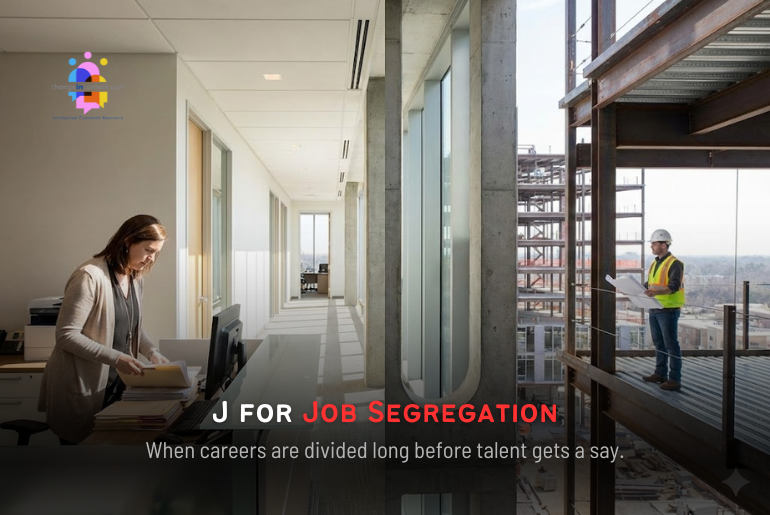
Long before people talk about pay gaps or leadership pipelines, careers are already being divided. J for Job Segregation examines how gender subtly shapes who enters which roles, who advances, and who remains stuck. From the subjects children are encouraged to study to the jobs adults are expected to “fit into,” segregation begins early and hardens over time.
This is not always about choice. It concerns access, expectations, and a system that continues to steer women toward lower-paid, lower-power roles while reserving growth-intensive industries for men.
What is Job Segregation?
Job segregation refers to a pattern in which women and men occupy different types of jobs, fields, or levels of seniority, rather than sharing equal access to the full range of opportunities. It arises from long-standing gender norms, social expectations, educational biases, and workplace cultures that push each gender toward specific roles.
Job segregation happens in two major ways, and both influence women’s economic opportunities:
Horizontal job segregation:
Horizontal segregation refers to the practice in which women and men work in different types of jobs. Women and men stand on different lines of work. Many women work as teachers, nurses, receptionists, front-desk staff, social workers, or HR executives. At the same time, men work as engineers, electricians, drivers, pilots, mechanics, police officers, or construction workers. If you look closely, it shows how girls are encouraged toward caring jobs and boys are directed toward technical or physical jobs.
Vertical job segregation:
Vertical segregation means women and men work in the same field, but men hold most of the senior or high-status positions. This happens due to workplace bias, unequal promotion opportunities, lack of support for working mothers, and assumptions that leadership fits men more. For instance, schools have many women teachers, but men often become principals or school administrators.
Women, work, and wage inequality
Jobs dominated by men usually pay better than those dominated by women, even when both require similar education, skills, and effort. In fact, women make up about two-thirds of workers in low-wage jobs, positions that pay as little as $7.50 per hour.
The gender gap is particularly pronounced in high-paying fields such as STEM (Science, Technology, Engineering, and Mathematics). According to the National Science Board, women make up less than a third of the science and engineering workforce. These are among the fastest-growing and most lucrative careers, highlighting a clear imbalance in access to well-paying opportunities.
One reason behind this imbalance is the way households influence education choices for boys and girls, a phenomenon known as gendered human capital investment. This is not just about the level of education, but also the type of education. For example, the All India Higher Education Survey (AIHES) 2021–22 data indicate that far fewer women enrolled in technology and engineering courses than men. However, women were much more likely to study subjects such as sociology, the humanities, or the arts.
Because women are less likely to pursue technical or STEM education, their employability in high-paying technical jobs remains lower. Over time, this contributes to job segregation, where women are clustered in certain jobs and men in others, reinforcing both pay gaps and limited career opportunities.
How to avoid job segregation in the workplace
Job segregation often determines who gets access to high-paying roles, leadership positions, and growth opportunities, leaving women and gender minorities concentrated in lower-paying or less influential roles. To break this pattern, companies need to address gender disparities actively at every stage.
Recruitment and Hiring
The first step in reducing gender disparities is fair recruitment. Organisations can use blind screening methods that remove names, gender markers, or other identifying details from resumes, thereby ensuring that candidates are evaluated solely on their skills, qualifications, and experience. Interview processes should be standardised and conducted by diverse panels to reduce unconscious bias and ensure that all candidates have an equal chance, regardless of gender.
Compensation
Pay equity is critical in tackling occupational segregation. Companies should conduct regular audits to identify and correct gender pay gaps. Transparent salary ranges allow employees to understand the earning potential of each role. It will ensure that compensation is based on skills and responsibilities rather than gender.
Work-Life Balance
Flexible working arrangements, remote work options, and supportive parental leave policies help employees balance career and caregiving responsibilities. These are things that disproportionately affect women. Encouraging all genders to take parental leave promotes shared responsibilities. It also reduces career penalties associated with caregiving.
Company Culture
An inclusive workplace culture results in equality. Employees need to feel that their voices are heard. Moreover, they must feel that the company values their contributions. At the same time, the company will not tolerate harassment or discrimination. Regular surveys can identify perceived gender disparities, while leadership accountability ensures that policies are implemented effectively.
Summing up the thoughts on J for Job Segregation
Horizontal and vertical job segregation affect women’s participation in the workforce. It ranges from the types of jobs they enter to the extent to which they can advance. Understanding and addressing job segregation helps us see why many women face limited options, lower pay, and slower career progress, even when they have equal or higher qualifications.
When companies actively remove gender-based barriers, they create a better workplace. It is a place where talent, skills, and ambition determine success, not gender.
ChangeInContent will return with the next letter in The A–Z of Women and Work as the series continues.
Changeincontent perspective
Job segregation reminds us that inequality does not always announce itself loudly. Sometimes it looks like guidance, encouragement, or “practical choices.” At Changeincontent, we believe absolute equality begins when career paths are not quietly filtered by gender. When women are free to enter, stay, and rise in every field (not just the ones society deems acceptable), work finally reflects talent rather than tradition.
Also Read: Imposter Syndrome: Why it hits women and LGBTQIA+ harder.
Disclaimer: The views expressed in this article are based on the writer’s insights, supported by data and resources available both online and offline, as applicable. Changeincontent.com is committed to promoting inclusivity across all forms of content. We broadly define inclusivity as media, policies, law, and history. It encompasses all elements that influence the lives of women and marginalised individuals. Our goal is to promote understanding and advocate for comprehensive inclusivity.
