
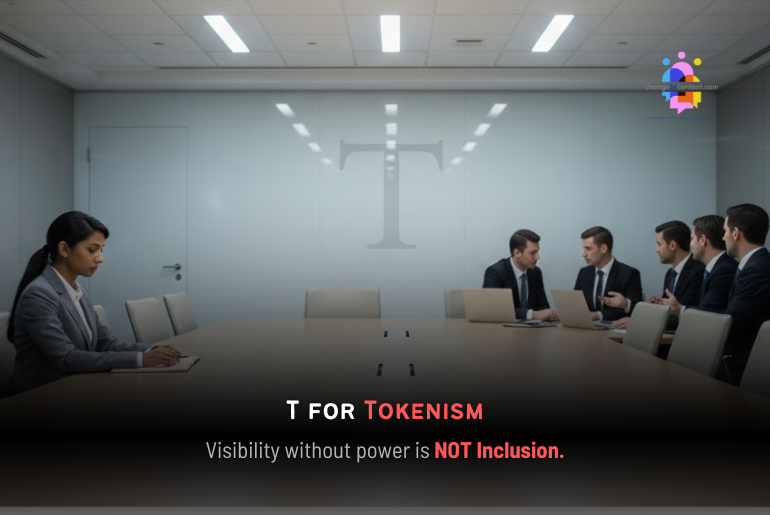
As we move to T in our A–Z of Women and Work, we confront one of the most performative practices in modern workplaces: Tokenism. Many organisations speak confidently about inclusion. They release statements, announce targets, and highlight success stories. Yet for many women, real access to power, influence, and opportunity remains unchanged.
Tokenism allows workplaces to look progressive without becoming fair. It replaces structural change with symbolic presence and confuses visibility with equality.
What do we mean by Tokenism?
Tokenism is the practice of including women or other marginalised groups in workplaces solely to create the appearance of diversity, without providing them with real influence, equal opportunity, or meaningful participation in decisions.
Organisations may appoint individuals to visible roles, committees, or leadership spaces, but they do not share authority, resources, or control with them. As a result, representation exists in form, not in function. Tokenism prioritises branding and compliance over genuine inclusion, structural change, or power redistribution.
How Tokenism shows up at work
Very often, a single woman or person from a marginalised community serves as the sole representative on every committee, review panel, or discussion space. At the same time, organisations highlight a single visible success story to claim progress, while many others in the same community continue to face barriers. Meanwhile, teams invite marginalised employees when they need representation, branding, or campaigns, but these employees do not have a seat at the table when leaders make important decisions.
The Companies Act 2013 requires listed companies to appoint women to their boards. Instead of using this as an opportunity to build more substantial leadership diversity, many companies treat it as a compliance task. Around 77% of BSE 200 companies place only one or two women on their boards simply to meet the legal requirement, not to build balanced leadership.
Even when women enter these spaces, they do not hold the same kind of control. Only about 11% of women directors in BSE 200 companies have executive positions, compared to 65% of men, which means women sit in the boardroom but do not drive decisions in the same way.
On top of this, more than one in three women directors experience dismissive attitudes, stereotyping, and clear signs of tokenism. Their presence is trivialised, and people subtly question their capability, credibility, or commitment rather than engaging with their expertise.
Tokenism peaks during “Celebration Moments” like Women’s Day
Tokenism is most visible on days such as International Women’s Day and other diversity observances. Many organisations now treat it as a performance checkpoint. They plan campaigns, design posters, invite speakers, and issue strong public statements about equality. Employees see celebrations, themed events, and social media messaging. But these celebrations often do not align with the realities within the organisation.
Many workplaces celebrate women publicly while they continue to:
- Pay women less for the same work
- Promote, mentor, and sponsor men faster despite similar performance
- Assign women more unpaid emotional and support work
- Overlook women for critical roles and decision-making responsibility
- Ignore harassment, bias, and unsafe behaviour
Women’s Day, in particular, often becomes a branding exercise. Companies highlight inspiring stories of women, but they do not review pay structures. They organise appreciation lunches, but they do not question why women leave mid-career. They talk about strength and resilience, but they do not reduce unrealistic workloads or recognise burnout.
This is the core problem. Workplaces want the image of inclusion without changing the conditions that create exclusion.
How to address and avoid tokenism
Tokenism ends when inclusion produces real results. That means equal access to leadership pathways, influence over key decisions, and visible change in power structures.
Give real power, not just a seat
Meaningful inclusion begins when representation comes with authority. Organisations must ensure that women and other marginalised employees are not assigned to roles that serve only as a visibility exercise. They should participate in core decision-making, lead critical portfolios, manage budgets, and hold responsibilities.
Resource and strengthen inclusion work
Many workplaces create gender or inclusion roles but leave them underfunded and sidelined. To avoid tokenism, leadership must treat inclusion as substantive work, not an add-on. This means allocating dedicated budgets, qualified teams, and senior-level backing.
Make inclusion part of everyday decisions
Organisations must embed inclusion into hiring, promotions, leadership pipelines, policy design, and performance evaluation. Inclusion should shape the agenda from the outset and at the grassroots level, rather than being added after decisions are made.
Make bias and tokenism visible
Track patterns of tokenism and subtle exclusion. Use surveys, exit interviews, and feedback mechanisms to identify where employees feel overburdened, underheard, or used symbolically. Share these insights with leadership and tie corrective actions to accountability metrics.
Address Women’s Day tokenism
Every year, Women’s Day brings speeches, campaigns, flowers, and hashtags. But once the day ends, many workplaces return to unequal workloads, limited leadership opportunities, and symbolic gestures instead of structural change. Token celebration does not create progress. Real commitment shows up in policies, pay, sponsorship, safety, and everyday respect. Women do not need one day of appreciation. They need systems that work for them all year.
Read how and why changeincontent.com advocates for #NoWomensDay.
The final thoughts
Tokenism undermines the promise of inclusion. Representation without authority, visibility without influence, and celebration without structural change create workplaces that appear fair but continue to limit opportunity for women and other marginalised groups. Real progress requires sustained commitment.
The A–Z of Women and Work continues. ChangeInContent will be back with the next letter to explore more issues that impact workplaces.
Changeincontent perspective
Tokenism is not progress. It is delay disguised as inclusion. When workplaces celebrate representation without sharing power, they protect existing hierarchies while appearing equitable. Women do not need symbolic seats or seasonal appreciation. They need authority, influence, safety, and fair systems every day of the year. Until inclusion changes who decides, who leads, and who benefits, it remains cosmetic.
Disclaimer: The views expressed in this article are based on the writer’s insights, supported by data and resources available both online and offline, as applicable. Changeincontent.com is committed to promoting inclusivity across all forms of content. We broadly define inclusivity as media, policies, law, and history. It encompasses all elements that influence the lives of women and marginalised individuals. Our goal is to promote understanding and advocate for comprehensive inclusivity.
