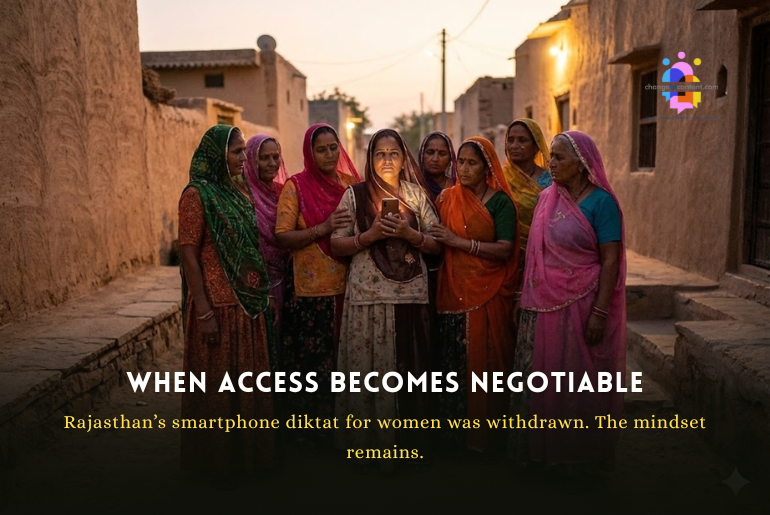
Ban on Women Using Smartphones: The news travelled faster than the rule ever could. In Rajasthan’s Jalore district, a caste panchayat made an announcement. The Panchayat announced that married women across 15 villages would be barred from carrying camera-enabled smartphones from Republic Day 2026.
The announcement triggered immediate public anger and a familiar question: when families worry about children, fraud, or “bad influence”, why does the solution so often begin with restricting women? Within days, village elders met again in Gazipur and rescinded the directive, stating that it had been misunderstood and that there was no intention to bind them.
The announcement and the restriction
The original proclamation emerged from a meeting held in Ghazipur village, in the Bhinmal area of Jalore. The community body behind it is the Sundhamaata Patti panchayat of the Chaudhary community. The idea, as reported, was blunt: women and girls should use only keypad phones for calls and avoid carrying smartphones at weddings, social gatherings, or even routine neighbour visits. The restriction was specifically around camera-enabled phones.
There was a carve-out, but it came with a leash. School-going girls may use phones for study at home, but not outside. The stated “why” focused on children’s screen addiction, eyesight concerns, and the belief that children were overusing women’s phones.
The list of villages included Ghazipur, Pawali, Kalda, Manojiyawas, Rajikawas, Datlawas, Rajpura, Kodi, Sidrodi, Aldi, Ropsi, Khanadewal, Savidhar, Hathmi Ki Dhani, and Khanpur.
The backlash was not just “online noise”
The proclamation drew sharp criticism from women’s rights voices and social activists. A circulated video of the announcement further amplified it. The outrage was not only about smartphones. It concerned a deeper pattern: invoking “community consensus” as a pretext to discipline women in public while calling it “protection.”
Even if the enforcement mechanism was vague, the message was not. A restriction of mobility often begins with a restriction of tools. The phone becomes the modern version of the gate, the veil, the curfew, the permission slip.
The ban was withdrawn on 25 December 2025. Here is what changed
On 25 December 2025, a meeting of village elders in Gazipur was held, and the Panchayat withdrew the restriction unanimously, according to reports. The elders argued that the intent was to keep children in mind. However, the decision was “misunderstood”. They also claimed no one was bound to follow it. Moreover, they cited concerns about cyber fraud and exploitation as part of the broader anxiety around smartphones.
The reversal is important because it demonstrates that pushback is effective. Social pressure can move “custom” when custom overreaches.
Changeincontent perspective: The problem is not the phone.
If the real worry is children doom-scrolling, the answer is parenting norms and digital boundaries, not gendered bans. If the genuine concern is cyber fraud, the answer is digital safety education. The other solutions are reporting pathways and community awareness. It is not stripping adult women of a tool that increasingly functions as their bank, workplace, helpline, and link to the world.
A smartphone is not leisure for many women. It is access. Moreover, it is the ability to navigate a hospital visit, receive a government benefit, run a small business, learn a skill, speak to a friend without a gatekeeper listening, or call for help at the right time.
When a community seeks to “solve” modern problems by restricting women’s access to technology, it implicitly signals what it believes women are: liabilities to manage, not citizens to trust.
What this episode indicates about exclusion in 2025 India
This is what makes the story bigger than one panchayat. A diktat like this survives because it aligns with a social instinct. An instinct that says control the woman, and you control the family’s reputation, the household’s routine, the community’s “order”. The language may shift from honour to eyesight, from shame to screen time, but the target remains the same.
If anything, the speed of the reversal should become the headline lesson for policy, civil society, and platforms alike. Communities need digital literacy infrastructure as urgently as they need roads. Otherwise, fear will continue to masquerade as governance.
Closing thoughts on the ban on women using smartphones
The Panchayat in Jalore withdrew the ban on women using smartphones. However, the mindset that produced it did not vanish with the meeting minutes. The real work now is not celebrating a reversal. It is about building communities in which women’s access to technology is treated as ordinary. At the same time, it is about building communities that address genuine concerns about children’s screen habits and cyber fraud. In the process, we must not make women pay the price for everyone else’s anxieties. Because when access becomes negotiable, equality becomes optional.
Also Read: Barriers for women in tech: Why progress headlines hide a stubborn reality.
Disclaimer: The views expressed in this article are based on the writer’s insights, supported by data and resources available both online and offline, as applicable. Changeincontent.com is committed to promoting inclusivity across all forms of content. We broadly define inclusivity as media, policies, law, and history. It encompasses all elements that influence the lives of women and marginalised individuals. Our goal is to promote understanding and advocate for comprehensive inclusivity.