
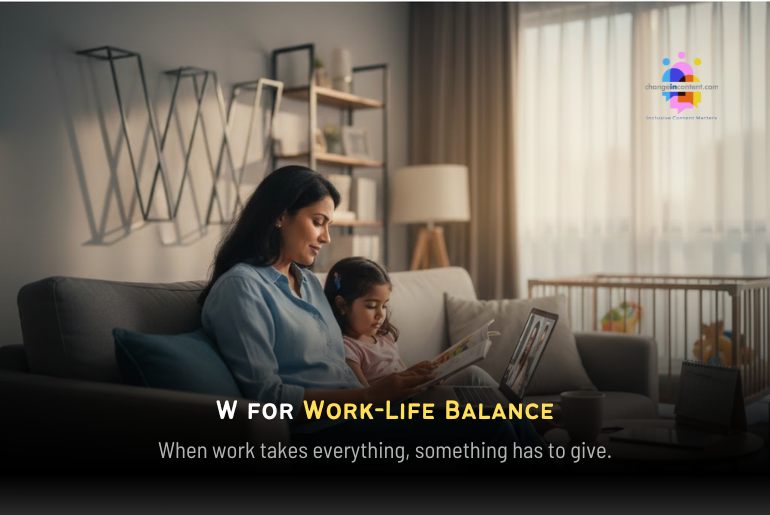
The A–Z of Women and Work cannot be complete without the W for Work–Life Balance. And it is even more relevant at a time when balance is deteriorating. In India, long working hours are no longer an exception. They are becoming the expectation. People often frame overwork as dedication and mistake exhaustion for ambition. The recent public conversations around extreme workweeks only made visible what many employees, especially women, already live with daily.
For women, work–life balance is not about optimisation or time management. It is about survival, continuity, and whether staying in the workforce is even sustainable.
Is toxic work-life balance normalised?
Poor work–life balance is getting normalised because work expectations have become extreme. Burnout rates the rising worldwide. A Gallup study found that 76% of employees feel burned out. The World Health Organisation says that depression and anxiety due to poor work-life balance cause a loss of nearly 12 billion working days every year.
In India, particularly in the corporate and IT sectors, employees often work well beyond the standard 40-hour workweek. Reports state that IT employees regularly cross 50 hours. According to KCCI data, half of IT professionals work more than 9 hours per day, and 3 out of 4 miss important family events due to work.
Why do women pay a bigger price?
For many women, poor work–life balance will determine whether they continue working or are pushed out of the workforce. Unlike many men, women are often expected to manage two full-time roles at the same time. One is their paid job. The other is unpaid work at home, such as running the household, raising children, caring for elders, handling emotional and family responsibilities, and ensuring that everything outside work remains cohesive. None of this is recognised as work, but it still takes time, energy, and mental space.
When workplaces demand long hours, constant availability, late-night meetings, and endless pressure, women do not have the option to simply switch off after work. They go home to another shift of responsibilities. Over time, this becomes exhausting. It is not just physical tiredness. It affects mental health, emotional well-being, confidence, and even how women see their future careers.
A study by The Udaiti Foundation and the Centre for Economic Data & Analysis shows that 36% of women leave their jobs due to poor work–life balance, compared with only 4% of men. Women are not leaving because they are less committed or less ambitious. They are leaving because workplaces are not supporting them.
Workplaces also fail women in terms of support and safety. The same study highlights that nearly 59% of companies do not even have mandatory Internal Complaints Committees. Around 37% do not provide proper maternity benefits. Only 17.5% offer childcare facilities.
How do we ensure better work–life balance?
Work–life balance does not improve by telling people to manage time better or be more disciplined. It improves when workplaces change the way they function, leaders take responsibility, and systems support people instead of draining them.
Create realistic work hours and workloads
Work–life balance begins with the amount of work people are expected to do. If long working hours, late nights, weekend work, and constant availability become the norm, burnout will become the norm as well. Workplaces need to set clear working hours and stick to them. Teams should not treat staying late as a sign of dedication. Leaders need to plan more effectively, set realistic deadlines, and avoid glorifying overwork as a success mantra or a form of hustle.
Respect boundaries and personal time
Employees should not feel guilty for logging off on time. Work should not follow people everywhere. Constant emails, late-night messages, emergency calls, and just five-minute meetings after work all slowly destroy balance. Respecting personal time means letting people disconnect. It means understanding that people have families, health needs, and lives beyond office walls.
Flexibility
Flexibility should help women, not harm their careers. Many women require flexible scheduling, remote work options, or hybrid models at different life stages, particularly during pregnancy, childcare years, elder care, or personal health needs. But flexibility is meaningful only when it does not come with judgment, slow promotions, or fewer opportunities.
Change workplace culture, not just rules
Even the best policies will fail if workplace culture shames women for needing support. Women must not feel guilty for leaving on time, requesting flexibility, or prioritising health and family when necessary. Leaders need to normalise balanced working, set better examples, and actively challenge bias. A supportive culture helps women feel welcome, valued, and safe to stay.
Share the load at home
While this is not something your employer should do, it is a critical part of why women struggle with work–life balance. Even when workplaces are supportive, many women continue to shoulder most of the unpaid labour at home. This second shift means women often finish their official workday only to begin another round of responsibilities. Daily chores, parenting responsibilities, and emotional labour should be shared deliberately rather than left to women by default.
The closing thoughts
Work–life balance is an urgent need. In India, in particular, where overwork has slowly been normalised and even celebrated, ignoring balance comes at a high cost. It affects people’s health, mental well-being, family life, and long-term careers. It also pushes many women out of the workforce because they are expected to handle both paid work and unpaid care work without enough support.
If we truly want equal opportunity, better leadership representation, and profitable workplaces, we must support work–life balance through better policies, a supportive culture, and a mindset that respects life outside the office.
ChangeInContent will return with the next letter in The A–Z Glossary of Women and Work.
Changeincontent perspective
Work–life balance is not a personal failure. It is a systemic one. When organisations reward overwork, ignore care responsibilities, and dismiss health and rest as secondary, women pay the highest price. Many leave not because they lack ambition, but because the cost of staying becomes too high.
If workplaces want women to remain, grow, and lead, they must bring balance to systems, policies, and everyday culture, rather than treating this as an individual adjustment. Respecting life outside work is not generosity. It is fairness.
Disclaimer: The views expressed in this article are based on the writer’s insights, supported by data and resources available both online and offline, as applicable. Changeincontent.com is committed to promoting inclusivity across all forms of content. We broadly define inclusivity as media, policies, law, and history. It encompasses all elements that influence the lives of women and marginalised individuals. Our goal is to promote understanding and advocate for comprehensive inclusivity.
