
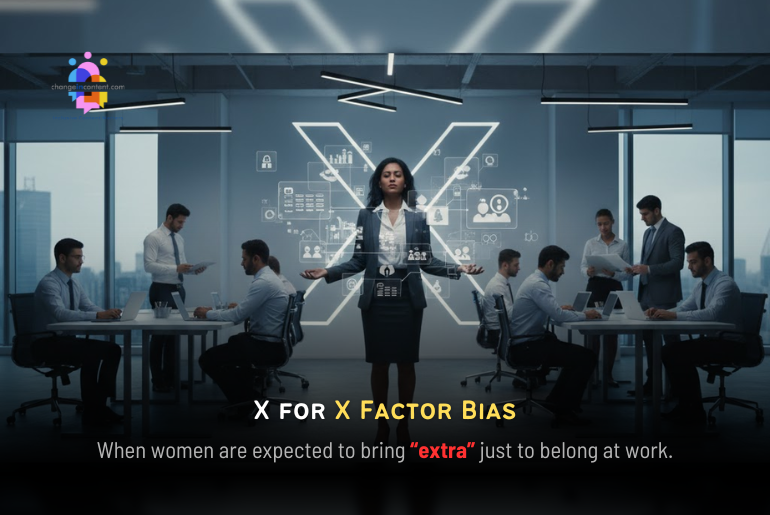
When people talk about women at work, the language often sounds complimentary. People often describe women as resilient, adaptable, emotionally intelligent, dependable, and capable of handling pressure. On the surface, these traits appear positive. But beneath this praise lies a deeper workplace problem. And there comes the X Factor Bias.
Many organisations expect women to bring something extra just to belong. Extra effort, Extra emotional labour, Extra tolerance, and Extra adaptability. This unspoken expectation is rarely acknowledged, rewarded, or questioned. It simply becomes the baseline.
This phenomenon is known as the X-Factor bias. It is the hidden assumption that women must overperform, endure more, and hold systems together to earn the same credibility that men receive by default. As part of our A–Z of Women and Work, X for X Factor Bias examines how this bias operates, why it is damaging, and what needs to change.
The double standard that women face
X Factor Bias treats women as if their presence at work always requires additional resilience, emotional labour, adaptability, and reliability. It assumes that women will:
- Manage teams and handle emotions
- Deliver results and keep everyone together
- Adjust quietly when systems fail
- Stay committed even when conditions are unfair
- Stay grateful instead of demanding equal treatment
1. Expectation of overperformance
Women often feel they need to do a little more to ensure that the workplace takes them seriously. They work harder to be promoted, take fewer risks because mistakes feel more costly, and remain visibly reliable to defend their credibility.
Women are consistently held to much higher standards. However, women are rated lower in leadership potential than men, resulting in a 14% lower likelihood of receiving promotions each year.
2. Emotional labour becomes invisible work
Women manage the human side of work. We are discussing checking team well-being, resolving conflicts, maintaining team morale, organising informal tasks, and taking on roles that keep the workplace functioning but do not count toward appraisals. Workplaces benefit from this emotional labour, but rarely acknowledge it.
3. “She Will Manage” becomes the default
When last-minute demands, stretched deadlines, or disorganised work arise, women are often positioned as dependable stabilisers. Teams assume they will adjust, absorb stress, and keep things running. It normalises tolerance and flexibility instead of building better systems.
4. The double judgment standard
Women face scrutiny from both directions. If they deliver results quietly, people treat it as expected. If they assert boundaries, ask for support, or refuse unreasonable demands, people treat it as a bossy attitude. The bias punishes women for both endurance and resistance.
5. The career penalty
Over time, these expectations slow growth. Women lose time, energy, and opportunity while carrying an unrecognised workload. Many step back not because of a lack of capability or ambition, but because they get exhausted negotiating bias, judgment, and social expectations alongside professional demands.
What needs to change?
Many working women already manage unpaid responsibilities outside work, such as childcare, household management, emotional labour, and family care. When workplaces add hidden expectations on top of this, women operate in a state of constant strain. It affects mental well-being, career continuity, leadership growth, and long-term participation in the workforce.
Count the invisible work
Organisations need to recognise emotional labour, team care, mentoring, crisis handling, and coordination as real contributions, rather than as natural traits that women are assumed to excel at. This invisible work keeps teams stable, improves culture, and supports performance, yet it rarely reflects in appraisals. Performance reviews must formally capture this labour so that it holds value, not just appreciation.
Set one standard for everyone
Women often need to overperform to gain credibility, while mistakes made by women get judged more harshly. At the same time, assertiveness gets questioned in women while rewarded in men. These uneven expectations create constant pressure and slow career progress.
Organisations must define clear, gender-neutral performance benchmarks, standardise evaluation criteria, use unbiased feedback systems, and train managers to identify bias in judgment. Equal work must come with equal expectations and equal consequences.
Identify gendered expectations
Meeting preparation, note-taking, coordination, organising celebrations, and checking in with everyone are tasks that cannot be automatically assigned to women. Rotate them. Make teams accountable. Statements such as “she can handle anything,” “she is the reliable one,” or “she manages chaos so well” sound positive but place women in caretaker roles.
Normalise shared emotional labour across teams
Emotional and care work is teamwork, not women’s work.
Organisations must consciously redistribute tasks, including conflict mediation, team communication, onboarding, nurturing, and morale-building. Train men to share relational work, not just technical or strategic roles. Make team well-being and coordination leadership responsibilities rather than silent expectations placed on women.
Who faces higher scrutiny for mistakes, and who receives more benefit of the doubt and understanding? Also, who gets assigned to high-impact roles? Who consistently manages coordination and care work? If the answers repeatedly place women in emotional and invisible labour and men in positions of power and opportunity, the organisation is operating with X Factor Bias.
The final thoughts on the X Factor Bias
X Factor Bias often looks positive on the surface, but it quietly pushes women to work harder, tolerate more, and stay grateful while carrying invisible labour. It is high time to eliminate the gendered expectation of constant extra effort in the workplace.
The A–Z Glossary of Women and Work continues, and ChangeInContent will return soon with the next chapter in this series.
Also Read: Understanding Patriarchy and Feminism in India.
Disclaimer: The views expressed in this article are based on the writer’s insights, supported by data and resources available both online and offline, as applicable. Changeincontent.com is committed to promoting inclusivity across all forms of content. We broadly define inclusivity as media, policies, law, and history. It encompasses all elements that influence the lives of women and marginalised individuals. Our goal is to promote understanding and advocate for comprehensive inclusivity.
