
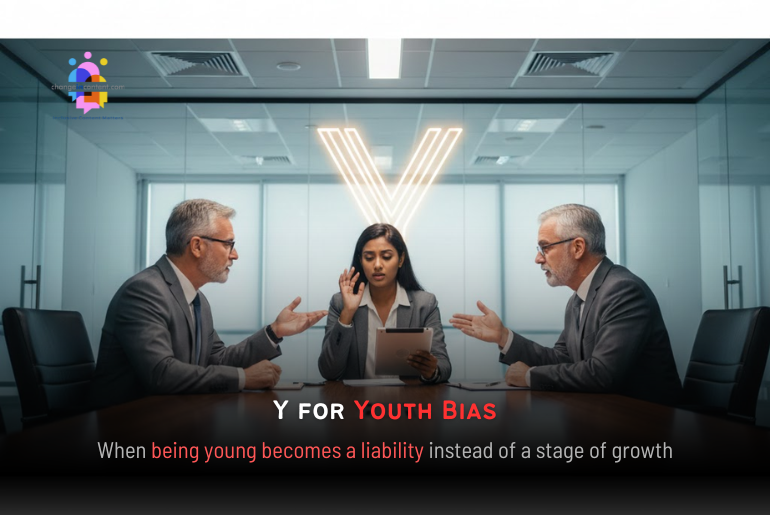
When we talk about age bias at work, the conversation usually centres on older women being pushed out, overlooked, or labelled as less adaptable. What rarely gets equal attention is what happens at the very beginning of a woman’s career. And the modern-day addition to it is the ‘Youth Bias.’
Young women entering the workforce face a distinct form of discrimination that combines age bias with gender bias. The workplace questions their competence, misreads their confidence as arrogance. Moreover, the workplace treats mistakes as evidence of unreadiness rather than as part of learning. That is Youth Bias.
As part of The A–Z of Women and Work, Y for Youth Bias explores the systemic underestimation of young women. We also examine why early-career discrimination has long-term consequences, and what workplaces must change to build fair, future-ready talent pipelines.
Youth Bias: The scale of the problem
More than half of young women, around 53%, say they have experienced discrimination at work. According to the 10th edition of the Women in the Workplace report by McKinsey and LeanIn.Org, 49% of women under 30 report facing age-related discrimination at work. In comparison, only 38% of women over 60 say the same. It shows that women who are just entering the workforce face more age-based bias than those nearing retirement.
Research from the charity Young Women’s Trust shows that 42% of young women have been offered zero-hours contracts, compared with 33% of young men, highlighting a clear gender gap in early-career stability. At the same time, 49% of young women worry about having insufficient opportunities to advance. Job security concerns are also rising, with 36% of young women worried about losing their jobs.
“Too young, too inexperienced”
Young women are often dismissed as lacking experience, even when they are qualified, trained, and performing well. Their ideas get questioned, their decisions get second-guessed, and their confidence is mistaken for overconfidence. Mistakes are treated as proof that they are not ready, rather than part of learning.
Patronising language undermines authority
Young women are often referred to as ‘girls’ or ‘kiddo’ instead of ‘professional,’ and addressed in a tone that assumes they need guidance rather than respect. These small acts erode credibility and make it harder for young women to be seen as capable contributors.
Appearance becomes a job requirement
In roles such as sales and customer-facing work, Youth Bias takes on an additional layer. Young women always hear comments on dressing better, smiling more, or “using their look” to appeal to clients. Their appearance is prioritised over their skills, reducing professionalism to performance and reinforcing the idea that their value lies in how they look rather than what they deliver.
Authority without trust
Young women are often given responsibility without absolute authority. They are expected to work long hours, meet targets, and stay available, but their judgment is not trusted. They are repeatedly asked to prove themselves, while older colleagues receive the benefit of the doubt.
The early career penalty
Facing constant doubt early on takes a toll. Youth bias undermines confidence, limits risk-taking, and pushes young women to stay quiet rather than be visible. Some leave roles or entire industries not because they lack ambition, but because they get tired of being underestimated from day one.
Challenging age-based assumptions in the workplace
When organisations treat age as a proxy for capability, young women end up spending their early careers proving their legitimacy rather than building skills and leadership.
Stop confusing age with capability
Experience matters, but age alone is not a measure of competence. Organisations must evaluate work based on output, skill, and responsibility, not assumptions tied to youth.
Set professional standards, not personal judgments
Young women are spoken to differently, corrected publicly, or addressed casually in ways that would not happen to older colleagues. Tone, respect, and authority should not fluctuate based on how young a woman looks or sounds. Patronising behaviour should be called out and corrected, not normalised as workplace culture.
Managers should intervene when young women are talked over, addressed informally, or excluded from serious discussions, and reinforce professional communication norms across teams.
Decouple women’s value from appearance
For young women, especially in sales, service, and public-facing roles, youth often becomes a justification for appearance-based expectations. This shifts focus away from competence and places additional emotional and physical labour on women.
No role should demand aesthetic labour as a substitute for skill. Performance metrics must focus on results, not visual appeal, especially in roles dominated by young women.
Protect young women from precarious work traps
Young women are overrepresented in temporary, contract-based, and zero-hours roles. While these arrangements are often framed as a source of flexibility or opportunity, they create instability and limit access to benefits, training, and promotion pathways.
Organisations should limit the use of insecure contracts for early-career roles and provide clear pathways to permanent positions. Stability enables young women to invest in skill development.
Challenging age-based assumptions is not about lowering standards or rushing careers. It is about applying the same standards to everyone, from the start. When organisations choose to value skill over age and respect over hierarchy, they do more than support young women. They build stronger, fairer workplaces for the future.
The final thoughts
Youth Bias shows that age-based discrimination is not limited to later stages of a career. For women, being young can also reduce trust and credibility at work. Addressing workplace inequality requires recognising how age and gender intersect, especially at entry and early-career levels. Youth should be treated as a stage of growth, not a flaw.
Until workplaces stop equating authority with age and stop policing young women’s competence and appearance, gender inequality will continue in the workplace.
The A–Z Glossary of Women and Work continues, and ChangeInContent will return soon with the final chapter in this series.
Also Read: Too young to lead? The harsh reality of age bias for younger women entering the workplace.
Disclaimer: The views expressed in this article are based on the writer’s insights, supported by data and resources available both online and offline, as applicable. Changeincontent.com is committed to promoting inclusivity across all forms of content. We broadly define inclusivity as media, policies, law, and history. It encompasses all elements that influence the lives of women and marginalised individuals. Our goal is to promote understanding and advocate for comprehensive inclusivity.
