
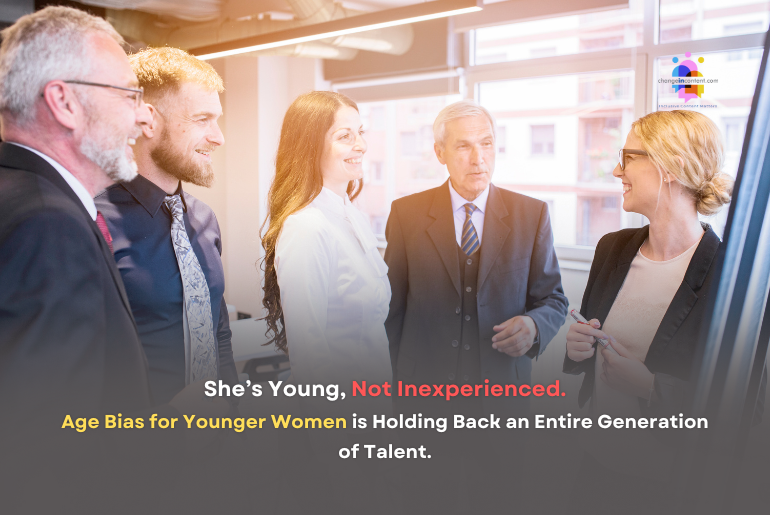
Age bias for younger women is a growing but often overlooked workplace issue. Unlike older professionals, younger women face a unique mix of discrimination based on both age and gender. The combination leads to assumptions, stereotypes, and an invisible credibility test they must constantly pass. What appears as inexperience is often just bias in disguise.
Understanding age bias for younger women
Women face age bias at work regardless of their age. Whether a woman is in her 20s or her 50s, she’s more likely to face ageism than any of her male colleagues. When women are young, they often encounter patronising language and nicknames, such as “kiddo,” “honey,” or “young lady.” However, as they grow older, the tone changes. Suddenly, the HR tells them that the company needs someone younger, someone with “fresh and new ideas”, as if experience no longer holds value.
Age bias at every stage of a woman’s career
The Harvard Business Review shows women are penalised for their age at every stage. Young women are dismissed as too inexperienced. Middle-aged women face assumptions about family responsibilities. Older women are viewed as out of touch or no longer worth investing in.
Even the way people see young women in the workplace reveals bias. Many report being mistaken for interns, assistants, or junior staff, even when they hold leadership positions. It is especially common among women of colour. Alongside this, many young women experience a phenomenon known as a “credibility deficit.” Companies do not take inputs seriously. Seniors doubt their knowledge and question their competence, often without reason. Moreover, all of this leads to an increase in reverse ageism.
Why reverse ageism hits women harder
Reverse ageism refers to the discrimination faced by younger workers, especially when their competence is questioned solely because of their age. This form of age bias shows up as backhanded remarks and doubts about a person’s skills, even when they’re qualified. While this affects many young professionals, it’s young working women who seem to feel the brunt of it the most.
In early career roles, many women encounter scepticism about their knowledge and authority. They have to prove themselves repeatedly to be taken seriously. This lack of trust early in their careers is a reason why working women are pushed out or held back at entry levels. As a result, they never get an equal chance to move up the career ladder.
Some data explaining the growing age bias for younger women
Men hold 52% of entry-level jobs, while women hold 48%. But do you know women earn 59% of all bachelor’s degrees and 63% of all master’s degrees? That’s more than half! In a fair system, companies should hire them at least as often as men for entry-level jobs, or possibly even more. However, that’s not what’s happening.
As roles become more senior, the number of women continues to decline. They make up 39% of managers, 37% of directors, 34% of vice presidents, and just 29% of senior vice presidents and C-suite leaders. These numbers have changed little over the last ten years. One reason behind this drop is reverse ageism.
Young men are often promoted based on what they could achieve someday. People say things like, “He has great potential,” even if he hasn’t proved much yet. But young women don’t get the same benefit of the doubt. Women are told to wait until they’ve done more, shown more, or “earned” it through extra effort. As a result, women, despite being equally or even more qualified, find themselves stuck in their careers.
The McKinsey report shows that age bias is strongest against women under 30
According to the 10th edition of the Women in the Workplace report by McKinsey and LeanIn.Org, 49% of women under 30 say they’ve faced age-related discrimination at work. In comparison, only 38% of women over 60 report the same. Younger women, who are just entering the workforce, are facing more age-based bias than those nearing retirement.
Interestingly, after the age of 60, both men and women experience ageism at roughly the same rate. However, before that age, especially in their 20s and 30s, women report much higher levels of ageism than men. So, the gender gap in how ageism is felt is worse for younger women. By the time they’re older, the difference between men and women evens out, but younger women face more unfair treatment early in their careers simply because of their age and gender combined.
In the words of Alexis Krivkovich, Senior Partner at McKinsey & Company, “Nearly half of women under 30 say that their age is impacting their opportunities, and that is much higher than the percentage of men reporting the same.”
Final thoughts: Age bias for younger women is everyone’s problem
Ageism, in all its forms, affects women as well as limits organisations too. Dismissing someone based on how old they look or how young they are cuts off real talent. It also prevents diversity in leadership. If nearly half of young women already feel their age is holding them back, even fewer make it to leadership later. That makes gender parity in the workplace harder to achieve, not because women aren’t capable, but because they’re never given a fair shot from the start.
Young women bring fresh ideas and older women offer experience. Both are assets, and both deserve a fair chance.
Changeincontent perspective
At Changeincontent, we believe age should never be a proxy for capability, especially when it comes to women entering the workforce. By ignoring the barriers placed on younger women, we are not only stalling their growth but also compromising future leadership. It is time to recognise reverse ageism as a real barrier to inclusion and tear down the stereotypes that make youth and femininity an occupational disadvantage.
Also Read: Household CEO, Office Employee: The double shift and invisible labour that no one acknowledges
Disclaimer: The views expressed in this article are based on the writer’s insights, supported by data and resources available both online and offline, as applicable. Changeincontent.com is committed to promoting inclusivity across all forms of content. We broadly define inclusivity as media, policies, law, and history. It encompasses all elements that influence the lives of women and marginalised individuals. Our goal is to promote understanding and advocate for comprehensive inclusivity.
