
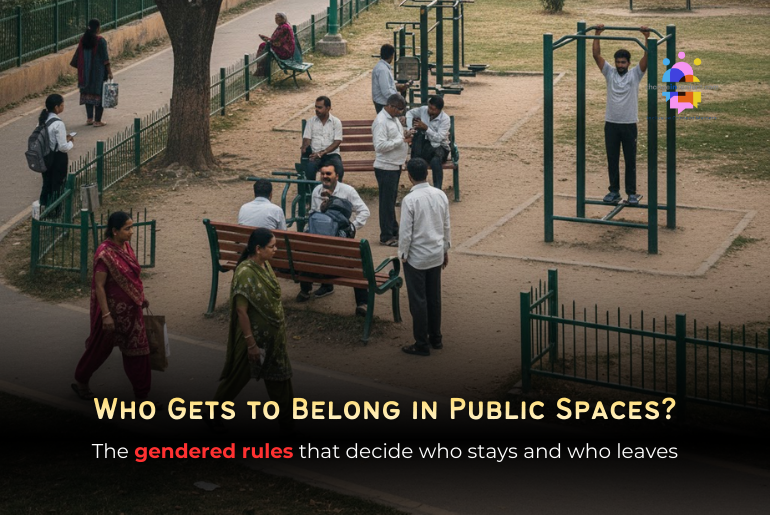
The gendered use of public spaces becomes visible when you stop looking at infrastructure and start noticing people.
Last weekend, while running an errand with my mother, I passed by our neighbourhood open gym. These open gyms are basically free workout spots, with no memberships or fees. They are also a chill place for the neighbourhood to hang out. What struck me immediately was who was actually using the space. Every bench, every machine, all taken over by middle-aged and older men. Not a single woman in sight. I brushed it off at first, thinking maybe it was just an evening thing.
A few days later, I passed by again, and nothing had changed. The same men were working out, sitting around, chatting like it was their regular hangout spot. Women were still missing. Adjacent to the gym is a public park, and even there, the scenario remained the same. No women hanging around. No young girls are playing. Just boys running around without a care.
After a point, it stopped feeling like a coincidence. One has to wonder whether these public spaces are genuinely open to everyone at all.
The ‘Unequal’ freedom of public spaces
A study on Gendered Use of Public Spaces in Urban and Rural Areas reports that men move freely through streets, tea stalls, bus stops, and markets in both urban and rural areas, which keeps these spaces largely male-dominated. Women, however, limit their time outside to necessary tasks such as commuting, caregiving, or basic errands.
Even if a park is close to home or an open gym has good facilities, many women still avoid staying there due to harassment, staring, comments, or being judged for being outside alone or for too long. Because of this, women often limit their time in public to what they perceive as necessary and safe, rather than using these spaces freely for rest or leisure.
Women usually treat public spaces as places to pass through. Conversely, for men, sitting at tea stalls, chatting on street corners, spending time in parks, or hanging around transit hubs feels normal and accepted.
Why do women move through cities differently than men?
Even in cities, where women have better access to physical infrastructure, problems like harassment and male control over public spaces continue. For example, Chennai has around 908 parks, 542 playfields, 27 indoor badminton courts, 73 outdoor courts, 30 indoor basketball courts, 44 football fields, 3 swimming pools, and 185 gyms that currently operate across neighbourhoods. Yet many young women say these spaces do not always feel welcoming or easy to use. [The Hindu]
The ‘Pink Zone’ problem
A big reason this keeps happening is who designs our cities. Indian cities barely have women planners, which means urban design often misses what women actually need. Streets lack proper lighting. Toilets stay poorly maintained. Parks have benches placed in isolated corners rather than in open, visible areas.
Because women don’t feel welcome or safe, they spend less time in public spaces. And when they don’t use a space, they also don’t get invited into conversations about improving it. It becomes a loop. Cities get designed without women in mind, women avoid public spaces, and their absence then gets used as proof that they don’t need those spaces anyway.
Why “Women-Only” is a shortcut, not a solution
We are starting to see more women-only spaces in Indian cities, such as pink autos, pink stores, pink parks, and pink everything. Basically, instead of making the whole city safe and inclusive for everyone, we just make colour-coded zones for women. It’s like saying, you can only be safe here, not everywhere else.
Using colours or separate spaces makes women feel like they’re the “weird exception” who needs extra protection. They do not feel like regular people who should be able to hang out anywhere in the city as men do.
Public spaces are supposed to be, you know, public.
Gendered use of public spaces: The closing thoughts
Public spaces are meant to be accessible and welcoming to all, yet for many women, they remain restrictive and uninviting. Safety concerns, social judgment, and gender norms influence how women navigate streets, parks, and recreational areas, often limiting their time and presence. Women-only zones, while offering temporary relief, address the symptom rather than the root cause, creating segregated solutions instead of true equality.
Only when public spaces are genuinely welcoming, safe, and navigable for everyone will women be able to engage fully with the city, as equal users of its streets, parks, and facilities.
The changeincontent perspective
At Changeincontent, we believe the gendered use of public spaces reflects how deeply inequality is embedded in everyday life. When women are absent from parks, gyms, streets, and transit hubs, it is not because they lack interest. Instead, it is because we did not build cities with their comfort, safety, or autonomy in mind.
We do not advocate for more pink zones or guarded corners. We advocate for cities where women do not have to calculate their presence. Inclusion should not require permission, timing, or justification. Public spaces must stop treating women as exceptions and start recognising them as equal users with the right to linger, rest, occupy, and exist without scrutiny.
Also read: Women still struggle for basic sanitation.
Disclaimer: The views expressed in this article are based on the writer’s insights, supported by data and resources available both online and offline, as applicable. Changeincontent.com is committed to promoting inclusivity across all forms of content. We broadly define inclusivity as media, policies, law, and history. It encompasses all elements that influence the lives of women and marginalised individuals. Our goal is to promote understanding and advocate for comprehensive inclusivity.
