
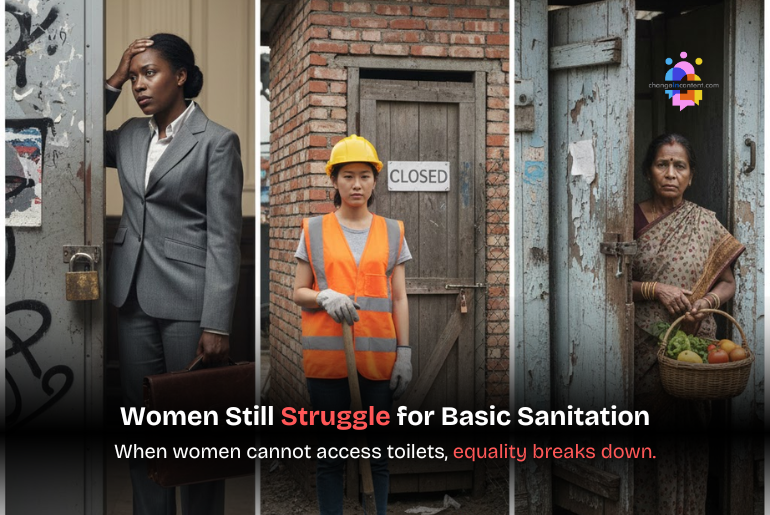
The struggle for basic sanitation remains one of the most ignored markers of gender inequality, even in spaces that claim progress. In October 2025, Japan appointed its first woman Prime Minister, marking a milestone. This late moment says a lot about where Japan stands on gender equality. In fact, the World Economic Forum ranked Japan 118th globally for gender equality, making it the lowest-ranked country among the G7 nations.
Months later, women Members of Parliament were still forced to petition for additional women’s toilets within the parliament building. At present, a single women’s toilet with two cubicles sits near the plenary chamber, serving dozens of women lawmakers. While the parliament building has nine women’s toilets, they collectively provide only 22 cubicles.
It is not a Japan-specific problem. From court complexes and construction sites to public markets and workplaces, women across countries continue to negotiate their dignity amid broken doors, poor lighting, shared facilities, and the absence of adequate sanitation.
In India (ranked 131st in the Global Gender Gap Report 2025), this struggle shows up every day. It quietly shapes where women can work, how long they can remain, and what risks they must bear merely to meet basic needs.
Women’s struggle for basic sanitation in Courts and Government buildings
Across India, many district courts still do not provide basic toilet access for women. Nearly 20% of district court complexes have no women’s restrooms at all. Even where toilets are available, adequate facilities remain rare. Only 6.7% of courts have sanitary napkin vending machines. In addition, many court toilets have broken doors and an irregular water supply, which makes daily use difficult and unsafe.
In some courts, toilets are within the chambers of judicial officers. As a result, male and female judges often use the same washroom. This setup raises serious concerns around privacy, comfort, and dignity.
A survey by the Vidhi Centre for Legal Policy covered 665 district court complexes across the country. The survey found that nearly 100 district courts had no washroom facilities for women. Among the remaining 585 courts with women’s toilets, approximately 60% were not operational.
Shared toilets, shared risk: Sanitation inequality in cities & villages
Across India, 12.5% of households still lack access to sanitation facilities. Most of these households are in rural areas. It means that more than 162 million people continue to lack access to basic sanitation.
Access to sanitation has improved in India’s cities, and most urban households now have some form of toilet facility. However, among the poorest urban households, nearly 1 in 3 households use a shared facility rather than a private toilet. It often affects women the most, as they must adjust their routines around availability, safety, and privacy.
Moreover, shared sanitation in cities typically involves numerous users. In urban areas, more than half of shared toilets are used by three or more households. In addition, 16% of these facilities serve ten or more families.
Poor maintenance limits the use of public toilets
Even where public toilets exist, poor maintenance often discourages regular use. Many facilities lack basic features that ensure safety, privacy, and hygiene. As a result, women frequently avoid these spaces, particularly in the late hours.
In Bengaluru, a survey of 48 public toilets points to these everyday problems. The study, titled The Big Bengaluru Toilet Survey [Bangalore Mirror], was conducted by Nguvu Change leader Archana KR. It found that 75% of the toilets lacked proper locks or latches on their doors. Without secure doors, users remain exposed and vulnerable.
Lighting remains another concern. Around 66%% of the toilets had inadequate lighting, which increases discomfort and fear, particularly for women who need to use these facilities at night. Poor visibility also reduces overall safety and limits access after dark.
During one of our exclusive conversations with Supreet K. Singh, Co-founder of Safecity, she highlighted that, during their community-driven safety activities, girls reported being unable to use the only available toilet without facing harassment or other violations.
The survey also recorded unequal user charges. Men paid Rs 2 per visit, while women paid Rs 5. This difference places a higher financial burden on women. In addition, 91% of women’s toilets lacked dustbins for sanitary napkin disposal, making menstrual hygiene management difficult in public settings.
Struggle for basic sanitation at women’s workplaces
The shortage of usable toilets extends into many workplaces, especially in sectors where women remain a minority. Women working in sales, fieldwork, and other male-dominated roles often struggle to access clean, accessible toilets during working hours. It affects their comfort, health, and ability to perform their jobs without stress.
India has more than 2,000 women working as loco pilots, yet access to toilets remains extremely limited. Fewer than 10% of locomotives are equipped with toilets. As a result, women loco pilots often work long hours without assured access to basic sanitation, especially on long routes and night shifts.
The situation is more difficult in construction and agricultural work. Many work sites do not provide separate toilets for women. In some cases, there are no toilets. Women workers then rely on open spaces or travel long distances, which wastes time and raises safety concerns. Some individuals go without drinking water for extended periods.
Long shifts, outdoor work, and limited privacy places added pressure on women in these sectors. Without proper sanitation facilities, workplaces fail to meet basic standards of dignity and care. As more women enter these fields, the lack of toilets remains a persistent barrier to safe and equal participation.
Changeincontent perspective
The struggle for basic sanitation is not solely about infrastructure. It is also about whose presence is assumed and whose needs are treated as optional. Toilets are political. They decide who can stay longer, work further, speak freely, or participate equally. When women plan their days around hydration, darkness, and fear, equality collapses into symbolism.
If institutions cannot guarantee women a safe toilet, they cannot claim to offer women dignity, opportunity, or power. Progress that does not reach the body is not progress at all.
The closing thoughts
From Japan’s parliament to India’s courts, workplaces, and public spaces, the lack of safe and usable toilets shows how systems still overlook women’s everyday needs. As 2026 begins, it is a good time to reflect on what equality really means for women. Numbers, titles, and policies matter, but real progress shows up in everyday life.
One of the simplest ways to measure equality is through access to basic facilities, like clean and safe toilets. Without these, women face persistent challenges at work, in public spaces, and even within institutions that are meant to symbolise progress.
Disclaimer: The views expressed in this article are based on the writer’s insights, supported by data and resources available both online and offline, as applicable. Changeincontent.com is committed to promoting inclusivity across all forms of content. We broadly define inclusivity as media, policies, law, and history. It encompasses all elements that influence the lives of women and marginalised individuals. Our goal is to promote understanding and advocate for comprehensive inclusivity.
