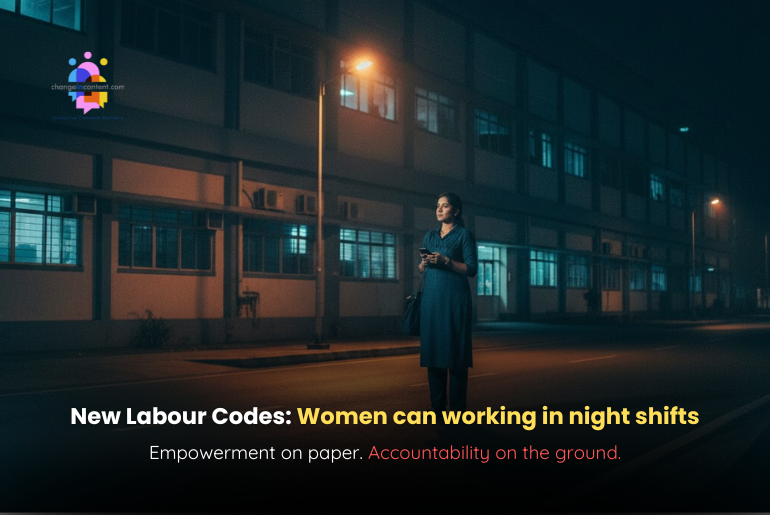
As India enters 2026, a longstanding barrier to women’s employment has been officially dismantled. The new labour codes now permit women working night shifts across sectors. These sectors range from IT parks and hospitals to factories, warehouses, and even mining. On paper, this is historic. For decades, the logic of protection restricted night work for women. Now, the law speaks the language of choice, consent, and equality.
But permission is not the same as power. And opportunity is not empowerment unless safety, infrastructure, and care support it.
The debate over women working night shifts has reignited longstanding questions in a new form. Is this reform a long-overdue step toward workplace parity, or does it risk exposing women to greater harm in a country where safety remains fragile even in daylight?
The answer, as with most feminist policy questions, lies in the uncomfortable space between intent and execution.
What the Labour Codes actually say about women working night shifts
India’s four new labour codes, particularly the Occupational Safety, Health and Working Conditions (OSH) Code, 2020, formally allow women to work between 7 PM and 6 AM across all sectors. It includes industries that were earlier off-limits, such as hazardous manufacturing and underground mining.
The permission, however, comes with conditions. Employers must obtain written consent from women employees. They are legally required to ensure safe transport from home to workplace and back, adequate lighting, functional CCTV surveillance, security personnel, restrooms, and grievance redressal mechanisms with women’s representation.
In theory, this marks a shift from “protection by restriction” to “empowerment through responsibility.” The burden of safety has shifted from women to employers and, by extension, the state.
But laws do not operate in isolation. They operate inside streets, buses, homes, families, and offices. That is where the tension begins.
Why women working night shifts has always been a feminist fault line
For years, feminist movements have been divided on night work. One side argued that restricting women’s access to certain hours and sectors reinforced patriarchal assumptions that women are fragile or incapable. The other warned that allowing night work without fixing public safety would merely shift risk onto women’s bodies.
Both were right.
India’s cities remain unevenly lit. Public transport at night is unreliable or unsafe. Sexual harassment is rampant even during daytime work hours and grossly underreported. In such a context, the idea of “choice” becomes complicated. When a woman agrees to a night shift, is it an act of empowerment? Or is it merely economic coercion disguised as consent?
That is where women working night shifts stop being a labour issue and become a civic one.
The promise: Economic agency, pay parity, and career mobility
There is no denying the upside. Night shifts often come with higher pay, overtime rates, and faster career progression. For many women (especially those in healthcare, logistics, manufacturing, and IT), being excluded from night work has meant being excluded from leadership tracks altogether.
Empowering women to work nights can increase female labour force participation, especially in urban India, where participation remains stubbornly low. It can open doors to formal employment, financial independence, and bargaining power inside households. For single women, migrants, and women without family support, night shifts can be the difference between informal survival and formal stability.
From this lens, denying women access to night work is not protection. It is economic gatekeeping.
The risk: When consent becomes compulsion
Yet, we cannot dismiss several concerns.
Enforcement
The first is enforcement. India has no shortage of progressive laws. What it lacks is consistent implementation. Safety measures mandated by law often collapse outside corporate campuses and tier-1 cities. Panic buttons fail. Transport vendors are unverified. CCTV cameras exist, but do not work.
Pressure
The second is workplace pressure. When night shifts are allowed, women who refuse them may quietly lose out on promotions, bonuses, or “high-visibility” projects. Consent, in such cases, becomes conditional. The fear is not hypothetical. It has played out before.
Unpaid Labour
The third is the unpaid labour question. Women still carry the bulk of caregiving responsibilities. Crèches are scarce. Childcare support is minimal. Night shifts do not erase domestic expectations; they merely stretch women thinner.
Without addressing these structural gaps, women working night shifts risk becoming another reform that benefits a few while burdening many.
What Arunima Bhattacharya thinks: Power without care is not empowerment
Arunima Bhattacharya, Co-founder of ChangeInContent, views the reform with cautious realism.
“Empowerment cannot exist without safety measures,” she says.
You cannot tell women they are safe at night without creating infrastructure for them. The infrastructure here is an offshoot of social construct . Let us aim for parity; and not just performative progress. Cities, income levels, castes and many more elements differ. Therefore, relative safety for women differ too. Uniformity can exist on paper but should be customised basis income and one’s ability to access available resources like transport, connectivity and safety measures.
For her, the labour codes signal intent, but intent must translate into lived safety. She believes that genuine empowerment would entail investing in transport infrastructure, childcare, grievance mechanisms, and community accountability—not merely corporate checklists.
What Saransh Jain adds: Safety is national infrastructure, not HR policy
Saransh Jain, Co-founder and Head of Editorial, frames the issue differently.
We cannot outsource women’s safety to individual courage or corporate goodwill. If women working night shifts is essential to India’s economic growth, then safety becomes national infrastructure. We cannot see it as an HR policy.
For Saransh, the debate should not be about whether women should work nights. That question has already been answered. The real question is whether the state, employers, and society are prepared to share responsibility for what that choice demands.
ChangeInContent perspective: Equity after dark requires accountability
At ChangeInContent, we believe the reform is neither a victory nor a failure. It is a test.
A test of whether India can move beyond symbolic equality and build systems that protect dignity in practice. It is also a test of whether consent is respected without coercion. A test of whether women’s labour is valued enough to be safeguarded.
Women working night shifts should not have to choose between income and safety, ambition and dignity, opportunity and survival.
Conclusion: Equality does not end at sunset
The new labour codes have opened a door that was long shut. What happens next will determine whether that door leads to freedom or further risk.
Empowerment is not about allowing women to enter unsafe spaces. It is about making every space safe enough to enter. Until that happens, night work will remain a paradox, which is full of promise, shadowed by fear.
As India moves forward, we cannot measure the success of this reform by how many women clock in after dark. Instead, the real measure would be whether they return home safely, respected, and unchanged.
Disclaimer: The views expressed in this article are based on the writer’s insights, supported by data and resources available both online and offline, as applicable. Changeincontent.com is committed to promoting inclusivity across all forms of content. We broadly define inclusivity as media, policies, law, and history. It encompasses all elements that influence the lives of women and marginalised individuals. Our goal is to promote understanding and advocate for comprehensive inclusivity.