
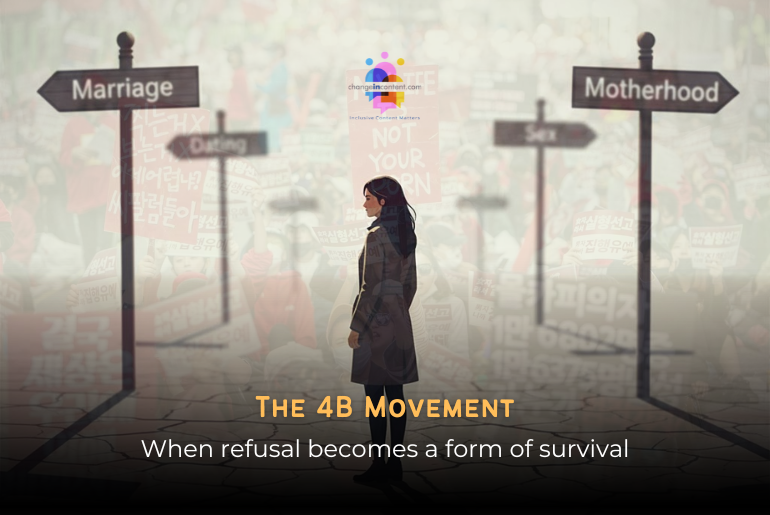
The phrase ‘The 4B Movement’ does not arrive gently. It is blunt, confrontational, and deliberately uncomfortable. Originating in South Korea, the movement is built on four refusals by women: no marriage, no dating, no sex, and no childbirth.
At first glance, it appears extreme. On closer reading, it sounds less like rebellion and more like exhaustion. As conversations around the 4B Movement surface on Indian social media and opinion pages, a deeper question emerges. The question is not whether India is ready for such a movement, but whether Indian women are already practising parts of it quietly, without naming it.
The 4B Movement is not about hatred of men, nor is it about rejecting intimacy itself. It is a political response to structural inequality. Moreover, it is a refusal to participate in systems that repeatedly fail women while demanding emotional, sexual, and reproductive labour in return.
What is the 4B Movement?
The 4B Movement, also known as “Four Nos”, originated in South Korea in the late 2010s. The four “Bs” stand for:
- No marriage
- No dating
- No sex with men
- No childbirth
It emerged in response to deeply entrenched patriarchy, gender violence, workplace discrimination, rising misogyny, and the unequal burden of care placed on women. South Korea’s context matters here. It is a country with one of the lowest fertility rates in the world, intense beauty standards, extreme work cultures, and persistent gender pay gaps. Despite high education levels among women, social and institutional structures continue to reward men disproportionately.
The movement does not organise marches or issue manifestos. It operates quietly, often anonymously, and primarily online. That silence is part of its power. It removes labour (emotional, sexual, and reproductive) from systems that take it for granted.
The four “Nos” explained.
Each refusal within the 4B Movement addresses a different layer of patriarchal expectation.
- No marriage is not a rejection of companionship. It is a rejection of marriage as an institution that often transfers unpaid domestic labour, emotional management, and caregiving almost entirely onto women. In South Korea, married women are far more likely to exit the workforce, while married men experience career stability or growth.
- No dating challenges the cultures where dating often involves emotional labour, safety risks, and performance expectations for women. It questions why intimacy so often requires women to absorb entitlement, control, or surveillance.
- No sex confronts the assumption that women owe sexual access. It is an assumption reinforced globally by the media, marriage norms, and even the law. The refusal is not anti-pleasure; it is anti-entitlement.
- No childbirth directly confronts reproductive coercion. In societies where women are blamed for falling birth rates but not supported as mothers, childbirth becomes a political act. Refusal becomes self-preservation.
Together, these refusals form not an ideology of isolation, but a demand for renegotiation.
Why the 4B Movement terrifies patriarchy
Patriarchal systems are sustained not only by laws but also by women’s participation. Marriage, dating, sex, and motherhood are central mechanisms through which gender roles are reproduced. When women collectively step back, even symbolically, the system feels exposed.
The panic around the 4B Movement often reveals more than the movement itself. Critics label it “anti-family,” “unnatural,” or “Westernised.” Still, they rarely ask why so many women feel pushed to this edge. The fear is not that women will be lonely. Instead, the fear is that women will be unavailable emotionally, reproductively, and economically.
To know more about Patriarchy in India, read our insightful perspective here.
Is there an Indian parallel to the 4B Movement?
India does not have a formally named 4B Movement. But its fragments exist everywhere.
- Women delaying or rejecting marriage
- Women opting out of motherhood
- Women choosing singlehood despite stigma
- Women refusing unsafe relationships
India’s context is different. Family structures are tighter, social surveillance is stronger, and economic dependence remains widespread. Yet the pressures are familiar. They involve unpaid care work, marital coercion, lack of reproductive autonomy, and the moral policing of women’s choices.
Recent data shows declining fertility rates across urban India, rising age at first marriage, and increasing conversations around child-free lives. These are not trends driven by ideology alone; they are responses to lived realities.
The question, then, is not whether India is “ready” for the 4B Movement. It is whether Indian society is ready to confront why such refusals feel necessary at all.
The misunderstanding: Radicalism vs Reality
One part of the society often dismisses the 4B Movement as radical feminism. But radical only means “root.” The movement addresses root problems of unequal labour, lack of consent, unsafe public and private spaces, and systemic dismissal of women’s pain.
Most women practising some form of 4B are not activists. They are professionals, caregivers, students, and workers. These individuals are making quiet calculations about safety, autonomy, and survival.
Refusal, in this sense, is not rebellion. It is boundary-setting.
What is the 4B Movement really asking for?
At its core, the 4B Movement asks uncomfortable questions:
- What would relationships look like if women were not expected to sacrifice themselves to sustain them?
- What would motherhood look like if it were genuinely supported?
- What would intimacy look like if consent were not assumed?
- What would society look like if women’s time, labour, and bodies were not treated as default resources?
Until we answer those questions honestly, refusal will continue to feel like the only language left.
The changeincontent perspective
At changeincontent, we do not see the 4B Movement as a provocation. We see it as data (social, emotional, and political data) emerging from women’s lived experiences. Movements like 4B force societies to confront uncomfortable truths about unpaid care work, sexual entitlement, reproductive coercion, and the cost of “normal” life for women.
Our role is not to sensationalise these conversations, but to deepen them. To document, analyse, and question why refusal feels safer than participation for so many women today. This piece is part of our larger commitment to unpack how policy, culture, work, and personal life intersect, and why women’s withdrawal is not the problem, but a consequence.
The closing thoughts
The 4B Movement is not a blueprint to be copied. It is a signal to be read. The movement reflects a growing refusal among women to absorb inequality quietly. Whether in South Korea or India, the movement exposes a simple truth: when systems fail to evolve, people withdraw from them.
India may never see a formal 4B Movement. But it will continue to see women renegotiating marriage, intimacy, and motherhood on their own terms. The real work lies not in asking women to return, but in fixing what made them leave.
Disclaimer: The views expressed in this article are based on the writer’s insights, supported by data and resources available both online and offline, as applicable. Changeincontent.com is committed to promoting inclusivity across all forms of content. We broadly define inclusivity as media, policies, law, and history. It encompasses all elements that influence the lives of women and marginalised individuals. Our goal is to promote understanding and advocate for comprehensive inclusivity.
