
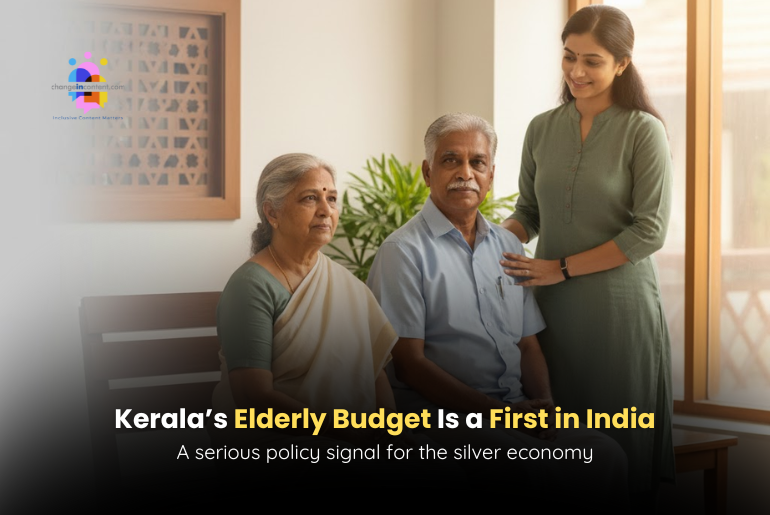
It is budget season. While the Union Budget dominates national headlines, state budgets quietly shape everyday life, often faster and more directly. This year, Kerala has done something no Indian state has attempted before: it has introduced a dedicated Elderly Budget.
India is ageing fast. The population aged 60 and above is expected to more than double, rising from approximately 100 million in 2011 to nearly 230 million by 2036. By then, almost one in seven Indians will be a senior citizen. As demographics change, policy has to keep pace, not play catch-up.
Kerala’s Elderly Budget: Why this is a national first
Kerala has set a new precedent in India’s budget history. Finance Minister K N Balagopal recently introduced a dedicated Elderly Budget as part of the State Budget, making Kerala the first state in the country to formally create a dedicated budget for the senior citizens. For 2026–27, the state has set aside ₹46,236.52 crore for the elderly, representing about 19% of the total Budget.
Kerala already has the highest ageing population in India. By 2036, nearly 22.8% of the state’s population will be 60 or older, meaning almost one in four residents will be elderly. Between 2011 and 2026 alone, Kerala’s elderly population has grown by 47%, well above the national average of 36%.
What Kerala’s Elderly Budget funds in 2026–27
The Elderly Budget highlights major allocations for healthcare, social protection, and community-based care.
Key initiatives include:
- A pneumococcal vaccination programme for senior citizens
- Retirement homes across all districts
- Abhay Kendra, a homestay scheme for senior artists
- Investments in adult education and age-friendly public infrastructure
A progressive start, but the Elderly Budget needs more “New Money”
Approximately 68% of the Elderly Budget currently goes toward pensions for retired government employees. It is an expense the state must cover regardless. While this still counts as elderly spending, it limits the amount of new funding available for services and innovations.
That said, creating a separate Elderly Budget itself is a progressive change. It brings visibility, accountability, and political attention to ageing as a policy issue. The next step is to gradually increase the share allocated to healthcare systems, community care, and age-friendly infrastructure, so the budget not only supports the elderly but also actively prepares society for an ageing future.
Why the Elderly Budget must address gender and ageism together
An Elderly Budget matters deeply for women, who form a growing majority of India’s ageing population. Women age with fewer economic resources and also face greater financial insecurity in old age. Many women spend their working years in unpaid care roles, informal jobs, or part-time work, which means they enter retirement without pensions, savings, or social security.
Older women are more likely to live alone, experience chronic health issues, and depend on public healthcare systems. Widows, in particular, face higher risks of poverty and social isolation.
Hence, ageing is not gender-neutral. The next step in policy must move beyond a generic Elderly Budget towards an Elderly Budget with a gender lens. States need to track how much of this spending reaches older women and design schemes that address their specific needs, such as health services for ageing women, support for widowhood in old age, mental health services, safe housing, and income support.
Older women and their responsibilities
Many elderly women also shoulder caregiving responsibilities for spouses, grandchildren, or even other elderly relatives, extending their unpaid labour well into later life. Caregiver allowances for older women who continue unpaid care work, and digital literacy programmes that help them access banking, healthcare, and government services in a digital-first system, are also key initiatives to consider.
If governments already recognise that women require separate gender budgets during their working years, the same logic must apply to old age. In an ageing India, dignity in old age will depend not just on age-sensitive policies but also on gender-sensitive ones.
The changeincontent perspective
Kerala’s Elderly Budget is not just a welfare headline; it is a statement of governance. Ageing is no longer a “future problem”, and pretending otherwise is how countries end up with overloaded hospitals, invisible caregivers, and older people living longer but living worse.
What we want next is sharper accountability: how much of this spend goes toward building new services, not just meeting existing pension obligations, and how much actually reaches older women who enter old age with fewer savings, weaker social security, and heavier caregiving burdens.
Ageing is also a workplace issue. If organisations still treat menopause, chronic illness, caregiver leave, and flexible work as “personal problems”, policy will never translate into dignity on the ground. An Elderly Budget is a strong start, but the real test is execution, measurement, and a gender lens built in, not added later.
The closing thoughts
Kerala’s Elderly Budget is a timely intervention in a country that is ageing faster than it is planning for it. As India’s senior population expands, more states will need to adopt similar approaches and treat elder care as a core part of economic planning.
The Union Budget must also place greater emphasis on ageing, with sustained investments in healthcare systems, social security, age-friendly infrastructure, and long-term care services. Some progress has already been made in this direction, particularly in areas such as pharmaceuticals and access to essential medicines, where recent budget measures have offered meaningful relief.
Disclaimer: The views expressed in this article are based on the writer’s insights, supported by data and resources available both online and offline, as applicable. Changeincontent.com is committed to promoting inclusivity across all forms of content. We broadly define inclusivity as media, policies, law, and history. It encompasses all elements that influence the lives of women and marginalised individuals. Our goal is to promote understanding and advocate for comprehensive inclusivity.
