
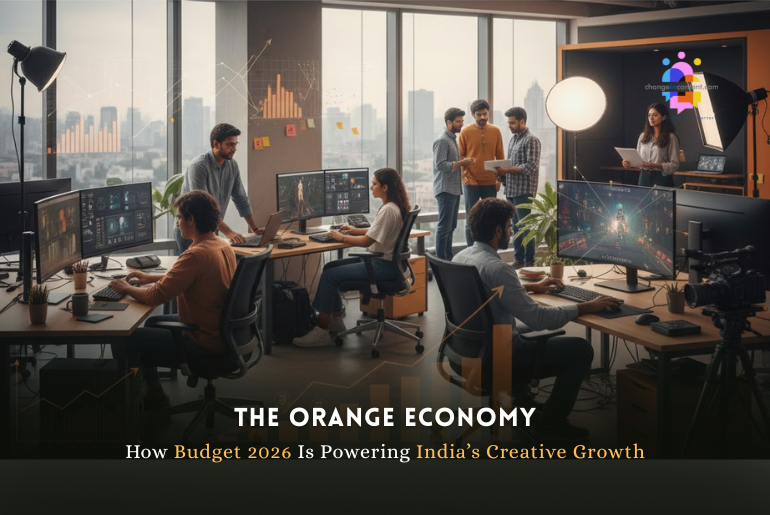
In the Union Budget presented on February 1, 2026, Finance Minister Nirmala Sitharaman highlighted the Orange Economy (also known as the Creative Economy) as a key driver of growth, exports, and employment. Long seen as informal or passion-driven, creative work is now being positioned as a structured economic sector built on talent, culture, intellectual property, and digital skills.
Budget 2026 signals a shift in how India values creativity not as a side economy, but as a scalable engine for jobs, innovation, and global cultural influence, especially among young people entering the workforce.
What is the Orange Economy, and why does it matter in the Budget 2026
The Orange Economy encompasses industries in which imagination, creative technology, and cultural expression are the primary resources. These are spaces where people create, design, perform, code, and tell stories, and those activities translate into real economic output.
It includes areas like:
- Animation, VFX, gaming and comics (AVGC)
- Cinema, music, and online storytelling platforms
- Fashion, design, branding and advertising
- Publishing and digital tools that support creators
What makes this economy different is that its biggest assets aren’t machines or land, but digital content, creative skills, and ownership of ideas. In an increasingly online world, that’s a decisive advantage.
The Orange Economy and its economic power
India’s creative industry is valued at around INR 3,01,245 crore (US$ 35 billion), with creative exports alone exceeding INR 94,677 crore (US$ 11 billion) in 2023. It accounts for nearly 8% of national employment and approximately 20% of India’s total Gross Value Added (GVA).
India’s media and entertainment (M&E) sector now constitutes a core part of the Orange Economy, encompassing streaming platforms, television, film, digital creators, gaming, advertising, animation, and live shows. In 2024, the sector reached an estimated value of INR 2.5 trillion (US$ 27.6 billion).
Budget 2026 proposals for strengthening the Orange Economy
The Budget 2026 proposed targeted moves to strengthen India’s Orange Economy, with a strong focus on skills, infrastructure, and future-ready talent.
1. Big push for AVGC talent
The budget places major emphasis on the AVGC sector (Animation, VFX, Gaming and Comics), which continues to grow as one of the most in-demand creative fields. Industry estimates suggest that the sector will need nearly 2 million professionals by 2030, underscoring the massive opportunity that lies ahead.
To meet this demand, the government will support the Indian Institute of Creative Technologies (IICT) in Mumbai and position it as a national hub for creative training.
2. Creator labs across schools and colleges
The budget plans to set up AVGC and content creator labs in:
- 15,000 secondary schools
- 500 colleges
These labs will give students hands-on exposure to animation tools, game design, visual effects, and digital content creation. This move brings creative education into mainstream classrooms instead of keeping it limited to niche institutes.
The focus is on normalising creative careers alongside conventional academic pathways, so that fields such as design, animation, gaming, filmmaking, and digital content creation are seen as equally valid and valuable as traditional options such as engineering, medicine, or management.
3. Fixing the design education gap
Budget 2026 also announces a new National Institute of Design (NID) in the eastern region of India, selected through the challenge route.
Currently, India has seven NIDs, all of which are recognised as Institutes of National Importance. Adding a new one helps reduce regional imbalance and expands access to high-quality design education beyond the usual urban clusters.
Creativity as an income stream
Mobile data in India is exceptionally cheap and is among the lowest in the world, and often over 90% cheaper than the global average. A large portion of the population, especially young people, remains online all day, whether streaming shows, scrolling social media, gaming, learning, or creating content. As a result, more people can not only consume digital content easily but also produce and monetise it.
The digital boom has created new income pathways, particularly for women and marginalised communities. You don’t need to move cities, work long office hours, or even leave home to earn anymore. Influencers, YouTubers, podcasters, writers, designers, gamers, educators, and creators now form a core part of the Orange Economy.
Almost every niche has an audience today, from finance and fashion to regional food and mental health. For many, content creation has shifted from a side hustle to a reliable source of income.
Learning from Korea, Japan, and scaling India’s creative power
The global success of South Korea shows how powerful a creative economy can be when backed by policy and investment. After the 1997 Asian Financial Crisis, South Korea adopted culture as a national growth strategy. The government invested heavily in K-pop, K-dramas, films, gaming, and animation, treating these creative industries as a serious form of economic infrastructure. Today, Korean content reaches almost every Indian household through streaming platforms, social media, and gaming apps.
Japan offers another strong example through anime and manga. What began as domestic popular culture has become one of Japan’s largest global exports. Anime franchises such as Pokémon, Naruto, One Piece, and Studio Ghibli films now generate substantial revenue through streaming, merchandise, gaming, conventions, and tourism.
India has the same, if not greater, potential to build a similar creative export engine. With its deep storytelling traditions, diverse languages, crafts, cinema, music, and rapidly growing digital talent, India can scale its cultural industries globally. The Orange Economy offers India an opportunity to convert creativity into economic power. Moreover, we can create millions of flexible, future-ready jobs while strengthening cultural influence on the world stage.
The closing thoughts on the Orange Economy
Budget 2026 makes an important shift by treating creative work as real economic infrastructure, not just passion projects or side hustles. With the right mix of policy support, digital access, and skill-building, creativity can turn into one of India’s most scalable growth engines.
The Orange Economy opens doors for youth, women, freelancers, and marginalised communities to participate in the economy. If executed well, this could reshape how Indians work, earn, and create, placing culture, storytelling, and innovation at the centre of India’s next economic chapter.
The changeincontent perspective
At changeincontent, we see the Orange Economy as an important correction in how economic value is defined. For decades, creative work in India has existed without institutional backing, predictable income structures, or long-term policy support. Finally, Budget 2026 marks a shift by acknowledging creativity as economic infrastructure rather than informal labour.
However, intent alone will not determine success. Execution, accessibility, and sustained investment will determine whether the Orange Economy benefits a broad base of creators or remains concentrated in a few urban clusters. If implemented thoughtfully, this framework can unlock flexible employment, regional growth, and global cultural exports at scale.
Disclaimer: The views expressed in this article are based on the writer’s insights, supported by data and resources available both online and offline, as applicable. Changeincontent.com is committed to promoting inclusivity across all forms of content. We broadly define inclusivity as media, policies, law, and history. It encompasses all elements that influence the lives of women and marginalised individuals. Our goal is to promote understanding and advocate for comprehensive inclusivity.
