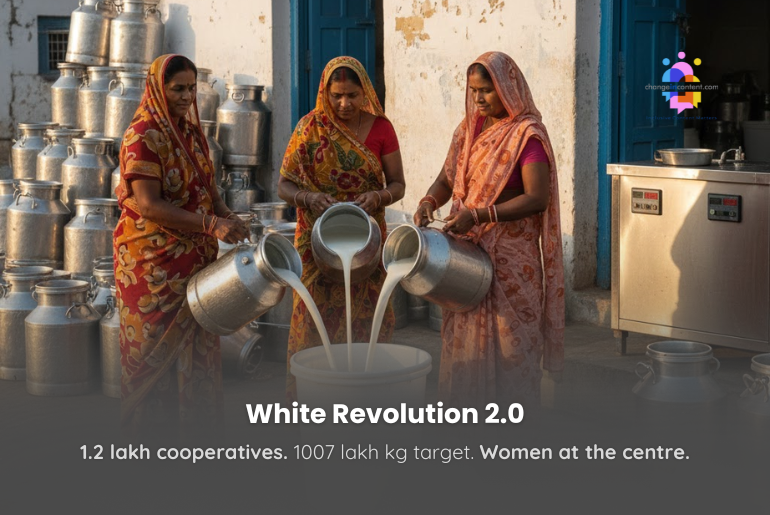
India’s White Revolution 2.0 is officially underway. Announced by the Ministry of Cooperation in Parliament on February 10, the initiative aims to expand cooperative coverage and increase milk procurement by 50% over five years. Moreover, it aims to bring more women dairy farmers into the organised sector.
The numbers are ambitious. The government has set a target for dairy cooperatives to increase daily milk procurement to 1007 lakh kilograms per day by 2028–29. Behind that headline figure lies a structural shift: 75,000 new Dairy Cooperative Societies in uncovered areas and the strengthening of 46,422 existing societies.
At its core, White Revolution 2.0 recognises a fact long known but rarely formalised. Nearly 70% of India’s dairy workforce consists of women. The question is whether this policy push will finally convert invisible labour into institutional power.
White Revolution 2.0: The core target
The Centre aims to increase dairy cooperatives’ milk procurement by 50% over the next five years from current levels.
In absolute terms, procurement can potentially reach 1007 lakh kg per day by 2028–29.
To reach this target, the government has adopted a two-pronged strategy:
- First, expanding cooperative coverage in previously uncovered regions.
- Second, deepening the reach of existing cooperatives to increase their share in the organised dairy sector.
This approach signals a shift from incremental growth to structured expansion.
Expanding the cooperative footprint under White Revolution 2.0
Under the initiative, 75,000 new Dairy Cooperative Societies will be established in uncovered areas. In addition, it will also aim to strengthen 46,422 existing DCSs.
The scale matters. That means over 1,20,000 new or strengthened cooperative structures, including:
- Dairy Cooperative Societies
- Multipurpose Dairy Cooperative Societies
- Multipurpose Primary Agricultural Credit Societies
The strategy is village-centric. The proposal aims to establish DCS in every uncovered panchayat or village, integrating dairy farmers into organised supply chains. Market access is the critical lever here. Women already produce milk. The policy seeks to formalise procurement, pricing, and aggregation systems.
Infrastructure Push: Technology and market access
White Revolution 2.0 is not limited to expansion on paper. It includes enabling infrastructure:
- Automatic Milk Collection Units
- Data Processing Milk Collection Units
- Milk testing equipment
- Bulk Milk Coolers
- New and expanded milk routes
The linking of new cooperatives with milk routes is essential. Without logistics integration, production gains do not translate into income gains. These activities are funded under the National Dairy Development Programme 2.0 (NPDD 2.0), implemented by the Department of Animal Husbandry & Dairying, Government of India.
NPDD 2.0 provides the operational backbone. White Revolution 2.0 provides the scale and cooperative focus.
Women at the centre of White Revolution 2.0
The policy explicitly acknowledges that women perform the majority of labour in dairy farming. They are involved in milking, feeding cattle, managing livestock health, and daily dairy operations.
Yet the sector remains largely unorganised.
According to the Ministry’s press release, nearly 70% of the workforce in dairy farming consists of women. However, because dairy is often a household activity, their work remains undervalued and unpaid in formal economic accounting.
White Revolution 2.0 seeks to correct this imbalance by:
- Bringing more women dairy farmers into organised cooperative structures.
- Strengthening women-led dairy cooperatives.
- Creating structured procurement channels.
- Improving income stability through formal market access.
The logic is straightforward. Cooperative membership converts labour into formal economic participation.
Addressing nutrition and rural livelihoods
The initiative also links dairy expansion with malnutrition concerns.
By strengthening cooperative milk supply chains and increasing organised procurement, the government argues that both income opportunities and nutritional availability will improve.
Dairy remains one of the most critical components of India’s protein and micronutrient supply. Improved procurement, stronger cold chain infrastructure, and organised supply systems can increase both household income and dietary access.
That is where the policy intersects with rural development and health objectives.
White Revolution 2.0 in context: Why it matters
India is the world’s largest milk producer. Yet the structure of dairy production remains fragmented.
The first White Revolution, driven by cooperative models such as Amul and institutional leadership from the National Dairy Development Board, transformed India into a milk-surplus nation. White Revolution 2.0 seeks to extend that model deeper into uncovered regions while formalising the participation of women.
The focus on cooperatives is significant. Unlike corporate procurement models, cooperatives distribute ownership and decision-making power among members. If implemented effectively, this model can enhance women’s collective bargaining power. However, success depends on governance quality, transparency, timely payments, and access to credit.
Expansion without accountability risks dilution.
Numbers that define White Revolution 2.0
Let us anchor the policy in numbers:
- Target procurement by 2028–29: 1007 lakh kg per day
- Increase in procurement targeted: 50% over five years
- New DCS to be established: 75,000
- Existing DCS to be strengthened: 46,422
- Total cooperative expansion footprint: around 1,20,000 units
- Women’s share in the dairy workforce: approximately 70%
These figures define the scale of ambition.
The changeincontent perspective
At changeincontent, we view White Revolution 2.0 as more than just an agricultural policy. It is a structural recognition of women’s unpaid labour in rural India.
For decades, women have sustained India’s dairy backbone without proportionate recognition in income structures or leadership positions. Bringing them into organised cooperative systems can shift this imbalance. However, it is only possible if the expansion is accompanied by financial literacy, leadership training, and transparent governance.
We have explored similar themes in our coverage of the Women in Agriculture Summit 2025. That is where discussions were centred on land rights, cooperative leadership, and market access for women farmers. Readers can revisit that analysis here.
White Revolution 2.0 must not stop at procurement targets. It must ensure that women move from labour contributors to decision-makers within cooperative boards and value chains. Numbers can transform economies. Inclusion transforms societies.
White Revolution 2.0: Final thoughts
White Revolution 2.0 places women at the heart of India’s dairy expansion strategy. With a target of a 50% increase in procurement and over 1.2 lakh cooperatives to be created or strengthened, the initiative is among the most ambitious cooperative-led rural programmes in recent years.
If implemented effectively under NPDD 2.0 guidelines, it could formalise women’s participation in a sector they already dominate. Milk volumes will rise. The real success metric will be whether women’s incomes, leadership roles, and financial autonomy rise with it.
Disclaimer: The views expressed in this article are based on the writer’s insights, supported by data and resources available both online and offline, as applicable. Changeincontent.com is committed to promoting inclusivity across all forms of content. We broadly define inclusivity as media, policies, law, and history. It encompasses all elements that influence the lives of women and marginalised individuals. Our goal is to promote understanding and advocate for comprehensive inclusivity.