
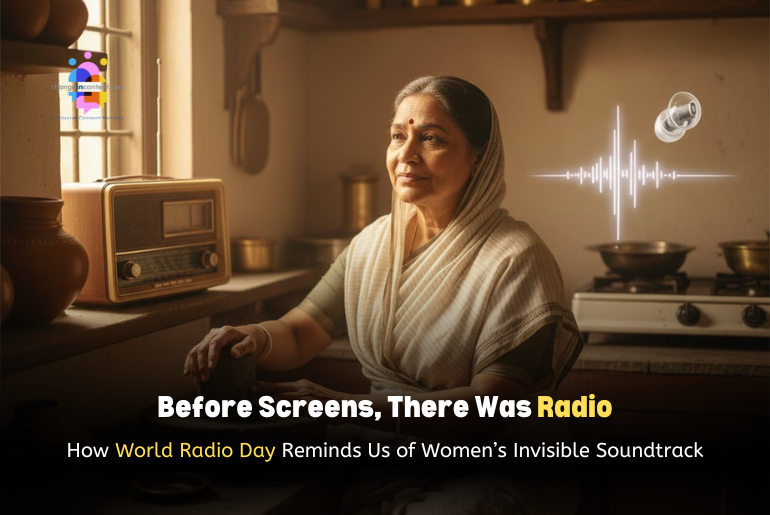
Every year on 13th February, World Radio Day celebrates one of the world’s most enduring mediums. This year’s theme, “Radio and Artificial Intelligence: AI is a tool, not a voice,” has sparked global conversations. But instead of focusing on technology, we want to pause and revisit something far more intimate: the quiet, lasting bond between Indian women and the radio.
For many women, radio was never just background noise. It was presence; it was rhythm; it was companionship during long afternoons in kitchens, late hostel nights, and slow mornings in small towns. Before smartphones and streaming, radio created a space where women could listen, learn, laugh, and sometimes simply feel less alone.
Akashvani and the sound of India
All India Radio, better known as Akashvani, operates 591 stations, reaching 98% of India’s population, broadcasting in 23 languages and 146 dialects. Whether someone lived in a metro or a small village, Akashvani brought the same voices into everyone’s homes. News, film songs, devotional music, cricket commentary, drama, and public announcements all came from the same source. Akashvani became a shared cultural space before social media even existed.
And that iconic Akashvani jingle? The moment it played, you knew the day had started. Families sat around with tea, grandparents listened to the news, and women managed the house with the radio running in the background like a familiar friend.
On June 8th, 2025, Akashvani marked its 90th anniversary. That is 90 years of being present in Indian homes, especially in women’s everyday lives.
Radio as a daily company
For women who spent most of their day at home, the radio broke the silence of long afternoons, repetitive routines, and lonely hours. While hands stayed busy with cooking, cleaning, and caregiving, the mind travelled elsewhere. Voices from the radio brought in music, jokes, film gossip, advice, and stories from outside their homes. It seemed someone spoke to them.
If you think about any Indian TV serial set in the 1990s, you already know the opening scene. The radio plays in the background. The pressure cooker whistles. Someone hums along to a song by M. S. Subbulakshmi or Lata Mangeshkar. The camera pans to a woman in the kitchen, sari pallu tucked in, moving between the stove and the sink.
This scene shows up every time for a reason. It is because the radio defined domestic spaces for decades. It created background emotion for everyday life. Even today, if a show on Star Plus or Colours wants to show “old-school 1990s Indian household,” the first thing they add is a radio.
Not a phone. Not a TV. A radio.
Community Radio: A grassroots tool for women’s empowerment
In 2006, the Indian government introduced a media policy that allowed universities and NGOs to start community radio stations. The goal is to use radio for social and economic development. These stations could not air political news, but they had the freedom to create local content. They discussed health, education, agriculture, employment, and gender issues. By 2020, more than 250 community radio stations were operating, reaching approximately 331 million people.
How Community Radio improved education, health, and gender awareness
Surveys report that girls and women who grew up in areas with access to community radio stayed in school longer. Young women became more likely to complete primary education (11% likely), secondary education (11% likely), and higher education (13% likely). On average, girls in these regions gained around 0.3 more years of education.
Community radio was successful because it spoke in local languages, used familiar voices, and discussed real issues. It explained scholarships, health schemes, school enrolment, farming practices, and women’s rights.
Community radio also played a big role in family planning and social awareness. Many stations ran birth control campaigns and programmes about child health, education, and early marriage. These messages reached far more families than schools or government offices ever could.
Women living in areas with community radio had 8% to 12% fewer children between the ages of 19 and 35. Parents in these regions also stopped using marriage as a main reason for girls dropping out of school. Child marriage declined by 22%. Overall, girls who grew up with access to community radio delayed marriage, often until their mid-twenties.
Even today, in homes filled with smartphones and smart TVs, the radio still survives in corners. On kitchen shelves, in auto-rickshaws, in small shops, playing softly in the background. It may no longer be the centre of attention, but it remains present.
When rural women became broadcasters: Sangham Radio and Radio Ujjas
Launched in 2008 by the Deccan Development Society, a non-profit organisation that works with rural women, Sangham Radio in Telangana became India’s first all-women community radio station, run by Dalit women. [TheGuardian]
Sangham Radio
One of the most recognised voices of Sangham Radio was Masanagari Narsamma, a farmer who became a radio broadcaster. For nearly twenty years, she and her team produced shows on everyday issues such as farming, education, and women’s health. They talked openly about menstruation and menopause, subjects about which many women had questions but rarely heard discussed out loud.
These programmes reached more than 40 villages. That ensured thousands of women could hear advice and information in their own language. These people were those who lived lives similar to theirs.
Radio Ujjjas
There is also Radio Ujjas in Gujarat’s Kutch region. The station is run entirely by local women, many of whom never had access to formal education. Despite that, they write scripts, record shows, and manage broadcasts independently.
Radio Ujjas creates radio serials, documents local folk music, and shares stories from everyday community life. During the 2002 Gujarat earthquake, the station provided real-time information about relief efforts, safety updates, and available support.
The changeincontent perspective
World Radio Day should not only celebrate nostalgia but also prompt reflection. Radio has historically offered women companionship, knowledge, and in many cases, a public voice. Yet women still make up only 26% of voices in broadcast and print media. Representation remains uneven.
The future of radio (whether traditional or AI-enabled) must prioritise gender-balanced programming, leadership roles for women in media houses, and policy support for community radio initiatives. Governments and media organisations must invest in women-led content, regional language programming, and safe media spaces.
Radio proves that accessible media can change educational outcomes, health awareness, and social norms. The next step is to ensure women are not just listeners but equal narrators of public discourse.
Conclusion: World Radio Day and the representation gap in media
World Radio Day reminds us that before playlists, podcasts, and algorithms, there was radio. World Radio Day, then, is not just about celebrating an old medium. It is about recognising a relationship that continues to evolve. From transistor radios to community stations to AI-powered broadcasts, radio continues to find ways to remain relevant in women’s lives. However, like two sides of a coin, this is only part of the picture.
Women still appear or get heard in just 26% of all broadcast, radio, and print coverage. As radio enters the age of AI and digital platforms, there also arises the need for safe spaces and better representation.
Disclaimer: The views expressed in this article are based on the writer’s insights, supported by data and resources available both online and offline, as applicable. Changeincontent.com is committed to promoting inclusivity across all forms of content. We broadly define inclusivity as media, policies, law, and history. It encompasses all elements that influence the lives of women and marginalised individuals. Our goal is to promote understanding and advocate for comprehensive inclusivity.
