
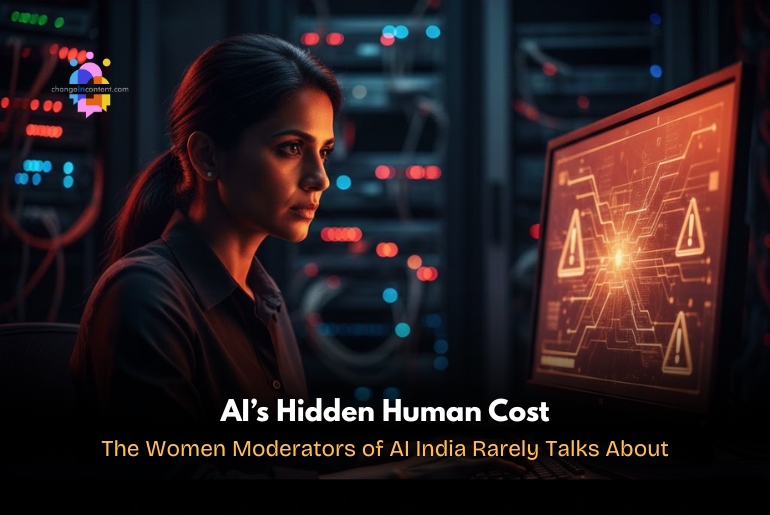
Today, 16th February, the India AI Impact Summit begins at Bharat Mandapam in New Delhi. Global leaders, founders, policymakers, and innovators will gather to discuss how artificial intelligence can transform economies, governance, and social development. Yet as this high-profile conversation unfolds, the invisible reality of women moderators of AI content in India remains largely unspoken.
Across the country, thousands of women spend their workdays reviewing some of the most violent, explicit, and disturbing material online. They label, sort, and classify data so that AI systems can “learn” what is harmful and what is safe. While the industry celebrates ethical AI and inclusive innovation, it rarely acknowledges the emotional toll borne by these women.
Women moderators of AI content: The invisible workforce behind training data
Across India, thousands of women spend their workdays watching and sorting some of the most disturbing content on the internet [TheGuardian]. Global technology companies hire them to train AI systems by reviewing images, videos, and text that automated tools flag as harmful. These workers label content that includes violence, sexual abuse, hate speech, and extreme pornography so platforms can decide what stays online and what gets removed.
Most of the women entering this work come from rural or semi-urban communities. Many sign contracts through outsourcing firms and never interact directly with the tech companies that use their labour. The industry often calls them ‘content moderators,’ but researchers and activists describe them as ‘ghost workers’ because their work remains invisible even though AI systems rely on them every day.
How AI depends on the exploitation of rural women
In India, companies direct a large share of data and content moderation work towards women from Adivasi and tribal communities because these regions offer cheap and abundant labour. Many women in these areas have limited access to formal employment, particularly work that allows them to earn income without leaving their towns or villages.
Tech firms and outsourcing companies present data work as empowering. They use terms such as flexible, skill-based, and future-ready to market these jobs. They promote the idea that women can work from home, balance family responsibilities, and participate in the digital economy. However, it is still built on the exploitative labour of marginalised women.
What numbers reveal
Data annotation now forms one of the fastest-growing digital industries in India. In 2022, India’s data-labelling market was valued at approximately $250 million. Nearly 60% of this revenue is coming from U.S.-based firms. The sector already employed about 70,000 workers.
According to NASSCOM, nearly 80% of data annotators come from rural India, and around 90% live in Tier-II and Tier-III cities. Most of the women in this workforce belong to first-generation working families. For many women, this job marks their first entry into paid employment.
In several centres, women make up almost the entire workforce. A data lab in rural Telangana employed only local women, many of whom held college degrees but remained out of formal employment due to family and social constraints. Companies such as iMerit and Niki.ai established offices in Jharkhand, Chhattisgarh, and Odisha to recruit workers directly from tribal and Dalit communities.
Psychological trauma and emotional numbing among women moderators of AI content
A typical content moderator must review hundreds, sometimes thousands, of posts in a single shift. She must watch each video in full, read every message, and then classify each message into the specified categories. Supervisors expect her to remain neutral and meet daily targets, regardless of how graphic or violent the material becomes.
AI content moderation exposes women to repeated scenes of sexual assault, child abuse, self-harm, and racial violence. Many workers say they cannot talk about what they see with their families because of stigma and fear. There is also an NDA signed before they enter the work. Over time, the content disappears from the screen. It stays in their minds.
Initially, they experience shock and distress. After a few months, they stop reacting. They describe this stage as emotional numbing. They feel nothing while watching extreme violence. They treat it like data. The real impact often appears later. Many workers report anxiety, sleep disorders, panic attacks, and intrusive memories. Some develop depression or symptoms similar to post-traumatic stress.
Global AI supply chains and digital labour exploitation
AI companies use women to watch the abuse of other women to make digital platforms safer. The industry places the emotional burden of cleaning the internet on female workers, many of whom already face economic and social vulnerability.
Content moderation, data labelling, and online customer support are jobs that require patience, attention, and emotional control, which society already expects from women. Men, on the other hand, dominate higher-paid roles such as software development, system design, and management.
The global plight of women moderators of AI content
This issue does not stop with India. It affects many developing countries, especially lower-middle-income nations, where Global tech firms find cheap digital labour and weak worker protections. The 2024 CBS documentary titled “Training AI takes a heavy toll on Kenyans working for $2 an hour” documented how digital workers in Kenya were required to review extreme and disturbing content to train AI tools.
Many workers said companies paid them very little, pushed them to meet unrealistic targets, and offered almost no mental health support. More than 140 Kenyan content moderators received diagnoses of post-traumatic stress disorder.
Milagros Miceli, a sociologist who leads the Data Workers’ Inquiry, studies the conditions of people who work for and under AI systems around the world. She warns that content moderation belongs in the category of dangerous work.
“In terms of risk,” she says, “content moderation belongs in the category of dangerous work, comparable to any lethal industry.“
The changeincontent perspective
We cannot speak about ethical AI, inclusive technology, or digital transformation while ignoring the women who absorb the worst of the internet so that others do not have to. AI governance must move beyond algorithms and into labour protections. Content moderation should be classified as high-risk psychological work under applicable law.
Companies must provide mandatory trauma counselling, rotational exposure limits, transparent contracts, fair wages, and long-term health insurance. Policymakers must regulate outsourcing chains and ensure that global tech firms remain accountable for working conditions in India.
If AI is the future, then its foundation cannot rest on invisible emotional exploitation. True inclusion demands visibility, protection, and dignity for Women Moderators of AI.
The final thoughts
There is a pressing need to address the uncomfortable reality that AI growth rests on the emotional and psychological labour of rural Indian women who absorb the worst, abusive, gender-based violent content on the internet.
If platforms and policymakers want AI to truly benefit society, they need to recognise this hidden work and address the conditions under which it happens. Progress in AI should not come at the cost of women’s mental health, dignity, and well-being.
AI summits will come and go, with global platforms, big names, and endless photos. But the conversation will mean little unless these spaces confront the exploitation happening on the ground.
Disclaimer: The views expressed in this article are based on the writer’s insights, supported by data and resources available both online and offline, as applicable. Changeincontent.com is committed to promoting inclusivity across all forms of content. We broadly define inclusivity as media, policies, law, and history. It encompasses all elements that influence the lives of women and marginalised individuals. Our goal is to promote understanding and advocate for comprehensive inclusivity.
