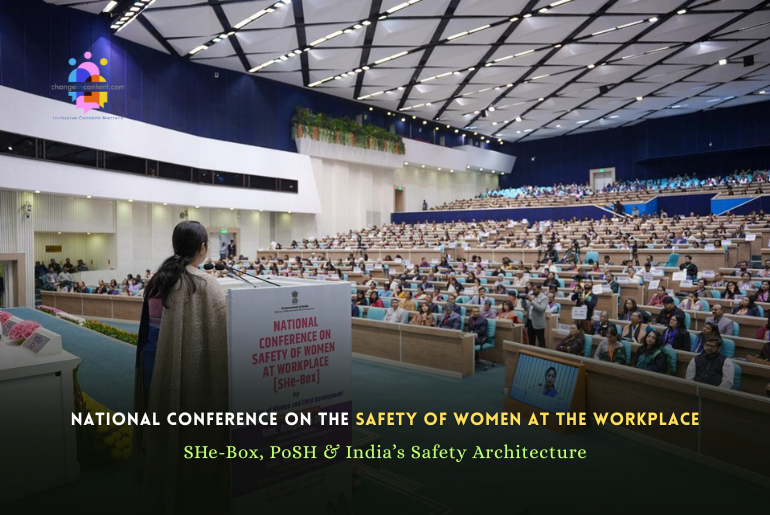
The National Conference on the Safety of Women at the Workplace, organised by the Ministry of Women and Child Development on 14 February 2026, marked a significant institutional moment for India’s workplace safety framework.
Anchored in the SHe-Box portal and the implementation of the PoSH Act, the conference brought together ministers, Members of Parliament, senior bureaucrats, industry leaders, civil society representatives, and international organisations to examine current progress and the next steps.
At a time when women’s labour force participation is rising, and economic inclusion is central to the vision of Viksit Bharat 2047, the message was clear. Safety is not optional infrastructure. It is economic infrastructure.
What the National Conference on the Safety of Women at the Workplace announced
Held at Vigyan Bhawan, the conference featured the Union Minister for Women and Child Development, Smt. Annapurna Devi, Minister of State, Smt. Savitri Thakur, Members of Parliament, including Shri Sudhanshu Trivedi, Smt. Rekha Sharma, Smt. Lovely Anand and Smt. Shobhanaben Mahendrasinh Baraiya, alongside senior officials from Central Ministries, States and Union Territories, and representatives from global institutions.
The programme began with remarks by Shri Anil Malik, Secretary, Ministry of Women and Child Development, who presented a scale assessment of India’s institutional architecture. More than 1.5 lakh workplaces have been onboarded to SHe-Box. Local Committees are active in every district. More than 60,000 Internal Committees are functioning across registered institutions. With female labour force participation at 42% and more than 80% of women engaged in the informal sector, he emphasised that expansion must now translate into deeper coverage.
During the inaugural session, the Union Minister launched the official SHe-Box logo, introduced the PoSH Voluntary Compliance Checklist, announced the integration of SHe-Box with the Mission Shakti App, and unveiled the Karmayogi Bharat PoSH Training Link on the SHe-Box portal. The National Workplace Safety Pledge was administered, reinforcing collective accountability.
These are not symbolic steps. They signal a shift toward digital integration, training alignment, and voluntary compliance backed by visibility.
SHe-Box and the compliance ecosystem
The National Conference on the Safety of Women at the Workplace placed SHe-Box at the centre of its institutional narrative. According to the Minister, over 1.48 lakh institutions are now registered on the portal. This scale is important because the PoSH Act depends on active Internal Committees and Local Committees to function meaningfully.
The integration of SHe-Box with the Mission Shakti App expands accessibility. The Karmayogi Bharat training link adds a capacity-building layer for government officials and institutional leaders. The PoSH Voluntary Compliance Checklist introduces a structured self-audit mechanism that organisations can use to assess their preparedness.
We previously examined the SHe-Box portal in detail in our earlier piece on its functionality and implications. This conference builds directly on that architecture and attempts to strengthen adoption across sectors.
Data points that framed the National Conference on the Safety of Women at the Workplace
The ministry did not build the conference on abstract language. It was grounded in numbers.
Women’s labour force participation has risen from 23% to 42% in the past six years, according to the Minister’s address. Nearly 41.7% participation was recorded in 2023–24. 70% of Mudra loans have been extended to women. 44% of PM SVANidhi beneficiaries are women. More than 10 crore women are connected through 90 lakh Self Help Groups.
These figures are important because they provide context. When economic participation increases, exposure to workplace environments increases. When exposure increases, compliance gaps become visible. The need for robust PoSH enforcement becomes structural rather than incidental.
The conference drew participation from approximately 1,500 stakeholders across more than 160 organisations. Over 40,000 participants joined virtually. The scale suggests that workplace safety is no longer treated as a departmental issue but as a cross-sectoral priority.
Legislative anchors and institutional voices
Shri Sudhanshu Trivedi highlighted the constitutional foundations of equality and justice. The PoSH Act and SHe-Box, he noted, strengthen transparency and trust. Representatives from the Ministry of Labour and Employment spoke about how the new Labour Codes intersect with safe workplace provisions.
A panel discussion featuring senior officials from the Ministry, Parliament, the Supreme Court of India, UN Women, the International Finance Corporation, and the World Bank explored compliance, global practices, and enforcement models.
The presence of international organisations signals that India’s compliance conversation is not isolated. It aligns with global frameworks that link economic growth to gender-safe work environments.
What changes in practice after the National Conference on the Safety of Women at the Workplace
Announcements matter only when they alter behaviour.
The integration of SHe-Box with Mission Shakti simplifies complaint accessibility. The voluntary compliance checklist may encourage proactive audits rather than reactive responses. The Karmayogi Bharat training link institutionalises PoSH learning for public servants. The nationwide pledge introduces reputational accountability.
Yet two realities remain.
First, over 80% of women remain in the informal sector. PoSH compliance in informal settings remains complex. Second, onboarding on a portal does not automatically guarantee cultural change inside organisations.
This is where implementation will determine credibility.
The changeincontent perspective
At Changeincontent, we see the National Conference on the Safety of Women at the Workplace as an important institutional consolidation moment. It reflects maturity in India’s compliance conversation. The scale of registration on the SHe-Box and the active functioning of Internal Committees are measurable indicators of progress.
However, we believe the next frontier is cultural literacy. Compliance must move from form submission to behavioural transformation. Training must move beyond modules into leadership accountability. Digital integration must translate into time-bound redressal.
We cannot view workplace safety as a legal risk-management exercise. Instead, we must see it as an economic multiplier. Women cannot fully participate in India’s growth story if they are unsure about the protection mechanisms in place.
The PoSH Act is a legal framework. SHe-Box is a technological framework. What remains is a social framework that ensures dignity is internalised, not just regulated.
The closing thoughts
The National Conference on the Safety of Women at the Workplace signals a structured expansion of India’s workplace safety architecture. With over 1.48 lakh institutions onboarded, 60,000 Internal Committees active, and new integrations launched, the scaffolding is stronger than before.
But scaffolding is not the building. The building is ‘Trust’.
If India is to align workplace safety with the vision of Viksit Bharat 2047, the momentum created at this conference must translate into visible improvements. It must happen at the level of factories, offices, startups, field operations, and informal networks.
Safety is not a side note to growth. It is its foundation.
Disclaimer: The views expressed in this article are based on the writer’s insights, supported by data and resources available both online and offline, as applicable. Changeincontent.com is committed to promoting inclusivity across all forms of content. We broadly define inclusivity as media, policies, law, and history. It encompasses all elements that influence the lives of women and marginalised individuals. Our goal is to promote understanding and advocate for comprehensive inclusivity.