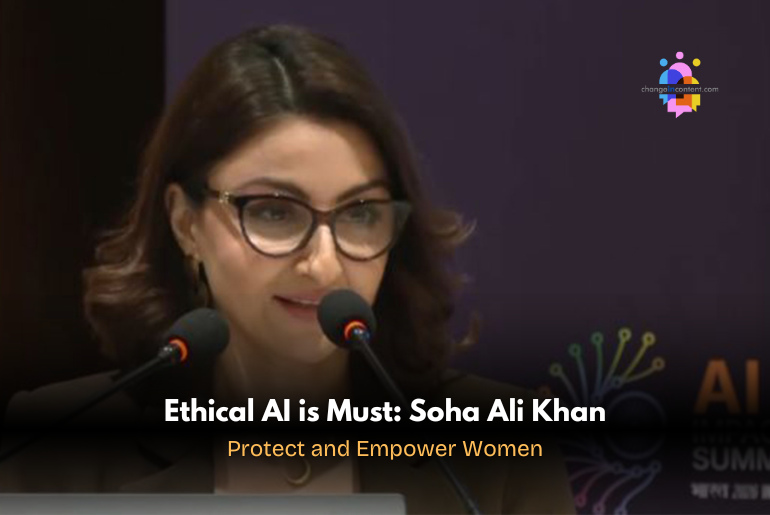
The call to protect and empower women took centre stage when Soha Ali Khan delivered the keynote address at the high-level session titled “Reimagining Gender in Technology: Designing Safer Digital Futures and Advancing Ethical AI for Inclusive Platforms” at Bharat Mandapam. As an advocate for sexual and reproductive health and rights with UNFPA, the United Nations sexual and reproductive health agency, she spoke about a reality many women already know too well: technology can amplify opportunity, but it can also amplify harm.
Her message was direct. We must build Artificial Intelligence with gender in mind. Without that lens, digital platforms risk reproducing the very biases women have battled offline for decades.
Protect and Empower Women: Why Ethical AI is not optional
Soha Ali Khan framed Ethical AI not as a luxury or a future ambition, but as an urgent necessity. She emphasised that algorithms are not neutral. They learn from existing data. When that data carries historical discrimination, stereotypes, and gaps in representation, AI systems can replicate and even intensify those patterns.
In her address, she underscored that digital spaces increasingly shape public discourse, economic participation, health access, and social mobility. For women and girls, especially those already marginalised by caste, class, disability, or geography, the consequences of biased systems can be severe. Deepfakes, online harassment, privacy violations, and data misuse are no longer isolated incidents. They are structural vulnerabilities embedded in platform design.
Her call was clear. If India wants to truly protect and empower women in the digital era, it must invest in gender-responsive technology governance. That includes inclusive datasets, stronger content moderation, and accountability frameworks that recognise digital violence as real violence.
The UNFPA Lens: Gender, technology, and SRHR
As a Sexual and Reproductive Health and Rights Advocate at UNFPA, Soha Ali Khan brought a public health perspective to the discussion. She highlighted how digital platforms influence young people’s understanding of relationships, consent, and body autonomy. When misinformation spreads unchecked or when online abuse silences women, the impact is not only reputational. It affects mental health, access to accurate health information, and freedom of expression.
UNFPA’s mandate centres on bodily autonomy, gender equality, and the right to make informed choices. In this context, ethical AI becomes an extension of reproductive justice and gender justice. If algorithms determine whose voice is amplified, whose image is manipulated, or whose data is exploited, then AI governance becomes deeply intertwined with women’s rights.
Soha emphasised that we must design technology to support informed decision-making, protect privacy, and ensure safe access to services. We must prioritise this for adolescent girls and young women navigating increasingly complex online spaces.
Reimagining gender in technology
The session title itself signals a broader ambition. Reimagining gender in technology means moving beyond token representation and into structural reform. It means ensuring women are not only users of platforms, but designers, engineers, policymakers, and decision-makers shaping the rules of digital engagement.
Soha Ali Khan acknowledged that India stands at a critical technological crossroads. The country is rapidly digitising public services, expanding AI deployment across sectors, and positioning itself as a global innovation hub. However, progress without inclusion risks deepening inequalities.
She urged stakeholders to ask harder questions. Who builds the algorithm? Whose data trains it? Who audits it, and who is accountable when harm occurs? These are not abstract debates. They are policy decisions that determine whether digital transformation strengthens or weakens gender equality.
Protect and empower women in the age of AI
The phrase Protect and Empower Women was not a rhetorical flourish. It reflected a dual approach. Protection requires stronger safety mechanisms, redressal pathways, and digital literacy. Empowerment requires access, representation, and economic opportunity in tech-driven industries.
Soha Ali Khan pointed to the need for collaboration among the government, the private sector, civil society, and international organisations. We cannot build Ethical AI in silos. It demands shared standards and transparent monitoring. At the same time, it demands that women’s voices, especially those from underserved communities, shape these standards.
The setting at Bharat Mandapam, a venue associated with national and international dialogues, underscored the scale of the conversation. This was not a niche discussion. It was positioned as part of India’s broader vision of inclusive development in a technology-led future.
Changeincontent Perspective
At Changeincontent, we see this moment as part of a larger pattern. AI is no longer a distant concept. It influences hiring, credit scoring, content moderation, health information, and public discourse. If we do not prioritise Ethical AI, digital platforms can reinforce gender bias, economic exclusion, and online violence.
Soha Ali Khan’s address aligns with a growing global consensus. Technology must be accountable to human rights principles. Protecting and empowering women in digital spaces requires legal clarity, institutional responsibility, and cultural change. It also requires sustained public engagement so that digital safety does not remain confined to conferences and policy rooms.
We believe conversations like this must translate into measurable commitments. Transparent audits of AI systems. Stronger action against online abuse. Clearer grievance mechanisms. Gender-sensitive AI training models. Without these, empowerment remains aspirational.
The closing thoughts
The digital future is not predetermined. It is being written now. When Soha Ali Khan urged Ethical AI to protect and empower women, she placed responsibility where it belongs: on designers, policymakers, companies, and citizens.
India’s technological ambitions are undeniable. The real test lies in ensuring that innovation does not outpace inclusion. A developed digital society is one where women can speak, work, create, and lead without fear of algorithmic bias or online harm.
Ethical AI is not a technical upgrade. It is a social contract. For women navigating today’s digital world, that contract could determine whether technology becomes a tool of liberation or another barrier to overcome.
Also Read: India AI Impact Summit 2026: Why the future of Artificial Intelligence must be built for women.
Disclaimer: The views expressed in this article are based on the writer’s insights, supported by data and resources available both online and offline, as applicable. Changeincontent.com is committed to promoting inclusivity across all forms of content. We broadly define inclusivity as media, policies, law, and history. It encompasses all elements that influence the lives of women and marginalised individuals. Our goal is to promote understanding and advocate for comprehensive inclusivity.