
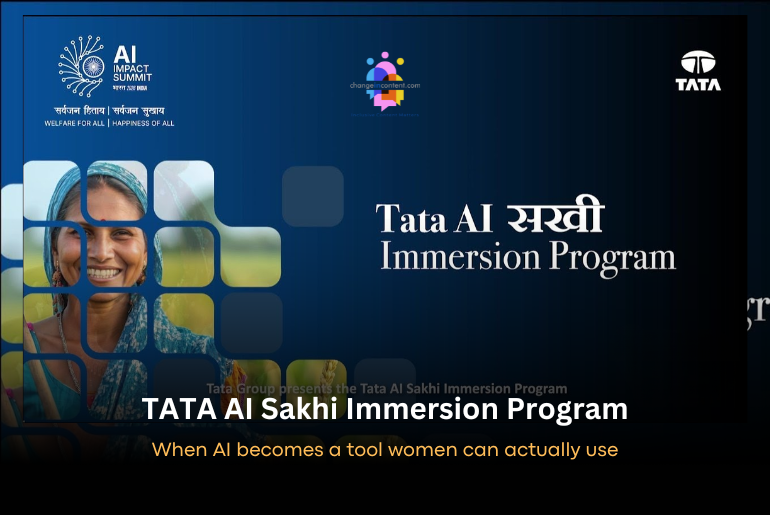
The Tata AI Sakhi Immersion Program arrived at the India AI Impact Summit 2026 with a simple but disruptive premise. If artificial intelligence is truly “transformative”, then it should work for women who run micro-businesses, lead self-help groups, and sustain India’s informal economy, not only for people who already speak the language of technology.
Hosted by the Tata Group in New Delhi on 17 February 2026, the immersion brought together 1,553 women artisans and entrepreneurs from rural India. It proved, in real time, that AI can be a practical tool when we design the training around lived realities, not corporate demos.
What happened at the summit matters because it moves the AI conversation away from fear and abstraction. It replaces “AI will change everything” with a sharper question. Who gets to use it, in which language, for what outcome, and with what support?
The Tata AI Sakhi Immersion Program in one snapshot
The program was conducted in the presence of Smt. Smriti Irani, Chairperson, Alliance for Global Good, Gender Equity and Equality, Confederation of Indian Industry, and Smt. Aarthi Subramanian, Executive Director and Chief Operating Officer, Tata Consultancy Services. The workshop brought women participants from six regions: Jharkhand, Bihar, Odisha, Rajasthan, Gujarat, and Delhi NCR.
The standout result is not the event scale alone. It is the pace of adoption: 1,553 women completed 4,727 AI-powered tasks in 2.5 hours, using their own phones, in their own languages. The program reported that the advanced cohorts achieved a 98% completion rate for assigned tasks.
In a country where access, confidence, and language shape digital adoption, that number is a signal. It says the barrier is not intelligence or ability. The barrier is the design.
Why the cohort design of the Tata AI Sakhi Immersion Program matters
One of the strongest decisions in this initiative was acknowledging that “rural women” is not a single category. Participants were organised into three cohorts: Artisanal, Digitally Literate (Basic), and Digitally Literate (Advanced). It matters because inclusion fails when training assumes everyone starts from the same point.
The cohorts also created dignity. An artisan does not need a lecture on machine learning. She needs a tool that helps her ideate, present, price, and sell. A self-help group leader does not need tech jargon. She needs clarity on government schemes, documentation, messaging, and daily operations. A digitally confident entrepreneur does not need basic navigation. She needs speed, experimentation, and growth use cases.
By separating learning pathways, the program avoided a common trap. The trap weare referring to is making beginners feel slow and advanced participants feel bored. That is how adoption becomes real.
Mentorship at scale: The 1:5 model that made the difference
The Tata AI Sakhi Immersion Program used a high-touch mentorship structure: one mentor for every five participants. That ratio might sound operational, but it is actually the heart of the program.
Most digital initiatives fail at the moment a user gets stuck. Not because the task is complex, but because the user hesitates, feels watched, worries about pressing the wrong button, or cannot translate a prompt into a clear instruction. A mentor sitting close enough to solve small problems in real time changes everything. It turns AI from intimidating to usable.
That is also what makes the immersion model more credible than a typical awareness session. It did not ask women to “go explore later”. It guided them through use, completion, and confidence in one sitting.
What women actually did with AI: Tasks that mirror real life
The strongest part of the program is the specificity of use cases. Participants did not get abstract exercises. They used AI for tasks tied to livelihood and autonomy.
447 traditional artisans used AI to generate design ideas, visual concepts, product photos, and innovation directions for crafts such as Pattachitra, Madhubani, and Dokra. It matters because for many artisans, the most expensive part of growth is not talent. It is presentation, discovery, and marketing. AI cannot replace craft. But it can compress the cost of ideation, visualisation, and communication.
940 women from self-help groups used AI to identify objects, navigate government schemes, create marketing materials, and draft business communication. That is not a small gain. These are the daily frictions that silently limit growth, especially when paperwork, language, and formal processes are designed for a very different kind of citizen.
The program also included 166 advanced digital entrepreneurs. These women already earn approximately ₹20,000 per month. They explored AI for self-learning and business growth. That detail is important because it indicates the program is not positioned only as “basic digital inclusion”. It is also a growth tool for women already operating businesses, enabling them to scale faster.
The bigger signal: AI adoption works when language stops being a barrier
There is a quiet but powerful detail in the press release: women completed tasks on their own phones, in their own languages. For India, language is not a “feature”. It is the difference between participation and exclusion.
When AI systems can translate, draft, summarise, and support local language queries, they become useful to the informal economy. That is where most women work, especially in rural India. A program like this validates a truth many policymakers and companies ignore: inclusion is not only about access to devices. It is about access to comprehension.
What this program gets right, and what needs to come next
The initiative, as described, makes the right choice by being practical, guided, and outcomes-led. It treats women as users and builders, not beneficiaries. At the same time, it is also rooted in a clear belief articulated by Aarthi Subramanian. She says technological progress must move in step with community progress, with AI serving as a bridge to creativity, opportunity, and sustainable livelihoods.
That said, any AI-at-scale initiative for last-mile communities must also plan for three realities.
Continuity matters more than immersion.
A 2.5-hour experience can unlock confidence. But real transformation requires follow-up support, refresher modules, and community-based problem solving. Otherwise, the learning remains event-based.
AI Safety and Misinformation
AI safety and misinformation risks are real, especially for new users. If women are using tools to navigate schemes, draft applications, or interpret information, the program ecosystem must include basic verification habits. We must teach women how to cross-check, when to mistrust an answer, and how to avoid scams or misleading claims.
Privacy and consent
Data privacy and digital consent need explicit attention. Many first-time users do not recognise what it means to upload an ID, share a photo, or paste a message thread into a tool. Training must include simple safeguards, such as what to avoid sharing, how to protect personal information, and how to recognise risky links.
If Tata Group and TCS build the next layer around these three realities, the Tata AI Sakhi Immersion Program can become more than a successful demonstration. It can become a replicable national model.
How other companies can learn from the Tata AI Sakhi Immersion Program
Corporate India often invests in skilling. But skilling becomes performative when it is disconnected from actual daily work. The lesson from this program is that AI training should be designed like a product, not like a lecture.
Start with the tasks women already struggle with. Some of them are pricing, cataloguing, photos, communication, navigating the scheme, and documentation. Teach those. Build mentorship. Use local language prompts. Give women a sense of immediate win. Measure outcomes in completed tasks and confidence, not in attendance.
If more companies adopt this structure, “AI for good” stops being a slogan. It becomes infrastructure.
Changeincontent perspective
At Changeincontent, we track inclusion stories that move beyond diversity statements and into measurable capability-building. The Tata AI Sakhi Immersion Program stands out because it treats rural women as real economic actors and provides them with tools to reduce friction in their work, not just inspire them in theory. It is also an important counterpoint to the louder narrative that AI will only replace jobs. In the hands of artisans, self-help group leaders, and entrepreneurs, AI can also become a multiplier.
We have previously written about gender inclusivity at TCS and how systems, not campaigns, shape long-term inclusion. This initiative fits that larger arc and adds a strong last-mile dimension to the story.
The final thoughts
The Tata AI Sakhi Immersion Program is not significant only because 1,553 women completed 4,727 tasks in 2.5 hours. It is significant because it shows what inclusion looks like when properly designed. The program is an example of cohort-based learning, mentorship that prevents drop-off, local-language usage, and task-based outcomes that map to economic reality.
If India wants AI to be a tool of shared prosperity, programs like this must grow beyond a summit moment. By integrating continuity, safety training, and privacy awareness into the next phase, this model can help rural women move from digital participation to real digital power.
Disclaimer: The views expressed in this article are based on the writer’s insights, supported by data and resources available both online and offline, as applicable. Changeincontent.com is committed to promoting inclusivity across all forms of content. We broadly define inclusivity as media, policies, law, and history. It encompasses all elements that influence the lives of women and marginalised individuals. Our goal is to promote understanding and advocate for comprehensive inclusivity.
