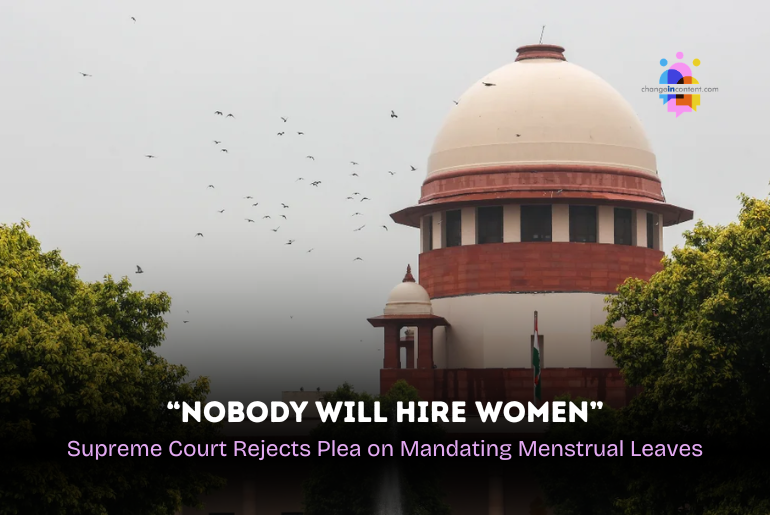
The Supreme Court rejects the plea to mandate menstrual leaves in India. That has triggered intense debate across legal, corporate, and social spaces. During a recent hearing, the court raised a controversial concern. That court said that making menstrual leave mandatory could unintentionally discourage employers from hiring women.
The remarks came while the court was hearing a petition seeking directions for governments to frame rules allowing women students and working professionals to take leave during menstruation. Chief Justice Surya Kant cautioned that legally mandating such leave could have unintended consequences in the labour market.
“If we make such a law, nobody will hire women,” the Chief Justice said during the hearing. It highlights what the court described as a practical concern about employer behaviour.
The statement quickly gained traction online, sparking discussions about gender equality, workplace realities, and whether policy solutions around menstrual health require deeper structural thinking.
Supreme Court rejects plea on Menstrual Leaves: What was the petition
Lawyer Shailendra Mani Tripathi filed the petition. It requested the Supreme Court to direct state governments to introduce paid menstrual leave policies for women across workplaces and educational institutions.
The petitioner argued that menstrual pain and related health conditions often affect women’s productivity and well-being. He stated that legal recognition of menstrual leave could help create a more inclusive environment.
Supporters of menstrual leave policies have long argued that menstruation is a biological reality that should be acknowledged in workplace structures. Countries such as Japan, South Korea, and Indonesia already have some form of menstrual leave policies, though implementation varies widely. In India, menstrual leave policies have largely emerged through voluntary initiatives rather than national legislation.
What the Supreme Court said on rejecting the plea on menstrual leave
During the hearing, the bench expressed concerns that mandatory menstrual leave could have unintended consequences for women’s employment.
Chief Justice Surya Kant emphasised that while awareness and sensitisation about menstrual health are important, mandating leave through law could affect hiring decisions. “The moment you bring in a law mandating menstrual leave, nobody will hire women,” the Chief Justice said.
Justice Joymalya Bagchi added another perspective, suggesting that policy frameworks must account for how employers operate in competitive economic environments.
From the court’s perspective, legislation that makes a category of employees appear less “competitive” in hiring decisions could potentially work against the very group it intends to support.
The bench therefore declined to entertain the plea. The court suggests that such policy decisions may be better addressed by governments or through voluntary workplace policies rather than judicial intervention.
India’s existing landscape of menstrual leave
The debate around menstrual leave is not new in India. Several state governments and institutions have already experimented with menstrual leave policies.
For example:
- Bihar introduced menstrual leave for women government employees in the early 1990s.
- Kerala has granted menstrual leave to women students in state universities.
- Some private companies in India have introduced flexible policies acknowledging menstrual health.
However, there is currently no national law mandating menstrual leave.
In January 2024, the Supreme Court itself made a significant observation regarding menstrual hygiene. The court states that it forms an integral part of a girl child’s right to life, dignity, health, and education under Article 21 of the Constitution.
The court also directed governments to ensure better access to menstrual hygiene infrastructure, including sanitary products and awareness campaigns.
The arguments supporting menstrual leave
Supporters of menstrual leave policies argue that menstruation can involve severe physical symptoms for some women. Conditions such as dysmenorrhea, endometriosis, and PMDD can cause intense pain, fatigue, nausea, and concentration difficulties.
Research shows that over 80% of women experience menstrual pain. Moreover, a smaller percentage experience severe symptoms that interfere with daily activities.
Advocates argue that recognising menstrual health through workplace policies can:
- Improve employee well-being
- Reduce presenteeism
- Create more inclusive workplaces
- Encourage open conversations about reproductive health
Some companies that have implemented menstrual leave policies report that they help normalise discussions around menstrual health.
The concerns raised by critics
Critics of mandatory menstrual leave raise a different concern.
They argue that gender-specific leave policies could reinforce stereotypes that women are less productive or more difficult to employ. Some fear that employers, especially in competitive sectors, may quietly favour male candidates to avoid perceived complications.
This concern formed the core of the Supreme Court’s observation. Some policy experts, therefore, suggest alternative approaches.
For example, introducing gender-neutral wellness or health leave policies could allow employees to take time off for a variety of health conditions without linking leave specifically to gender.
Such policies may address health needs while avoiding potential hiring biases.
The larger question: Workplace design
Beyond the immediate legal debate, the issue reveals a deeper structural question. Most workplace policies were historically designed around male employment patterns. Conversations around menstrual leave, therefore, raise broader questions about how workplaces accommodate biological and health realities.
Flexible work arrangements, wellness leave policies, and supportive organisational cultures may play a crucial role in addressing such challenges.
At Changeincontent, we previously explored how menstrual health intersects with workplace justice in India. Read the full article here.
These discussions highlight that menstrual leave is not simply about time off. It is about how workplaces acknowledge human health realities.
The changeincontent perspective
The Supreme Court’s remarks have sparked strong reactions across India, reflecting how complex the issue truly is.
The debate is not merely about leave policies. It is about how societies balance equality, workplace realities, and biological differences.
Ignoring menstrual health entirely is not a sustainable solution. At the same time, policies must be carefully designed to avoid unintended consequences.
The path forward may lie in broader workplace reforms that recognise health needs without reinforcing harmful stereotypes.
What is clear, however, is that the conversation itself is necessary.
Closing thoughts: The debate India must have
Yes, the Supreme Court rejects the plea to mandate menstrual leave in India. It may have closed one legal avenue, but it has opened a much larger national conversation.
How should workplaces address menstrual health?
Should the responsibility lie with legislation, corporate policy, or broader cultural change?
There are no simple answers. But the debate itself reveals something important.
For far too long, menstrual health has remained a silent subject in professional environments. If this moment leads to deeper conversations about workplace design, health policies, and gender equality, it may still mark an important step forward.
Disclaimer: The views expressed in this article are based on the writer’s insights, supported by data and resources available both online and offline, as applicable. Changeincontent.com is committed to promoting inclusivity across all forms of content. We broadly define inclusivity in terms of media, policies, law, and history. It encompasses all elements that influence the lives of women and marginalised individuals. Our goal is to promote understanding and advocate for comprehensive inclusivity.