
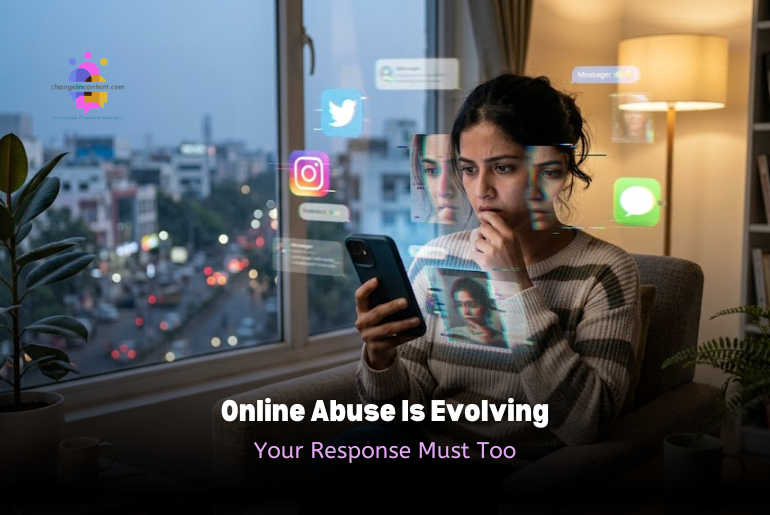
Combating online abuse against women has become far more complex than most conversations acknowledge. What many still dismiss as “trolling” or “online negativity” has evolved into something far more organised, invasive, and damaging. Today, abuse includes surveillance, impersonation, sexualised manipulation through deepfakes, and coordinated harassment that can follow a woman across platforms and into her real life.
One of the biggest challenges is that online abuse rarely begins in an obvious or dramatic way. It often starts subtly with repeated messages, unwanted attention, anonymous comments, or someone monitoring activity. Over time, it escalates. By the time many women realise what is happening, the abuse has already taken shape in ways that are difficult to contain or reverse.
That is precisely why awareness must move beyond general advice. Women do not just need to “be careful online.” They need to understand patterns, risks, response mechanisms, and the systems that are currently failing them.
In our earlier analysis, we examined how this crisis is growing across systems, platforms, and societies. This article goes a step further. It focuses on what individuals, organisations, and institutions must do because awareness without action is no longer enough.
What online abuse looks like today: Beyond trolling and comments
The definition of online abuse has not kept pace with reality. Today, women experience abuse in forms that are often invisible to others but deeply invasive:
- Cyberstalking and monitoring, where someone tracks online behaviour, locations, or interactions over time
- Non-consensual image sharing, including private images circulated without permission
- AI-generated deepfake content, where a woman’s face is used to create explicit or misleading visuals
- Impersonation and identity misuse are often tools to damage credibility or extract information
- Doxxing, where personal details such as phone numbers or addresses are exposed publicly
- Coordinated attacks, where multiple accounts target a woman simultaneously
According to UN Women, most legal frameworks and designs fail to cover these forms of abuse, especially deepfake content. That creates a situation in which the harm is real, but the legal clarity is not. The result is confusion, delay, and often inaction.
Combating online abuse against women: Why the abuse and violence feels so overwhelming
Online abuse is not just harmful; it can easily overwhelm. It works by:
- Creating uncertainty (Is this serious? Should I ignore it?)
- Creating isolation (Who do I even tell?)
- Creating fear of escalation (What if this gets worse?)
Many women hesitate to act because they are unsure whether what they are experiencing is “serious enough.” This hesitation is exactly what allows abuse to grow.
Another layer of complexity comes from deepfake abuse. Women often question whether to act because the content is “not real.” But the impact is real. Reputation damage, emotional distress, and professional consequences do not depend on whether the content is technically authentic.
The real impact: When online harm becomes offline risk
The idea that online abuse is separate from real life is outdated. Data shows that a significant number of women who experience online abuse also face other consequences.
- 41% of women in public life who face online abuse also experience offline harassment
- The workplace consequences are real
- Many women withdraw from public platforms, leadership roles, or professional visibility
- Mental health impacts include anxiety, fear, sleep disruption, and long-term trauma
As discussed in this analysis on misogyny in academia, even professional spaces are not immune. In professional environments, it often leads to reduced visibility. Women stop speaking, posting, leading, or engaging publicly. That is because they lack capability, but also because the cost of visibility becomes too high.
Combating online abuse against women: Why prevention is difficult but necessary
Unlike traditional crimes, online abuse:
- Moves faster than legal systems
- Crosses borders instantly
- Can be anonymous or automated
- Is often dismissed until it escalates
Deepfake abuse, in particular, has made prevention more complicated. A woman does not need to share anything for her identity to be misused. Her digital presence alone can become a vulnerability.
That is why prevention is not about eliminating risk completely. It is about reducing exposure, strengthening response, and building awareness.
What women can do: Practical, real-world protection steps
Online abuse often feels overwhelming because it can disorient, isolate, and intimidate. Many women do not immediately recognise the seriousness of what is happening to them. That is especially true when the abuse begins with anonymous messages, manipulated images, repeated monitoring, or threats disguised as jokes.
That is why practical awareness of combating online abuse against women matters. Protection does not begin only when a crisis escalates. It begins with recognising patterns early, documenting what is happening, and knowing that digital abuse is real harm, not something women must quietly tolerate.
No single precaution can eliminate risk. Still, several steps can reduce exposure, strengthen evidence, and improve a woman’s ability to respond if abuse occurs. These are not perfect solutions, but they can help women protect themselves while larger legal, technological, and institutional systems continue to fall short.
1. Audit your digital visibility before anything happens
Most online abuse begins with publicly available information. Review privacy settings across social media platforms, messaging apps, email accounts, and cloud storage. Go through:
- Social media profiles
- Tagged photos
- Old posts
- Public comments
Ask a simple question: What can a stranger learn about me in 10 minutes?
Restrict who can see personal details such as phone numbers, locations, family photographs, and tagged content. Publicly available images are often used in impersonation, stalking, and deepfake abuse. So, remove or restrict:
- Phone numbers
- Home locations
- Family details
- Frequent locations or routines
You do not need to disappear from the internet. But you do need to control how much of your life is easily accessible.
2. Treat account security as personal safety
Weak digital security is often the entry point for serious abuse. Remember, basic cyber hygiene is no longer a luxury. It is self-protection.
Take the following steps:
- Enable two-factor authentication on all key accounts
- Use different passwords for email, social media, and financial apps
- Avoid linking personal and professional accounts unnecessarily.
- Avoid saving sensitive content in easily accessible cloud folders.
If someone gains access to your email or cloud storage, the situation can quickly escalate into impersonation, blackmail, or data leaks.
3. Do not delete evidence in panic. Preserve it first.
One of the most common reactions to abuse is to delete messages, comments, and images immediately. That instinct is understandable, but evidence matters. Deleting harmful content can weaken your position.
Before taking anything down:
- Take screenshots (with timestamps visible)
- Copy profile links and URLs
- Save usernames and message history
- Record dates and frequency of incidents
If the matter moves toward police reporting, legal action, or escalation to the platform, this documentation becomes your strongest asset.
4. Recognise that manipulated images and deepfakes are an abuse, even if they are fake.
Many women hesitate to act because the image or video is not real in the literal sense. Let us be clear: If someone creates or shares sexualised or misleading content using your identity, it is abuse. It does not matter whether it is “real” or AI-generated. It harms:
- Reputation
- Mental health
- Professional credibility
- Personal safety.
The fact that something was artificially generated does not make the violation smaller. In many cases, it makes the system’s response more confusing, which is why women must name the act clearly for what it is. Remember, naming the abuse correctly is the first step toward addressing it.
5. Report strategically, not just reactively
If abuse occurs on a platform, use its formal reporting and takedown processes, and keep a record of every complaint. If there is impersonation, sexualised abuse, extortion, or threats, legal advice may be necessary alongside platform reporting.
Reporting once is rarely enough. Instead:
- File a formal complaint on the platform
- Save the complaint reference number
- Follow up if no action is taken
- Consider legal consultation if threats, impersonation, or sexual content are involved.
Women should not assume that one complaint will solve the issue. Often, the process requires persistence, escalation, and parallel action.
6. Tell at least one trusted person early.
Online abuse isolates women by making them feel ashamed, exposed, or afraid of being blamed. That silence often helps perpetrators more than anyone else. It is better to tell a trusted colleague, friend, family member, legal aid contact, or mentor. They can help document events, review reporting procedures, and provide emotional support.
Handling abuse alone often makes it harder to act decisively.
7. Separate self-protection from self-blame
Women often hear, directly or indirectly, that they should have posted less, shared less, said less, or responded differently. That is victim-blaming. The responsibility lies with the abuser. Self-protection is wise. Self-blame is harmful. The distinction matters because many women struggle here. They stop seeking help once they internalise guilt that never belonged to them.
You can:
- Improve privacy
- Strengthen security
- Respond strategically
Remember, none of this means you caused the abuse.
- Visibility is not an invitation for harm.
- Expression is not a mistake.
- Self-protection is necessary.
- Self-blame is damaging.
8. Know when the issue has crossed into legal territory.
Repeated stalking, doxxing, non-consensual sexual imagery, blackmail, threats, impersonation, and coordinated harassment are not merely unpleasant digital experiences. They may amount to criminal offences depending on the context and jurisdiction.
Women should not wait for abuse to become physically dangerous before taking it seriously.
What workplaces must understand: This is not “Outside Office Scope”
Many workplaces treat online abuse against women as a private issue, especially when it happens outside official work channels. That approach is deeply flawed. If a woman is being targeted because of her job, public role, opinions or visibility, then the organisation is already connected to the issue.
Moreover, a woman facing online abuse may also be a colleague, employee, journalist, academic, entrepreneur, public speaker, or leader. The abuse can affect her concentration, confidence, visibility, safety, and willingness to participate in public or professional life.
In that sense, online abuse is not only a personal crisis. It is also a workplace and institutional issue. Workplaces must:
- Create clear reporting mechanisms
- Offer mental health support
- Provide legal guidance where needed
- Train managers to respond without dismissal
Managers and peers should know how to respond without minimising the harm or turning the incident into gossip. Silence from an organisation often forces women to choose between safety and visibility.
The role of colleagues and professional communities
Support does not always require large actions. Colleagues can help in simple but important ways. They can:
- Help document abuse when requested
- Avoid sharing harmful content (even in outrage)
- Support takedown efforts
- Check in without forcing disclosure
They can also intervene culturally by refusing to normalise misogynistic humour, “harmless” trolling, or the casual dismissal of digital harassment. Sometimes the strongest form of support is not a grand statement. It is a workplace culture where women do not have to prove that online abuse is serious before they are believed.
Equally important is cultural responsibility. Normalising sexist humour, dismissing harassment, or treating abuse as “part of being online” creates an environment where women are expected to endure rather than report.
What the systems must fix: Laws, platforms, and education
The burden cannot remain on individuals.
Legal systems
Many laws still do not clearly define AI-generated abuse. This creates loopholes that perpetrators exploit.
Technology platforms
Delayed responses, inconsistent reporting systems, and automated rejections continue to fail users.
Education systems
Digital literacy must include:
- consent
- online behaviour
- reporting mechanisms
Awareness must begin early, not after harm occurs. That is the first step towards combating online abuse against women.
The changeincontent perspective
At Changeincontent, we see online abuse not as a digital anomaly, but as a continuation of societal behaviour in a new format. Technology did not create misogyny. It amplified it. That means solutions cannot be limited to platforms or policies alone. They must also address how we:
- Speak
- React
- Tolerate behaviour
Online safety is not just about protection. It is about changing what we collectively accept.
Conclusion: Combating online abuse against women needs more than awareness
Combatting online abuse against women is not about telling women to be more careful. It is about building more accountable systems. Women can take steps to protect themselves. But protection is not a substitute for responsibility. The real shift will happen when:
- Platforms act faster than harm spreads
- Laws recognise emerging threats
- Organisations take ownership
- Society refuses to normalise abuse
Because the problem is not that women are online. The problem is that abuse is still allowed to exist without consequence.
Disclaimer: The views expressed in this article are based on the writer’s insights, supported by data and resources available both online and offline, as applicable. Changeincontent.com is committed to promoting inclusivity across all forms of content. We broadly define inclusivity in terms of media, policies, law, and history. It encompasses all elements that influence the lives of women and marginalised individuals. Our goal is to promote understanding and advocate for comprehensive inclusivity.
