
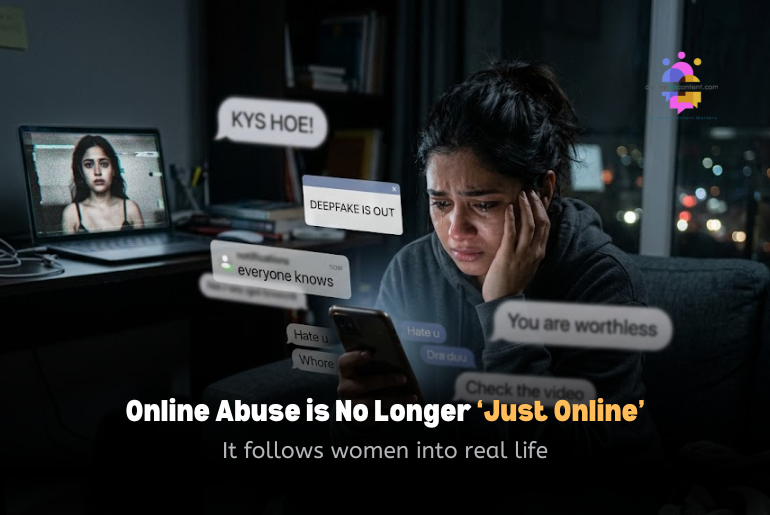
Online abuse against women has quietly become one of the most under-acknowledged crises of the digital age. It is persistent, often invisible, and deeply personal. Every day, millions of women navigate online spaces that promise connection and opportunity, while simultaneously exposing them to harassment, surveillance, and violation.
What makes this more concerning is not just the scale of abuse, but the systemic failure around it. Laws are outdated. Platforms are inconsistent. Reporting systems are exhausting. And for many women, the cost of seeking justice feels heavier than the abuse itself. What we are witnessing is not a gap in technology. It is a gap in accountability.
The scale of online abuse against women: What the data actually tells us
The numbers are not abstract. They reveal patterns that are both widespread and normalised. According to the European Institute for Gender Equality:
- 8.5% of women in the European Union have experienced cyberstalking
- 7% of working women have faced sexual harassment online
- 10.2% have had their location tracked or monitored by an intimate partner
These are not isolated incidents. They are behavioural patterns embedded in digital ecosystems.
At the same time, the rise of AI has introduced a new layer of abuse. Deepfake technology now allows perpetrators to create non-consensual sexual images using a woman’s face and publicly available photos. The speed, scale, and anonymity of this abuse make it far more damaging than traditional forms of harassment.
The most disturbing part is not the existence of such tools. It is the ease of use with little or no control.
When technology evolves faster than the law
One of the most striking observations from UN Women is that legal systems have simply not kept up.
Most laws addressing image-based abuse were written before AI-generated content existed. That has created what the report describes as “legal grey areas” where deepfake abuse often does not clearly fall under existing definitions of crime.
In many countries:
- Deepfake pornography is not explicitly illegal
- Consent frameworks are unclear
- Jurisdiction becomes complicated when content crosses borders
That leaves survivors in a situation where they are unsure whether what happened to them is even prosecutable. And when the law itself is uncertain, justice becomes even more distant.
The reporting paradox: Why women do not come forward
Most people often misunderstand underreporting as silence. However, now is the time to understand that it is not silence. It is a calculation. The process of reporting online abuse is, in many cases, deeply retraumatising.
As highlighted by UN Women:
- Survivors are often required to show manipulated sexual images to authorities
- Their identities may enter official records, increasing exposure risk
- There is a possibility of backlash, defamation, or public scrutiny
For many women, reporting means reliving the violation repeatedly in front of systems that may not even deliver justice. We cannot see this simply as a failure of courage. It is a failure of systems.
The role of platforms: Neutral or Negligent?
Technology platforms continue to operate under “intermediary” protections, which allow them to avoid direct responsibility for user-generated content.
In practice, this has led to:
- Slow or delayed removal of abusive content
- Automated rejection of takedown requests
- Lack of transparency in reporting processes
- Minimal cooperation with law enforcement
While these platforms have built sophisticated systems for advertising and engagement, their response mechanisms for abuse often remain inconsistent and reactive. Self-regulation has not worked. And yet, it remains the dominant model.
When online abuse becomes offline violence
One of the most critical insights from the UN Women analysis is that digital violence rarely stays digital. A survey shows that 41% of women in public life who experienced online abuse also faced offline harassment or attacks linked to it.
That changes how we must understand online abuse. It is not separate from real life. It is an extension of it. What begins as harassment in a comment section can escalate into stalking, intimidation, and physical threat.
The Deepfake crisis: Consent without control
Deepfake abuse represents one of the most disturbing developments in online violence. A woman does not need to share explicit content to be violated. Her image can be taken, manipulated, and circulated without her knowledge.
That creates a dangerous reality:
- Consent becomes irrelevant
- Identity becomes vulnerable
- Reputation becomes fragile
As explained in this detailed analysis on Changeincontent, we are approaching a tipping point where digital abuse is predictive, scalable, and automated. It is no longer reactive.
And that changes everything.
Where systems fail: The Justice Gap
Even when laws exist, enforcement is weak. Investigating online abuse requires:
- Digital forensics expertise
- Cross-border legal coordination
- Platform cooperation
Most justice systems lack all three. That creates a gap where:
- People are committing crimes quickly
- Evidence disappears quickly
- Justice moves slowly
The imbalance is obvious.
What needs to change: Beyond awareness
The recommendations from UN Women are clear, and they go beyond awareness campaigns.
Legal Reform: The legal policy must introduce clear definitions of AI-generated abuse. Laws must prioritise consent and close existing loopholes.
Platform Accountability: Technology companies must be legally required to:
- Proactively detect abuse
- Remove content within defined timelines
- Cooperate with law enforcement
Faster Justice Systems: Digital forensics and international cooperation must be strengthened to keep pace with the speed of online crime.
Survivor-Centric Systems: Reporting processes must be trauma-informed. Legal aid should be accessible and affordable.
Digital Education: Online safety, consent, and response mechanisms must be taught early and widely.
Learning from existing conversations
The conversation is not new, but it is evolving. In a story on misogyny in academia, we explored how online abuse is not limited to anonymous spaces. It exists even in professional and intellectual environments. It tells us that online abuse is not a fringe problem, but a cultural one.
The changeincontent perspective
At Changeincontent, we do not see online abuse as a technology problem. We see it as a reflection of how society treats women, amplified by technology.
What happens online is not separate from how women are spoken about in homes, offices, or institutions. The same biases travel across platforms, only faster and with fewer consequences. The question we must ask is not whether platforms should act. It is whether we are willing to demand systems that protect women with the same urgency with which we build systems that monetise their attention.
Because if content shapes culture, then ignoring online abuse is also a form of content.
Conclusion: The problem is not digital, it is human
The society and laws often dismiss online abuse against women as a byproduct of digital life. It is not. Now is the time to understand that the problem is structured, repeatable, and preventable.
The failure is not in identifying the problem. The failure is in acting on it. If systems continue to lag behind technology, the cost will not just be digital harm. It will be real-world consequences for real people.
And the question we must leave with is simple: How long will we continue to build platforms faster than we build protection?
Disclaimer: The views expressed in this article are based on the writer’s insights, supported by data and resources available both online and offline, as applicable. Changeincontent.com is committed to promoting inclusivity across all forms of content. We broadly define inclusivity in terms of media, policies, law, and history. It encompasses all elements that influence the lives of women and marginalised individuals. Our goal is to promote understanding and advocate for comprehensive inclusivity.
