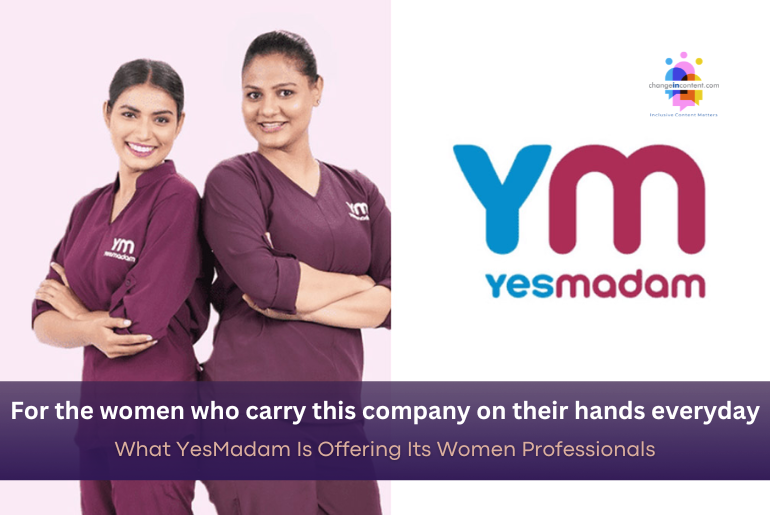
With its latest support offerings for women employees, YesMadam is now drawing attention. The company has publicly announced a benefits package for the women professionals who form the backbone of its at-home beauty and wellness platform.
As described in the founder’s public messaging, the package includes health insurance, term insurance, full body health check-ups with consultation support, legal assistance, emergency medical loans, and a zero-commission policy during pregnancy. Taken together, these measures position care not as a festival campaign or one-off reward, but as a structured promise to workers whose labour keeps the platform running.
YesMadam is not a small neighbourhood service brand. It is a fast-growing tech-enabled home salon and wellness company that has expanded across dozens of Indian cities. It works with thousands of beauty professionals. When a company at that scale publicly frames worker support as part of how it does business, the announcement deserves more than applause or suspicion. It deserves scrutiny, context, and a closer look at what others can learn from it.
Knowing YesMadam, and why does this support announcement matter?
YesMadam was founded in 2016 by Mayank Arya, Aditya Arya, and Akanksha Vishnoi as a home-based beauty and wellness services platform. The company operates across more than 50 cities, with over 200 services. They have onboarded more than 12,000 beauty professionals, of whom around 7,500 are currently active.
The platform now serves over 17.8 lakh customers and handles more than 24.6 lakh annual bookings. That makes it one of the more visible players in the at-home salon and wellness market. (Source: YourStory)
That scale matters because worker welfare looks different when a platform is no longer in startup infancy. At that point, support is no longer only about goodwill. It becomes part of how the business defines sustainability, retention, trust, and brand credibility. In a sector where workers often bear the emotional and physical costs of platform growth, any structured welfare announcement deserves careful examination.
What the YesMadam Support package includes
According to the founder, Mayank Arya, YesMadam supports its women professionals with:
- A full body health check-up and doctor consultation through Healthians.
- Dedicated legal support to ensure working women understand and can act on their rights.
- Health insurance cover of ₹2 lakh.
- Term insurance cover of ₹20 lakh.
- Emergency medical loans of up to ₹50,000 directly from the company, without the involvement of banks or elaborate paperwork.
- Zero commission during pregnancy, so women can retain full earnings while managing their health.
Parts of this broader worker-support logic are also visible on YesMadam’s own professional onboarding announcements. It already highlights accidental insurance, life insurance, emergency support, and safety assistance for partners. The company website also states that service partners receive accidental and term insurance, health insurance, and certified training.
It is significant because the package goes beyond the usual language of incentives and earnings. It addresses health, income continuity, legal awareness, emergency liquidity, and pregnancy-linked vulnerability. Those are not cosmetic additions. They map onto the actual risks many women in service-led gig work face.
Why are these specific benefits notable?
Each part of the package addresses a different point of fragility in platform work.
- Health check-ups and consultations matter because gig workers are often expected to remain continuously available without regular preventive care.
- Term and health insurance matter because illness or death can turn one worker’s vulnerability into an entire household’s crisis.
- Legal support matters because women who enter private homes to provide services may encounter harassment, disputes, or rights violations without knowing what recourse exists.
- Emergency medical loans matter because liquidity is often the first thing to run out when a worker falls ill.
- The zero-commission pregnancy provision matters because pregnancy remains one of the most punishing moments in women’s working lives, especially in sectors that still measure value through uninterrupted output.
What makes the package interesting is that it does not frame women only as earners. It acknowledges them as workers with bodies, risks, rights, dependents, and life events. That may sound obvious. In the gig economy, it still is not.
The founder’s message and what it reveals
The language used by Mayank Arya matters as much as the offering itself. His statement, “Pehle apno ka khayal rakho, baaki sab baad mein,” is not corporate jargon. It frames workers as “our own” rather than as an abstract supply. He also says, “A woman who feels secure works differently. Lives differently. Sehat hai toh sab hai.” That makes the case even more direct. It links security not just to productivity, but to the quality of life itself.
There is, of course, a strategic value in such language. It creates emotional trust and positions the brand as human. But that does not automatically make it empty. In fact, one of the hardest tests for founder language is whether it links to specific, measurable support. In this case, the announcement at least attempts to do that.
What the YesMadam support model already says about worker management
It is not the first time YesMadam has publicly presented itself as a company trying to differentiate through worker-side systems. In its official communications, the company says partners can earn up to ₹70,000 per month, choose flexible work hours, access safety support, get insured, and receive emergency support. (Source: YesMadam)
It also says partner progression depends on performance tiers. The company has focused on partner retention and ecosystem building as part of its scale strategy.
All of that provides context for the new support announcement. It is not coming from a brand that only talks about customers. It is coming from a platform that has increasingly positioned partner systems as part of its business proposition.
What this does not solve
It would be too easy to turn this into a hero story. That would miss the point.
A support package, however well-intentioned, does not automatically resolve larger gig work concerns around social security, classification, bargaining power, grievance systems, or the uneven dependence of workers on platforms for income. Nor does a founder announcement equal long-term policy certainty. Some questions always remain.
- How widely and consistently will these measures be implemented across all women professionals?
- What are the eligibility conditions?
- How many women will actually access the legal support or medical loan facility?
- What accountability mechanisms exist if a worker is denied support or faces retaliation?
- How will pregnancy-linked support be sustained operationally?
These are not reasons to dismiss the announcement. These are reasons to take it seriously enough to ask what implementation will look like.
What other companies should learn from the YesMadam support model
There is a practical lesson here for businesses far beyond beauty services.
If women are central to your growth, you cannot treat the cost of supporting them as a form of generosity. You have to treat it as basic business design.
Too many companies continue to rely on women’s labour while externalising the cost of their safety, health, and emergency needs back to their families or to chance. The YesMadam support model suggests a different possibility. It says that a company can choose to identify the actual pressure points in women’s working lives and respond to them structurally.
That should matter to startup founders, platform businesses, service aggregators, and even traditional employers. Worker care does not weaken a company. Done seriously, it can strengthen retention, trust, quality, and long-term brand legitimacy.
The Changeincontent perspective
At Changeincontent, we do not believe inclusive companies are defined by what they post during celebration weeks. They are defined by what they build into everyday work. The YesMadam support announcement becomes meaningful in that light because it shifts the conversation from praise to design. It asks a tougher question of employers: What have you concretely built for the women who generate your revenue?
We are less interested in whether a company sounds compassionate and more interested in whether it is building structures that reduce everyday precarity. We have explored that broader benchmark before in our coverage of companies setting stronger inclusion standards.
The real opportunity now is for more companies to stop treating women’s well-being as a retention strategy alone. It must become part of how work itself is organised.
The final thoughts
The support announcement by YesMadam may not transform the entire gig economy, but it does raise the standard of what platform companies can provide. In a sector where women often travel alone, work inside private homes, and carry both income and care burdens, benefits linked to health, protection, legal literacy, emergency response, and pregnancy are not indulgences. They are work essentials.
The larger lesson is not that YesMadam should be applauded without question. It is that other companies should now be questioned more closely. If a fast-scaling platform can publicly commit to worker-centred support, what stops others from doing more than the bare minimum?
Disclaimer: The views expressed in this article are based on the writer’s insights, supported by data and resources available both online and offline, as applicable. Changeincontent.com is committed to promoting inclusivity across all forms of content. We broadly define inclusivity in terms of media, policies, law, and history. It encompasses all elements that influence the lives of women and marginalised individuals. Our goal is to promote understanding and advocate for comprehensive inclusivity.